Google has officially confirmed that Schema markup isn’t going anywhere.
Following a wave of confusion after Google’s announcement that support for several structured data types will be discontinued starting January 2026, John Mueller, Google’s Search Advocate, stepped in on Reddit to set the record straight: “Google is not killing schema.”
The update comes after many SEOs misinterpreted Google’s vague developer post, fearing that structured data, the foundation of rich results and semantic understanding in search was being phased out entirely. But according to Mueller, that is far from the truth.
Instead, he clarified that Google regularly retires old or redundant markup types, while keeping the essential ones that help Search understand, categorize, and display web content better. Schema isn’t dying, it is just evolving.
So, what’s really happening? And what does it mean for how we use structured data in 2026 and beyond? Let’s break it down.
What Exactly Did Google Announce About Structured Data?
Earlier this month, Google quietly published a developer update announcing that support for certain structured data types will be discontinued starting in January 2026.
The announcement was vague, it didn’t list all the schemas affected or give specific examples of what’s staying. But from the tone, it was clear: Google wants to clean up old, low-impact, or experimental markup types that aren’t contributing meaningfully to Search or rich results.
As expected, this sparked confusion. SEOs began asking:
“If Google is removing support for some schemas, is it still worth the effort?”
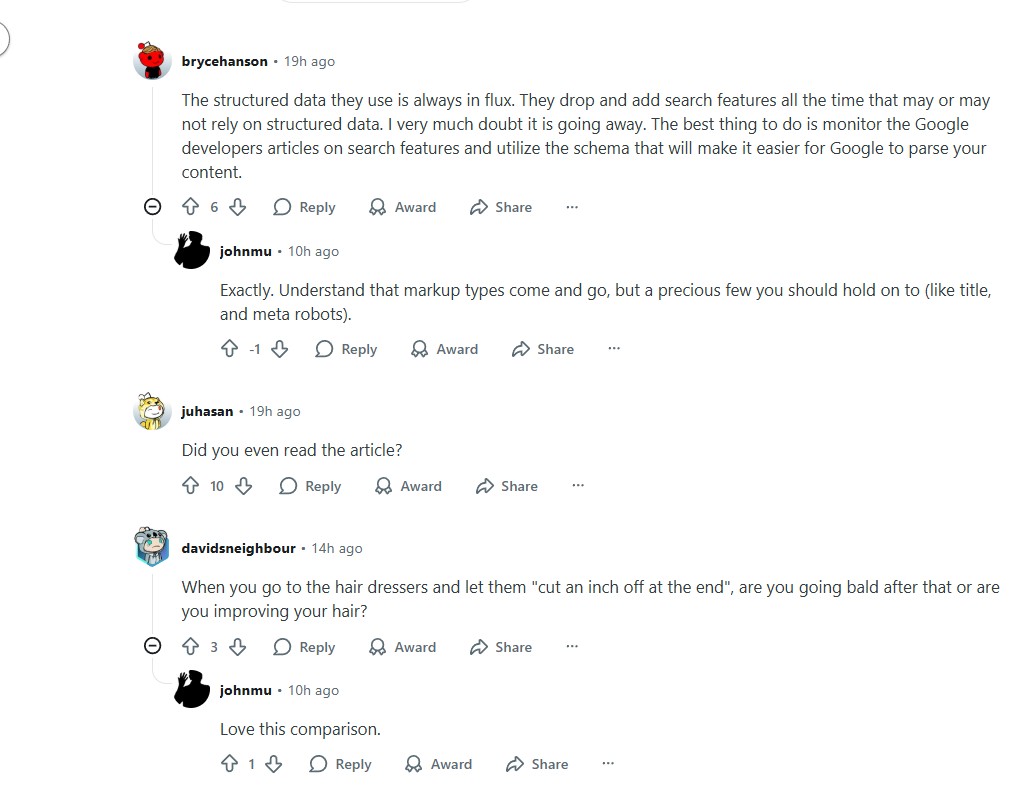
One Redditor summed up the general sentiment:
“Dataset already works only in Dataset Search, and rich results are getting more selective. So… is schema still worth it? Or are we moving past it entirely?”
That’s when John Mueller jumped in with a much-needed dose of realism.
What Did John Mueller Say About Schema and Structured Data?
In his Reddit response, Mueller clarified that schema is here to stay, but it’s natural for specific markup types to come and go over time.
“Exactly. Understand that markup types come and go, but a precious few you should hold on to, like title and meta robots,” he wrote.
This is a key insight that schema isn’t disappearing. It’s evolving.
Mueller’s point is that Google continuously tests and retires certain types of markup as Search changes. Some structured data helps Google understand and display content better. Others, once tied to experimental features, lose relevance once those features are phased out.
It’s less about “killing schema” and more about refining what matters most.
He even endorsed one Redditor’s humorous analogy:
“When you go to the hairdresser and let them ‘cut an inch off at the end,’ are you going bald or just improving your hair?”
In other words, trimming old or redundant markup doesn’t mean schema is gone and it means it’s getting cleaner, leaner, and more meaningful.
Why Does Google Keep Dropping (and Adding) Schema Types?
If you have been in SEO long enough, this probably feels familiar. Google introduces new schema types, encourages their use, and then years later, quietly sunsets them.
But there’s a reason for that.
Structured data is experimental by design. Many markup types are launched to test specific user experiences in Search like FAQ rich results, how-to snippets, or event listings.
When those features stop driving value or become spam-prone, Google removes support for their rich results.
That doesn’t mean the schema is useless, it just means Google isn’t surfacing it visually anymore.
The underlying data can still help Google understand your content better, even if it no longer affects how results appear.
As one Redditor put it in the thread:
“The structured data they use is always in flux. They drop and add search features all the time that may or may not rely on structured data. The best thing to do is monitor Google developers’ articles on search features and use the schema that makes it easier for Google to parse your content.”
Mueller agreed, adding that keeping up with official documentation is the smartest way to future-proof your SEO strategy.
So… Is Schema Still Worth It in 2026?
Short answer? Absolutely, yes.
It is easy to feel skeptical when features like FAQ or How-To snippets disappear, but schema’s value goes beyond those visual perks.
Structured data helps search engines:
- Understand your site hierarchy and entity relationships
- Associate your content with verified business, author, and product data
- Feed AI-driven systems (like Google’s Search Generative Experience) with structured context
Even if rich results shrink, structured data remains the language that connects your content to Google’s machine learning models.
Mueller’s comments reinforce this, schema markup types are not static checklists. They are a living framework that adapts as Google’s understanding of the web deepens.
So while some schema types (like Dataset, HowTo, or Speakable) might fade out, core ones like Product, Organization, Breadcrumb, Article, and Event continue to play a huge role in structured content discovery.
Which Schema Types Should You Focus On Going Forward?
John didn’t list specific schema types to prioritize, but his phrase “a precious few you should hold on to” says a lot.

Here’s how to interpret it:
Core schema elements likely to remain essential include:
- Title, meta robots, and canonical signals — the backbone of all web indexing.
- Organization / LocalBusiness — critical for brand identity and local SEO.
- Product and Offer — key to eCommerce visibility.
- Review and AggregateRating — still vital for products, recipes, and services.
- BreadcrumbList — helps Google understand your site’s structure.
- Article and NewsArticle — foundational for publishers and content-rich websites.
Mueller’s underlying message is clear: focus on evergreen structured data that communicates meaning, not temporary types that chase visual SERP features.
What This Means for the Future of Structured Data and SEO
2025 has been a transformative year for AI SEO. With AI Overviews, SGE, and multimodal search, Google is shifting from displaying web results to interpreting web meaning.
That shift makes schema even more important.
Think about it: if Google’s AI is pulling summaries, snippets, and answers from your content, structured data gives it the precision it needs to represent your business accurately.
Removing outdated markup doesn’t weaken schema’s role, it strengthens its alignment with AI-driven search.
So when Mueller says schema types “come and go,” he’s not predicting obsolescence and he is acknowledging evolution.
Schema’s purpose isn’t just about earning rich snippets anymore; it’s about feeding machine-readable context into a search engine that’s becoming increasingly conversational and predictive.
A Quick Reality Check – What’s Actually Going Away?
Google hasn’t released a full list of deprecated schema types yet.
But based on past trends and Barry Schwartz’s coverage, it’s likely that low-impact or rarely-used markups will be phased out — not the major ones that drive structured understanding.
Google has done this before:
- It deprecated
VideoGameandCourserich results in 2023. - It limited visibility for FAQ and How-To schema in 2024 due to misuse.
- It deprecated
COVID-19andJobTrainingschemas after the pandemic.
In every case, Google removed only feature-level support, not the underlying understanding of the data itself.
So if history’s any guide, this new cleanup is just another pruning, not a purge.
TL;DR – Key Takeaways
- Google is not killing schema; it’s refining which types matter most.
- John Mueller confirmed that structured data “comes and goes,” but core elements remain critical.
- 301 redirects > rel=canonical when consolidating domain signals (from prior context).
- Outdated schema types tied to old features will lose support in January 2026.
- Schema still plays a major role in AI search, entity understanding, and contextual indexing.
- Focus on evergreen schema: Product, Organization, Article, Review, and Breadcrumb.

Dipti Arora
AuthorDipti Arora is a Senior Content Writer with over seven years of experience creating impactful content across Digital Marketing, SEO, technology, and business domains. She has a strong background in managing news verticals and delivering editorial excellence. Dipti has contributed to leading publications such as The Times of India and CEO News, where her research-driven storytelling and ability to simplify complex subjects have consistently stood out. She is passionate about crafting content that informs, engages, and drives meaningful results.
