In a new BBC interview, Google CEO Sundar Pichai clarified a widely misunderstood point: AI is not a standalone source of truth, nor a replacement for search, journalism, teachers, doctors, or any other human expert.
Instead, he emphasized that the information ecosystem is far richer than AI alone, and that tools like Search still play an essential grounding role.
This statement comes amid global debates about AI reliability and after social media headlines, including a BBC post mischaracterized Pichai’s remarks as a warning to “not trust AI.”
But what did he really mean? And why did he repeatedly zoom out to the broader ecosystem, while the interviewer kept zooming in?
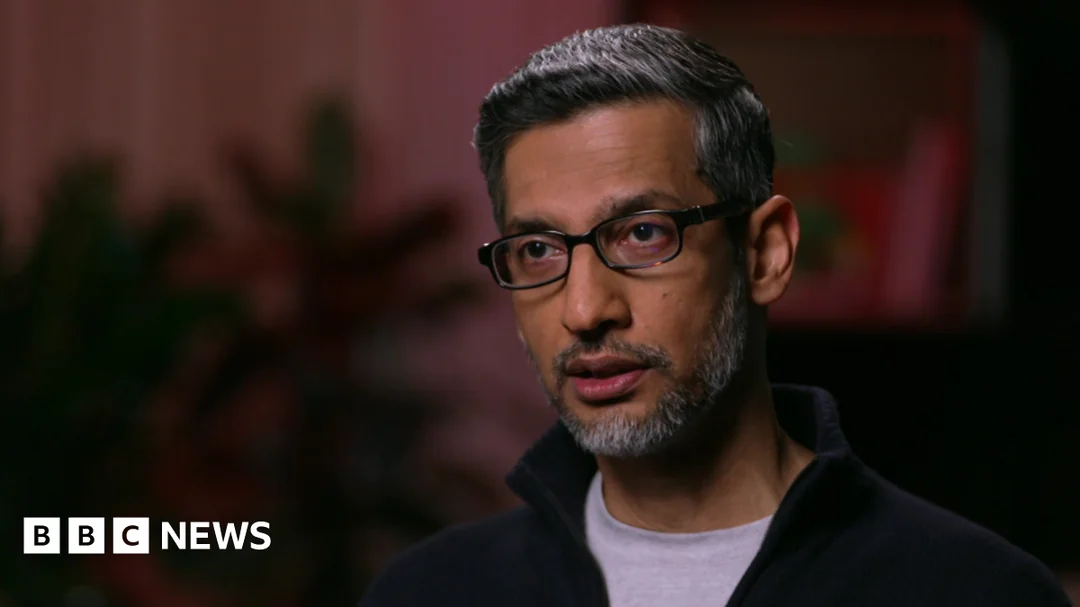
Why Did Sundar Pichai Emphasize That AI Is Not a Standalone Information Source?
The conversation began with Pichai discussing how AI will enable entirely new opportunities in the coming years, such as the ability for people to create feature-length films or perform complex tasks that traditionally required high expertise.
But the interviewer shifted quickly to a narrower concern: Does AI actually work?
This tension defined the entire interview. While Pichai was describing long-term societal transformation, the interviewer focused almost exclusively on AI accuracy today, repeatedly asking:
- Is AI reliable?
- Doesn’t AI make information less reliable?
- Should Google be held responsible because the Transformer originated at Google?
Pichai refused to answer in ways that treated AI as the only source of knowledge. Instead, he insisted on zooming out, reinforcing that AI is only one tool among many within the broader information ecosystem.
Is AI Accurate All the Time? What Did Pichai Say About Errors and Truth?
When asked whether Gemini (Google’s ChatGPT competitor) is always accurate, Pichai gave a candid but nuanced answer.
He reminded the interviewer that generative AI does not “know” truth, it only predicts the next best tokens statistically.
He explained: “These AI models fundamentally have a technology by which they’re predicting what’s next, and they are prone to errors.”
This is why grounding, anchoring AI responses to real-world information remains essential. Pichai noted that Google has integrated Search into Gemini specifically to enhance factual accuracy. Search serves as the factual backbone that generative models can rely on, reducing hallucinations.
He added:
“We are working hard from a scientific standpoint to ground it in real world information… Part of what we’ve done with Gemini is brought the power of Google Search.”
This highlights a critical truth: AI search is not intended to replace validated, verified, high-quality knowledge sources. Instead, it expands what is possible when combined with them.
Why Did Pichai Say: “Use Each Tool for What It’s Good At”?
Pichai made a clear distinction between creative uses of AI and factual, grounded tasks where Search or expert guidance still matter. He elaborated that current AI models remain prone to occasional errors because of how generative prediction works.
In his words:
“The current state-of-the-art AI technology is prone to some errors. This is why people also use Google Search… But the same tools are helpful if you want to creatively write something.”
This response underscores one of the most important messages from the interview:
AI is powerful, but it is not universally reliable for every purpose.
People must understand which tasks suit AI, creative ideation, rewriting, drafting and which tasks still require grounded systems or professional expertise.
Did Pichai Really Say “Don’t Blindly Trust AI”? What Was Misrepresented?
Social media, especially a BBC News tweet, summarized the interview with the line: “Don’t blindly trust what AI tells you.”
While the statement was technically something Pichai said, the phrasing distorted his message. It made it appear as though he was warning against trusting AI at all.
But Pichai’s real point was contextual:
- You shouldn’t blindly trust any tool.
- AI is useful for certain tasks; Search is useful for others.
- The information ecosystem includes teachers, journalism, medical professionals, and more.
In the full conversation, Pichai emphasized that grounding, verification, and expert input remain essential. His message was not anti-AI, it was pro-ecosystem.
What Responsibility Does Google Have, Given It Invented Transformers?
The interviewer pressed Pichai harder, suggesting that Google bears special responsibility because the Transformer model the “T” in ChatGPT, originated at Google.
He also implied that AI might be making the information ecosystem less reliable overall.
Pichai disagreed with this premise. He argued that AI becomes unreliable only when used in isolation, without checks, context, or grounding.
His answer reflects a larger philosophy:
“If you only construct systems standalone, and you only rely on that, that would be true.
Which is why the information ecosystem has to be much richer than just having AI technology…”
He then emphasized the role of human expertise:
“Truth matters. Journalism matters… If you’re a student, you’re talking to your teacher.
If you are a consumer, you want to trust your doctor. All of that matters.” In other words, AI is not replacing these pillars, it complements them.
Why Does Pichai Keep Using the Phrase “Information Ecosystem”?
Throughout the interview, Pichai consistently tried to correct the framing. While the interviewer repeatedly zoomed in on AI alone, Pichai zoomed out to the bigger picture.
He sees AI as one part of a complex, multi-layered ecosystem made of:
- Search engines
- Journalists and fact-checking institutions
- Educators
- Medical professionals
- Scientific sources
- Authoritative databases
- And, yes, AI models
This ecosystem creates the world’s collective understanding.
AI neither replaces nor undermines it, unless we misuse it as a standalone authority.
Pichai’s message is ultimately about balance. AI expands human capability, but validated sources of truth still matter deeply.
What Does This Interview Reveal About Google’s AI Philosophy?
The interview makes Google’s position clearer than ever:
- AI is a transformative tool, not an oracle.
- AI should be combined with grounded information sources.
- Human expertise remains irreplaceable.
- Google sees Search as the factual backbone that stabilizes generative AI.
- Mischaracterizing AI as “the only source of truth” is dangerous and inaccurate.
This philosophy aligns with Google’s broader vision: AI should enhance the world’s information, not reinvent or replace it.
Key Takeaways
- Pichai clarified that AI is not a standalone source of truth.
- Google believes the information ecosystem is richer and includes experts, search, and journalism.
- AI remains prone to errors, which is why grounding with Search is essential.
- AI and Search should be used for what they’re each good at.
- Misleading headlines distorted Pichai’s message; he did not tell people to stop trusting AI.
- Google views AI as one tool among many, not a replacement for human expertise.

Dipti Arora
AuthorDipti Arora is a Senior Content Writer with over seven years of experience creating impactful content across Digital Marketing, SEO, technology, and business domains. She has a strong background in managing news verticals and delivering editorial excellence. Dipti has contributed to leading publications such as The Times of India and CEO News, where her research-driven storytelling and ability to simplify complex subjects have consistently stood out. She is passionate about crafting content that informs, engages, and drives meaningful results.
