
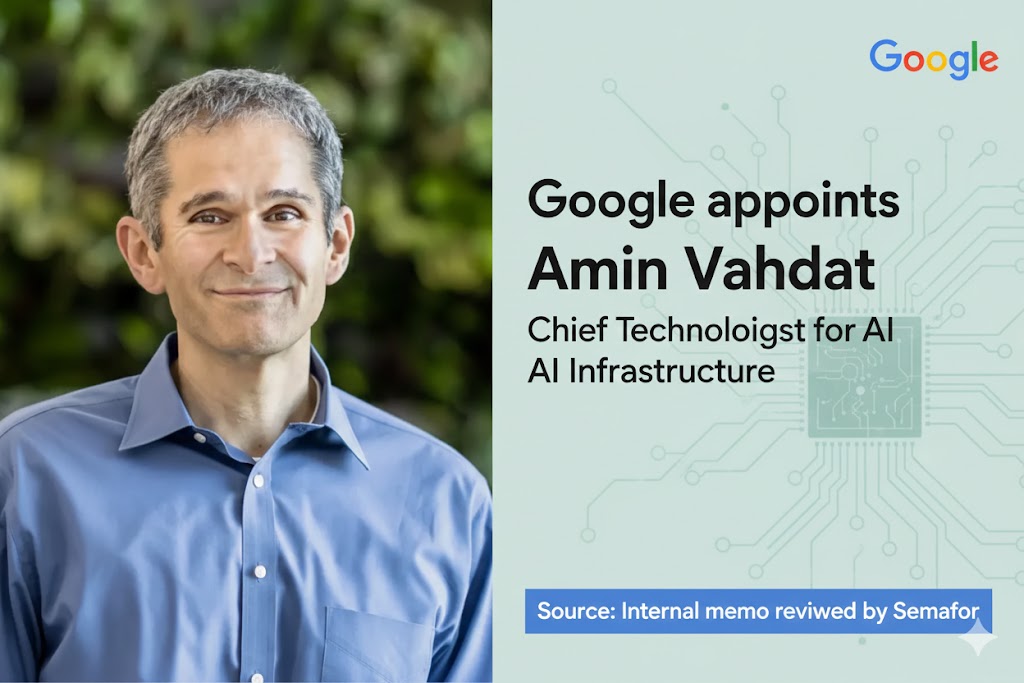
Google has appointed longtime engineering leader Amin Vahdat as its new chief technologist for AI infrastructure, according to an internal memo reviewed by Semafor.
Vahdat will now report directly to CEO Sundar Pichai, becoming one of only around 15–20 people in that circle.
The move comes as Google expects to surpass $90 billion in capital expenditures by the end of 2025, the overwhelming majority of which is tied to the very infrastructure Vahdat will now oversee.
This leadership transition reveals more than a promotion. It signals that Google sees AI infrastructure not as a support function, but as a strategic pillar that could determine who wins the next decade of AI development.
Why Is Google Prioritizing AI Infrastructure Leadership Now?
The memo from Google Cloud CEO Thomas Kurian put it bluntly: “This change establishes AI Infrastructure as a key focus area for the company.”
It’s a clear internal acknowledgment: in the AI era, infrastructure is no longer behind the scenes. It is the engine, the moat and the competitive differentiator.
Google’s advantage over OpenAI and other rivals has never been only algorithms. It has been something harder to copy: an unparalleled capacity to serve AI-enabled products to billions efficiently and affordably.
This capability rests on: custom silicon (TPUs), data center networking breakthroughs and vertically integrated hardware–software stacks.
Vahdat has been central to these efforts for years, long before AI infrastructure became a headline topic.
AI model sizes are growing, inference demands are rising, and competitors are aggressively scaling. Google needs the person who built the foundations to steer the next stage.
Who Is Amin Vahdat and Why Is He the One to Lead This?
Amin Vahdat joined Google about 15 years ago from academia. Over that decade and a half, he has become one of the quiet but essential architects behind Google’s infrastructure evolution.
The memo designates him as chief technologist for AI infrastructure, a title that formalizes responsibilities he has already been carrying informally:
- Designing data center networks
- Optimizing AI compute clusters
- Scaling Google’s TPU systems
- Overseeing orchestration software
According to people familiar with his work, Vahdat has long been in the center of Google’s infrastructure strategy.
But the world is only noticing now because the AI boom has placed these systems under the microscope of investors, reporters, competitors, and global regulators.
How Has Google Built Infrastructure as a Competitive Moat?
While OpenAI and other startups dazzle users with model capabilities, Google’s edge has always come from its infrastructure sophistication.
1. Custom AI chips: Tensor Processing Units (TPUs)
For nearly a decade, Google has developed TPUs, specialized processors purpose-built for AI training and inference.
The team at Google DeepMind works closely with the TPU organization to co-design chips optimized for the needs of models like Gemini 3, giving Google control end-to-end.
2. A fully integrated hardware + software stack
From optical circuit switches to liquid cooling systems, Google has engineered nearly every part of the AI cluster environment.
This brings massive efficiency gains in lower energy use, faster communication across chips, better inference performance and reduced operating costs
3. Data center networking breakthroughs
One of Vahdat’s lesser-known contributions but arguably one of the most important, was detailed in a 2022 blog post that received little recognition at the time.
His team transformed Google’s Jupiter network, the internal fabric that connects computers in data centers. The result was major cost reductions for serving products like YouTube, Search and Google Cloud
4. Borg: The orchestration super-system
Vahdat has also overseen Borg, Google’s legendary internal orchestration system that manages massive fleets of machines and workloads.
In AI context, Borg is critical: it ensures no compute is wasted.
Think of it like a universe-sized game of Tetris, where every block is a task and every placement affects efficiency. In the AI age, the stakes are even higher, every drop of compute saved is millions of dollars retained.
How Did Google’s Infrastructure Prove Its Importance in 2025?
In August, Google published a paper co-authored by Vahdat that revealed astonishing efficiency statistics:
The energy used to run a median AI prompt was equivalent to less than nine seconds of television and five drops of water.
These numbers stunned many observers. Critics had been warning that AI would become an energy monster. Competitors likely hoped Google’s costs would balloon.
Instead, the data showed the opposite: Google’s infrastructure optimization had delivered industry-leading efficiency.
This was not a lucky win, it was the result of years of aligned work across silicon, networking, cooling, datacenter design, orchestration and modeling strategies
And the person at the center? Vahdat.
Why Does This Leadership Change Matter in the AI Race?
Google is not simply building bigger models. It’s building the platform that will run those models for decades.
And the reality is you cannot train next-generation AI on general-purpose hardware. And you can’t deploy it to billions without ultra-efficient data centers.
That’s why this role matters.
If 2023–2024 were defined by model breakthroughs, 2025–2026 will be defined by infrastructure scale, who can run AI fastest, cheapest, and most reliably.
Google seems to understand this deeply. By placing Vahdat in a direct reporting line to Sundar Pichai, Google is signaling its long-term thesis:
The AI race will not be won by the biggest model, but by the most efficient ecosystem.
What Does This Mean for the Future of AI Infrastructure?
This appointment sends several messages:
- AI infrastructure is no longer backend, it is strategic.
- Efficiency will matter as much as raw model power.
- Google plans to scale AI to billions without exploding energy use.
- Leadership in hardware–software integration will determine market position.
- Organizational alignment is becoming as important as technical innovation.
There is no single recipe for optimizing an AI data center. It takes globally distributed teams working in perfect coordination.

Dipti Arora
AuthorDipti Arora is a Senior Content Writer with over seven years of experience creating impactful content across Digital Marketing, SEO, technology, and business domains. She has a strong background in managing news verticals and delivering editorial excellence. Dipti has contributed to leading publications such as The Times of India and CEO News, where her research-driven storytelling and ability to simplify complex subjects have consistently stood out. She is passionate about crafting content that informs, engages, and drives meaningful results.
