AI Overviews (AIOs) represent one of the most significant structural changes to search in decades, not simply because Google is answering queries with generative AI, but because advertising is now placed directly inside those AI-generated answers.
What began as a neutral, citation-driven summary experience has evolved into a monetized interface where sponsored placements appear within the AI’s response itself, rather than being positioned separately above or beside it.
These ads are presented as contextually relevant recommendations added into the narrative flow of the overview.
As a result, ads feel like a natural extension of the answer rather than traditional advertisements. The implication is clear: ads are now part of the answer.
How Ads Inside AI Overviews Push Organic Results “Below the Fold”
Pixel displacement refers to how much vertical screen space is consumed before organic results appear.
With AI Overviews occupying significant real estate, followed by sponsored product carousels or local ads, organic listings are being pushed further down the page.
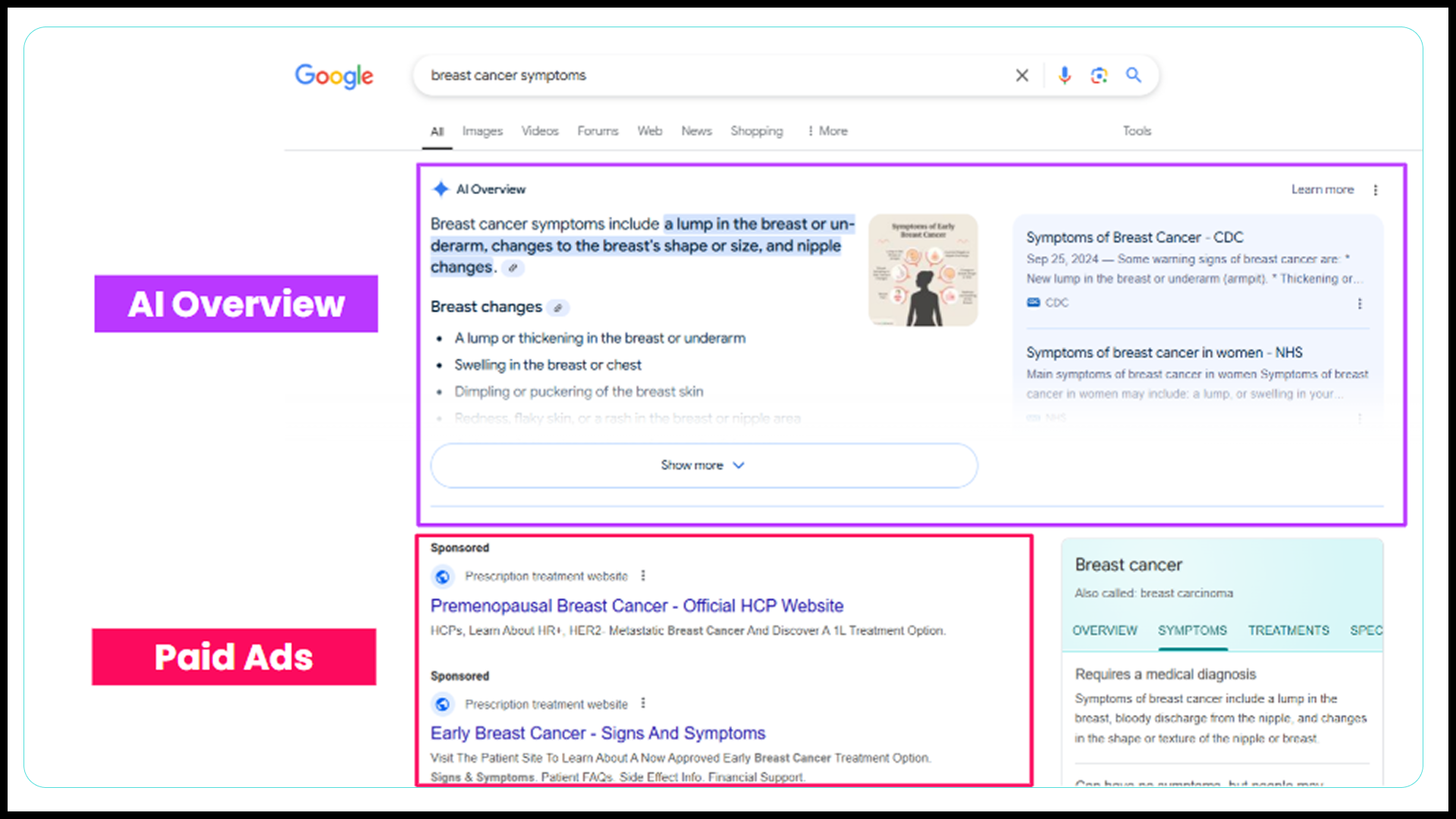
On many commercial queries, the SERP stack now looks like:
- Traditional search ads
- AI Overview (with citations and ads)
- Sponsored product or local placements
- Organic results (often below the fold)
This structural shift fundamentally alters visibility dynamics.
“Double Jeopardy” Effect for Organic Results
Organic links now face competition from two paid layers: Ads above the AI Overview and Ads embedded inside the AI Overview.
Even ranking first organically no longer guarantees attention, as users may never scroll far enough to see it.
Mobile Search Hit the Hardest
On mobile devices, the issue is amplified: Smaller screens mean fewer visible pixels and AI Overviews can consume the entire first screen.
Scrolling fatigue reduces the likelihood of reaching organic links. As a result, organic click-through rates (CTR) on mobile are declining faster than on desktop.
How Are Click-Through Rates (CTR) Changing in the AI Overview Era?
AI Overviews are exceptionally effective at satisfying informational intent. Users searching for definitions, explanations, or comparisons often get everything they need directly from the AI response.
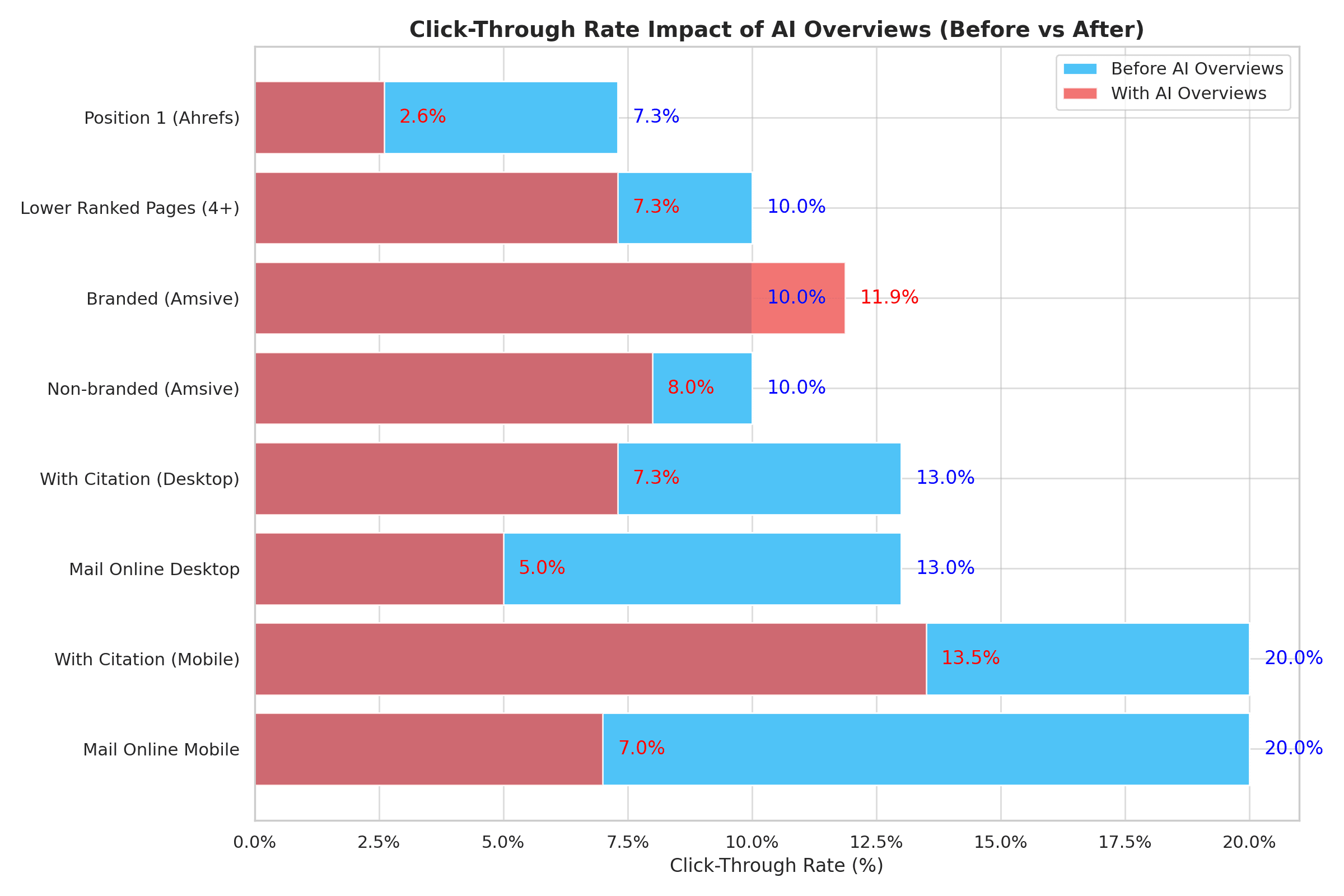
This leads to:
- Fewer clicks to informational websites
- Increased “zero-click” searches
- Ads capturing the remaining high-intent actions
#1 Organic Position Losing Its Authority
Traditionally, ranking first organically meant visibility, trust, and traffic. With ads embedded in the AI’s response, that authority is diluted. Users may trust the AI’s recommendation more than a blue link.
Most importantly? Click a sponsored product suggested by the AI and never notice the organic result, even if cited.
Attribution Becoming More Difficult
SEOs now face a new challenge: understanding why traffic declined.
- Was it lost to the AI answer itself?
- Or to the ad embedded within that answer?
Current analytics tools struggle to separate these effects, making performance analysis increasingly complex.
How Does the Impact Differ by Keyword Intent?
Informational sites such as blogs, publishers, and knowledge bases are most at risk. For these queries: The AI provides a complete summary, Ads offer related tools or products.
Educational organic links are bypassed and even authoritative sources may be cited without receiving traffic.
Commercial Queries Seeing Faster Monetisation?
For transactional searches, AIO ads function as a “fast pass”:
- Users can compare products directly in the AI interface
- Sponsored listings shortcut the research phase
- Organic reviews and listicles lose mid-funnel traffic
Direct-to-consumer brands benefit disproportionately from this model.
Local Searches Being Disrupted
Sponsored local placements inside AI Overviews are beginning to interfere with: The traditional Local Pack, organic local rankings and map-based discovery.
Businesses that previously relied on local SEO may now need paid support to remain visible.
Source Links vs Sponsored Recommendations Inside AI Overviews
One of the most consequential shifts introduced by AI Overviews is how organic citations and sponsored placements now coexist inside the same AI-generated response.
Traditionally, users could easily distinguish between editorial results and advertisements. AI Overviews blur that separation.
Within an AI Overview, users typically see:
- Cited source links that inform the AI-generated explanation
- Sponsored recommendations positioned as logical next steps
Although sponsored content is labelled, it is embedded within the AI’s narrative flow.
This means paid placements benefit from the credibility and authority of the AI answer itself, rather than standing apart as overt advertisements.
Strategic Shifts Required for SEOs and Content Creators
Ads inside AI Overviews force a fundamental redefinition of what SEO success looks like. Rankings still matter, but visibility without clicks is becoming a new reality.
Modern SEO strategies are shifting focus toward influence inside AI responses, not just traffic generation.
This includes ensuring brands are consistently referenced, cited, or contextually associated with key topics.
Key strategic changes underway include:
- From traffic to influence: Measuring brand presence within AI Overviews, not just sessions.
- From keywords to entities: Building topical authority so AI systems consistently associate your brand with a category
- From volume to defensibility: Prioritizing content that AI cannot easily summarise or monetise
Content types that remain more resilient in this environment include:
- Original research and proprietary datasets
- Expert-led analysis and opinion pieces
- Industry-specific implementation guides
- Experience-driven case studies
These formats provide depth and nuance that AI struggles to compress into a single answer.
Optimizing for AI Overview Inclusion (Without Chasing Clicks)
Being cited in an AI Overview does not guarantee traffic, but it preserves relevance and brand authority in an AI-first SERP. As a result, optimization efforts are shifting away from traditional CTR tactics and toward AI usability.
Content that performs best as AI source material tends to:
- Be clearly structured with logical subheadings
- Answer questions comprehensively, not superficially
- Demonstrate subject-matter expertise
- Provide contextual depth beyond definitions
Example: A basic “What is zero-trust security?” articles may be fully summarized by AI and lose traffic.
A deeper article explaining how zero-trust is implemented differently in healthcare, fintech, and SaaS, supported by real-world examples, is more likely to be cited repeatedly and remain visible across AI responses.
In this environment, being the source matters more than being the destination.
The Convergence of SEO and Paid Search
AI Overviews collapse the traditional separation between organic and paid search. When ads appear inside AI-generated answers, SEO and PPC can no longer operate as independent silos.
High-performing teams are increasingly aligning both functions to:
- Target the same high-intent queries strategically
- Coordinate messaging between organic content and paid placements
- Maximize brand presence within AI Overviews
In many competitive SERPs, the strongest position is achieved when a brand appears:
- As a cited source informing the AI response
- As a sponsored recommendation capturing action
This dual presence ensures visibility even when organic clicks decline.
AI Overviews vs Traditional SERP: Structural Comparison
| Dimension | Traditional SERP | SERP with AI Overviews & Ads |
| User behavior | Click to explore | Read, decide, then act |
| Ad placement | Clearly separated | Embedded within AI answers |
| Organic visibility | High for top rankings | Frequently pushed below the fold |
| Content role | Traffic destination | Source material for AI |
| Decision flow | Multi-step journey | Single-interface completion |
| SEO success metric | Rankings & CTR | Visibility, mentions, influence |
Broader Economic and Industry Implications
As organic visibility becomes harder to sustain, businesses increasingly rely on paid placements to maintain demand capture.
This drives up competition and customer acquisition costs, particularly in commercial and local SERPs.
Independent publishers and niche content sites face the greatest pressure.
Their content powers AI answers, but declining referral traffic threatens long-term sustainability. Without consistent clicks, monetisation through ads, affiliates, or subscriptions becomes increasingly difficult.
For Google, the challenge lies in balancing:
- Fast, high-quality AI answers
- Clear commercial disclosure
- Long-term trust in the search ecosystem
AI Overviews improve efficiency but aggressive monetization risks weakening confidence if users begin to feel steered rather than served.
What the Future of Organic Search Looks Like
Organic search is not disappearing but it is becoming more selective and more competitive.
Rankings alone no longer guarantee visibility. Authority, originality and alignment with AI-driven discovery now determine success.
Ads in AI Overviews signal a shift from link-based discovery to decision-based search.
In this environment, organic presence becomes a premium asset, earned by brands and publishers that provide depth, credibility and insight that AI summaries and sponsored recommendations cannot fully replace.
The next phase of SEO will not be about resisting AI Overviews. It will be about earning influence with AI SEO.

Dipti Arora
AuthorDipti Arora is a Senior Content Writer with over seven years of experience creating impactful content across Digital Marketing, SEO, technology, and business domains. She has a strong background in managing news verticals and delivering editorial excellence. Dipti has contributed to leading publications such as The Times of India and CEO News, where her research-driven storytelling and ability to simplify complex subjects have consistently stood out. She is passionate about crafting content that informs, engages, and drives meaningful results.
