
A new study published by Ahrefs reveals that AI Overviews now appear in one out of every five Google searches, and they’re transforming how people discover information online. Here’s what the numbers tell us and how businesses can adapt.

At Stan Ventures, we’ve always believed that understanding Google’s behavior is key to future-proof SEO strategies. And the latest data from Ahrefs gives us one of the clearest signals yet of what’s next.
According to the report, Google’s AI Overviews are showing up in 21% of all queries. But what is interesting is that these AI-generated snippets aren’t showing up everywhere. They appear almost entirely on informational and question-based searches.
That means the nature of your content and how your audience searches matter more than ever.
Where AI Overviews Appear the Most
Let’s break down the numbers.
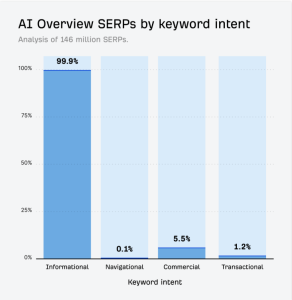
The data shows that 99% of all AI Overviews appear on informational keywords.
When users type a question or a long query (seven words or more), the chance of seeing an AI Overview rises dramatically:
- 46% of long-tail queries trigger AIOs.
- 57.9% of question queries show them.
To be more precise, the more conversational or curiosity-driven a search is, the more likely Google’s AI steps in with a synthesized answer before showing traditional web results.
At the same time, non-branded queries (like “how to reduce screen time”) are 1.9x more likely to display AI Overviews than branded ones (like “Apple Screen Time feature”).
From this, it’s pretty much evident that Google’s AI prefers to handle general knowledge before pushing users toward specific brands.
Health, Science, and “Why” Queries Lead the Pack
Some categories are seeing stronger AI activity than others.
- 44% of medical and 44% of science queries now show AI Overviews.
- 60% of “reason” or “why” queries trigger them.
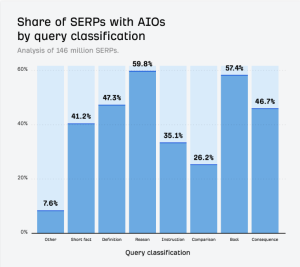
This tells us that Google sees AI as an explainer, stepping in when users seek understanding rather than decisions.
On the other end of the spectrum, only 6% of news queries, 7.9% of local searches, and 4% of NSFW queries display AI Overviews.
That shows Google seems to trust AI summaries most in stable, factual areas (like health or science) and least in fast-changing or subjective ones (like news or local business listings).
What This Means for Brands and Publishers
For businesses and publishers, the implications are twofold: visibility and trust.
- Visibility: AI Overviews occupy premium space on SERPs, often pushing organic listings below the fold. Even if your site ranks well, your click-through rate might decline if users find their answer in the overview itself.
- Trust: AI Overviews summarize information from multiple sources without always naming them prominently. That means authority and transparency matter more than ever. Sites that publish clear, cited, and expert-backed content stand a better chance of being referenced or linked in these summaries.
At Stan Ventures, we view this not as a setback but as an evolution.
Google is signaling that it values context, clarity, and credibility above all else. Those who align their content with these signals, especially around E-E-A-T, will stay visible in the new AI-driven ecosystem.
Adapting Your SEO Strategy for the AIO Era
Here’s how we advise brands and publishers to respond strategically:
1. Focus on question-driven content
Build pages that directly answer user questions using natural, human-like phrasing. Google is rewarding content that reads like it was written for real conversations.
2. Strengthen topical authority
Instead of scattering across too many keywords, dominate one topic cluster. The more consistently you publish around a theme, the more context AI systems have to trust your content.
3. Cite and credential your sources
Especially for YMYL topics, use verifiable data, expert opinions, and transparent sourcing. This boosts both credibility and the chance of being referenced by AIOs.
4. Leverage schema markup
Structured data helps Google understand your content’s purpose and hierarchy, an often-overlooked advantage when AI models summarize information.
5. Track impressions, not just clicks
Traffic might fluctuate, but visibility metrics (like impressions in Search Console) reveal whether your content is still being surfaced, even if fewer users are clicking.
The Bottom Line
AI Overviews mark a new phase in search, one where Google tries to “answer” rather than simply “list.” It’s an experience built around understanding intent, not just indexing pages.
For brands, this means SEO must evolve from chasing rankings to building semantic and topical relevance.
For users, it means search is becoming faster but potentially less diverse if AI summaries replace nuanced human perspectives.
At Stan Ventures, we see this change as an opportunity, not a challenge. Through our AI SEO services, we help businesses strengthen their online visibility and credibility in an era where AI shapes what people see and trust. By combining data, strategy, and human insight, we help brands create content that connects with both algorithms and people.
Key Takeaways
- 21% of Google searches now display AI Overviews.
- They appear in 99% of informational and 58% of question-based searches.
- Medical, science, and “why” queries show the highest AIO presence.
- News and local searches rarely trigger AI Overviews.
- Success now depends on clarity, authority, and structured data.

Zulekha
AuthorZulekha is an emerging leader in the content marketing industry from India. She began her career in 2019 as a freelancer and, with over five years of experience, has made a significant impact in content writing. Recognized for her innovative approaches, deep knowledge of SEO, and exceptional storytelling skills, she continues to set new standards in the field. Her keen interest in news and current events, which started during an internship with The New Indian Express, further enriches her content. As an author and continuous learner, she has transformed numerous websites and digital marketing companies with customized content writing and marketing strategies.
