
Google’s John Mueller says structured data can help machines read important facts, but it cannot make a product rank higher or be named the “best” by AI systems. Its value depends on accuracy, context, and the ability to update it as features change.
A discussion on Reddit this week asked whether extensive schema markup helps LLMs such as Gemini understand entities more effectively, or if its benefits are limited to Google’s rich result features.
John Mueller responded to the thread and clarified that structured data can be useful in some cases, but its impact varies based on purpose and implementation.
Does extensive Schema markup actually help Large Language Models (LLMs) understand your entity better, or is it just for Google Rich Snippets?
byu/Usual_Confidence_756 inTechSEO
Why the Question Matters
The question came from a SaaS founder who wanted to know if improving a knowledge graph could help a product appear as a recommended tool in AI answers.
Many site owners hope structured data can strengthen entity recognition and improve visibility in generative responses. Mueller’s reply offered careful guidance instead of simple promises.
Where Structured Data Makes a Real Difference
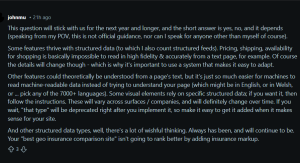
Mueller explained that some information cannot be read accurately from normal text. Details like pricing, stock status, and shipping data require precision.
Machines struggle to extract those values only from written content. Structured formats make those details clear and consistent. They reduce confusion and improve reliability across many contexts.
He also mentioned that some features depend on specific structured inputs. These features expect machine-readable fields. If site owners want those features, they must follow the related implementation rules. These rules can change, so systems should allow easy updates.
Situations Where Text Alone May Still Work
Other types of information can often be understood from page content without markup. Articles and general descriptions may still be processed correctly.
Even then, structured data can reduce ambiguity and make machine reading faster and simpler. It removes guesswork and presents information in a direct form.
Mueller encouraged flexibility. Structured formats evolve over time. Treating markup as a static task can create future problems. Site owners should be ready to adjust their data anytime requirements change.
The Limits of Schema for Rankings and AI Mentions
Mueller warned against unrealistic expectations. Adding schema will not make a site rank higher by itself.
It will not force an AI system to label a product as the “best” option. Claims based on quality or reputation arise from broader signals.
These signals include authority, real-world references, and user trust across many sources. Structured data supports factual clarity. It does not replace credibility.
Why This Matters for Long-Term Visibility
Structured data is most effective when it supports clarity and reliable interpretation. It improves factual understanding, but meaningful visibility still depends on trust, relevance, and recognition across the web.
Investing in clear content, trustworthy signals, and support from professional SEO services can help brands maintain stronger visibility across search and AI systems.
Guidance for Site Owners
Given these insights, site owners should approach structured data as a support system for clarity rather than a shortcut to prominence.
To apply it effectively:
- Use structured data where precision matters most, especially for details like pricing, availability, and product attributes.
- Keep implementations flexible so updates remain simple when formats or feature requirements change.
- Prioritize credible content and authentic references that reinforce trust and strengthen real authority across multiple sources.
- Focus on accuracy and relevance first, with structured data enhancing understanding instead of trying to act as a ranking trigger.
- Treat markup as part of a broader strategy, supporting usability, expertise, and long-term alignment with how machines interpret information.
Key Takeaways
- Structured data helps machines interpret factual information more reliably in some situations.
- It is most valuable for details that require precision, such as pricing and availability.
- Some features rely on machine-readable inputs, and these formats may change over time.
- Schema does not cause a product to rank higher or be labeled the “best” in AI responses.
- Broader credibility signals and genuine authority still shape how entities appear in AI outputs.

Zulekha
AuthorZulekha is an emerging leader in the content marketing industry from India. She began her career in 2019 as a freelancer and, with over five years of experience, has made a significant impact in content writing. Recognized for her innovative approaches, deep knowledge of SEO, and exceptional storytelling skills, she continues to set new standards in the field. Her keen interest in news and current events, which started during an internship with The New Indian Express, further enriches her content. As an author and continuous learner, she has transformed numerous websites and digital marketing companies with customized content writing and marketing strategies.
