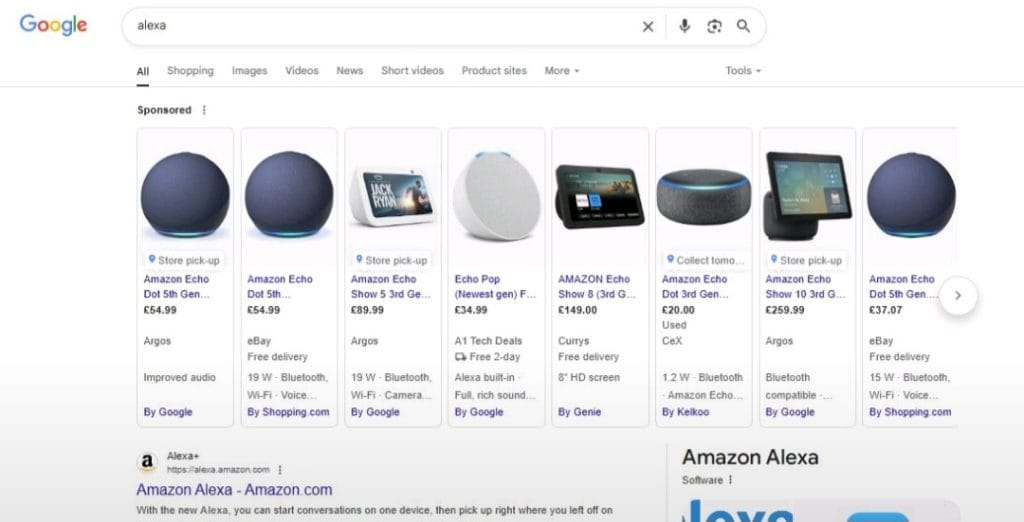
Amazon, once a dominant presence in Google Shopping results, has abruptly lost visibility. Audience Key data shows a 31 percent drop in late July and an almost complete disappearance from organic product grids in mid-August.
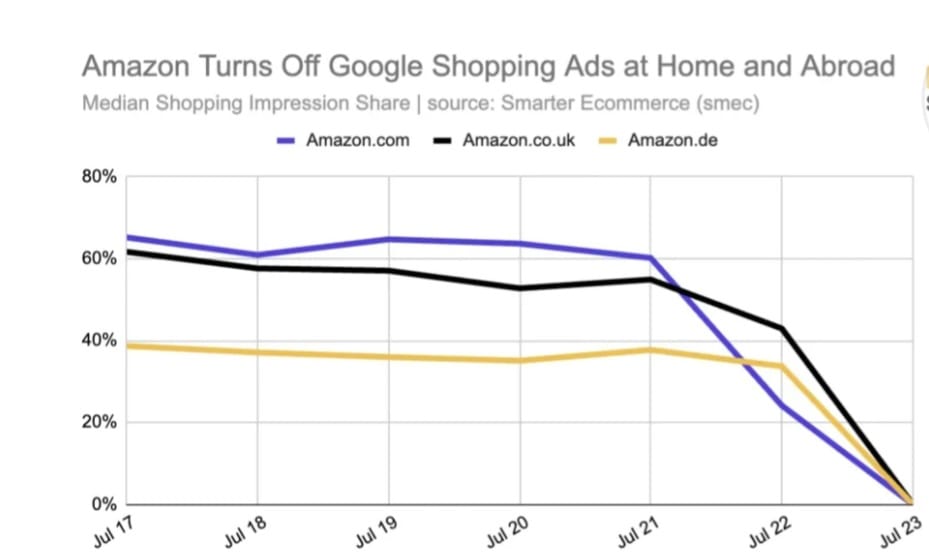
Between July 21 and 23, 2025, something unprecedented happened in the world of digital advertising: Amazon disappeared from Google Shopping ads entirely worldwide.
And no, this was not a technical glitch. This was intentional, fast and complete.
According to industry analysts and advertising experts, Amazon’s global withdrawal from Google Shopping auctions has left a void and one that is already shifting auction dynamics, advertiser strategies and perhaps, the very relationship between retail giants and the platforms they depend on.
But what exactly is happening? And what will the ripple effects look like across digital advertising?
What Happened Between Amazon and Google?
According to Mike Ryan, Head of Ecommerce Insights at Smarter Ecommerce (SMEC), “Amazon has made a dramatic international exit from product advertising on Google Shopping.
They are a massive source of revenue for Google parent Alphabet Inc. and also serve as a tide that lifts all increase in terms of auction prices. So this has to sting.”
And it was not just Mike. Mikael Brakker, E-commerce Director at L’Oréal Luxe for Europe has also confirmed the drastic drop in ad impression share via LinkedIn:
The retreat was not partial but it was a full-scale, global shutoff.
Amazon had already cut its Google Shopping ad spend by 50% in the US back in May 2025. But this July move? It is the official end. And it caught many advertisers and agencies off guard.
To put the scale in perspective, Amazon’s product cards had long dominated prime placement in Google Shopping, shaping how millions of shoppers compared prices and discovered products. Audience Key reported that on July 25, Amazon held 428,984 organic placements across more than 79,000 keywords. By July 26, that number fell to 294,983—a staggering loss of 134,001 listings in just one day. Weeks later, by August 18, U.S. product grids showed almost no Amazon listings at all, something unprecedented for a retailer of its size.
Data Confirms the Disappearance
The numbers say it all:
- United States: 60% → 0% impression share
- United Kingdom: 55% → 0%
- Germany: 38% → 0%
- Japan: Confirmed complete exit
For context, Amazon typically appeared in around 30% of shopping auctions for many advertisers according to Josh Duggan, Co-founder at Vervaunt.
That is a big vacuum left behind.
Even free listings seem to have been affected. David Kyle, a senior media manager, noted:
“I can’t get them to trigger for anything in Free Listings… It is as if they have completely disconnected from the Merchant Center.”
Audience Key also highlighted the scale of impact across categories: Apparel was hit hardest with several segments losing more than 50% of coverage, Home Goods listings dropped 45%, Laptop Computers shrank by 36%, Outdoor Furnishings fell 28%, and Business Supplies declined about 22%. This breadth of contraction shows Amazon’s retreat—or breakdown—was not isolated to a single niche.
This raises questions that Amazon pulls just paid ads? Or did they cut ties with Google Merchant Center entirely?
Why Did Amazon Do This And Why So Fast?
That is one of the most important questions..
Mike Ryan called it a “colossal shift,” likening it to Amazon’s retreat during the COVID-19 lockdowns. This time, however, the move appears strategic, not reactive.
Let me break down the five leading theories:
Incrementality Testing:
Similar to a move Amazon made during the 2020 pandemic, the company could be testing whether Google Ads are truly driving incremental sales or just cannibalizing traffic they would have received anyway.
Post-Prime Day Clearance
Prime Day wrapped up mid-July. The blackout could help Amazon clean up ROAS (Return on Ad Spend) metrics before the back-to-school shopping wave.
Margin Optimization
Why pay Google when you can retain customer acquisition internally? Especially when Amazon already owns the buyer journey from intent to purchase.
Negotiation Tactics
By yanking millions in ad spend, Amazon may be signaling to Google: reduce your fees or lose our business.
AI-Powered Search Shift
With AI tools like Amazon’s Rufus assistant and platforms like Perplexity gaining momentum, Amazon may be preparing for a future beyond traditional search advertising.
Other observers suggest there could also be a technical explanation. When Amazon consolidated three merchant labels (Amazon, Amazon.com, and Amazon.com – Seller) into one, Google’s system may have misclassified or dropped feeds, leading to verification failures or indexing errors. At Amazon’s scale, even minor feed issues can produce massive visibility losses, making it difficult to separate strategy from system breakdown.
What Does This Mean for Other Retailers?
Here is where it gets interesting.
Amazon was a dominant force in Google Shopping auctions, appearing in nearly 30% of all product ad results for many agencies and advertisers. Their exit means:
- Less auction pressure
- Potentially lower CPCs (cost-per-click)
- Higher impression share for competing brands
Will CPCs Really Drop with Amazon Pulling Back? Not Quite Yet.
Josh Duggan, Co-Founder at Vervaunt, sums it up well:
“CPCs haven’t dropped… but it is definitely one to review across your own account data.”
While advertisers hoped Amazon’s retreat from Google Shopping might drive costs down, the reality is more nuanced.
David Kyle shared another critical observation:
“I can’t get Amazon to trigger even for free listings anymore. It’s as if they are completely disconnected from the Merchant Center.”
So, what does this mean for the rest of the market?
Yes, Amazon’s absence opens up room—but that breathing space won’t be shared equally. Expect bigger retailers and marketplaces like Walmart, Target, or Best Buy to capitalize faster and scale their presence.
Independent retailers and mid-sized brands could also benefit. With Amazon out, optimized feeds and targeted campaigns can translate into meaningful visibility gains. Agencies are watching closely, since budgets may shift toward those who can hold these new positions long term.
Smaller businesses may still struggle to capture visibility and clicks, especially without the same ad budget or feed optimization resources.
And for sellers who relied on Amazon?
The impact is clear: that “piggy-back” traffic is gone and fewer new-to-brand shoppers will stumble upon their products via Google. For third-party sellers operating inside Amazon’s marketplace, the disruption is even sharper. Many counted on Amazon’s Google Shopping visibility to drive traffic, and without it, inventory forecasts and marketing budgets can quickly unravel—leaving some overstocked, others understocked, and small businesses especially vulnerable to financial strain.
A Recap of the Timeline
- May 2025: Amazon cut U.S. Google Shopping ad spend by 50%, signaling early retreat.
- July 21–23: Amazon’s ad presence goes to 0% globally.
- July 24: Mike Ryan posts rumors of the shift.
- July 25: Ryan confirms complete disappearance using Auction Insights.
- October 2024: Google had already adjusted auction rules which remove priority for Performance Max campaigns, possibly triggering Amazon’s reassessment.
Let’s Talk Auction Dynamics & Google’s Loss
Amazon’s departure does not just affect retailers but it hits Google’s bottom line.
Shopping ads represent a major revenue source for Google’s retail ad ecosystem. And Amazon was a whale and possibly one of the top contributors to Shopping campaigns globally.
Early signs suggest that CPCs have not dropped significantly, likely because other big players rushed in to absorb the gap. But as more advertisers realize the opportunity, we may see:
- Lower CPCs
- Higher click-through rates (CTR
- More ad inventory for competitors
Audience Key advises businesses to act now: audit Merchant Center feeds, track impression shifts weekly, and launch quick campaigns where visibility improves. Beyond Google, diversification into email, social, and direct search can reduce dependency risks exposed by Amazon’s sudden withdrawal.
This is particularly relevant heading into the Q4 holiday shopping season, where 71% of consumers plan to start shopping before Thanksgiving as per PPC Land’s report.
Bottom Line
Amazon’s 48-hour global retreat from Google Shopping was not just a technical update but it was a powerful strategic statement.
It tells us that the rules of online retail advertising are changing. Giants like Amazon are reconsidering their dependencies and experimenting with direct customer acquisition, AI-driven funnels, and greater control over margins and user data.
Whether this is a temporary blip or the start of a permanent reorientation, one thing is for sure that the rest of the advertising world is watching and adjusting.

Dileep Thekkethil
AuthorDileep Thekkethil is the Director of Marketing at Stan Ventures, where he applies over 15 years of SEO and digital marketing expertise to drive growth and authority. A former journalist with six years of experience, he combines strategic storytelling with technical know-how to help brands navigate the shift toward AI-driven search and generative engines. Dileep is a strong advocate for Google’s EEAT standards, regularly sharing real-world use cases and scenarios to demystify complex marketing trends. He is an avid gardener of tropical fruits, a motor enthusiast, and a dedicated caretaker of his pair of cockatiels.
