Safari is losing ground as AI-native browsers surge ahead. While Chrome, Perplexity’s Comet, and the ChatGPT Browser now offer deep AI integration, Safari still feels stuck in a pre-AI era. Apple’s stalled Siri 2.0 effort—and its dependency on Google to fix it—has only widened the gap. If Apple doesn’t make a major AI leap soon, Safari’s shrinking market share may accelerate even faster.
Safari’s global share has quietly slipped to 13.27%, according to the latest October 2025 StatCounter data visible below.
Chrome continues to dominate at 73.22%, while AI-native browsers like Perplexity’s Comet and ChatGPT’s own AI-powered browser are reshaping how users search, read, and interact online.
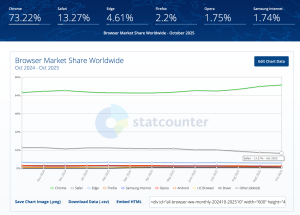
And the pattern is becoming hard to ignore: Safari isn’t keeping up.
A Browser Falling Behind the AI Curve
Over the last 18 months, browsers have stopped competing on speed alone — they’re competing on intelligence.
- Chrome now runs on Gemini, deeply integrated across the browser.
- Perplexity’s Comet is built around a conversational AI agent that reads and synthesizes the web for you.
- ChatGPT Browser (Atlas) lets users interact with webpages directly through AI.
All three run on Chromium and ship with modern AI capabilities that help users work faster, research deeper, and automate more.
Safari, meanwhile, still feels like it’s living in a pre-AI era.
Even though Apple added a native “writing tool” to Safari, it’s limited compared to Chrome’s Gemini-powered features or Comet’s full-stack AI browsing experience. Safari’s writing assistant is a nice touch — but in today’s AI-competitive landscape, it’s a speck of a feature next to the fully agentic browsers rolling out everywhere else.
The Siri 2.0 Failure — Ripple Effects Across Apple’s Ecosystem
Safari’s slowdown didn’t happen in isolation. Apple’s broader AI push has stumbled too.
Siri 2.0 was supposed to be Apple’s big comeback — a next-gen assistant powered by upgraded models and deep device integration. But after delays, internal resets, and lackluster demos, Apple reportedly had to seek Google’s help to bring parts of the project to life.
And when Siri — the heart of Apple’s AI vision — misses the mark, the effects trickle down:
- Safari doesn’t get meaningful on-device intelligence.
- Search assistance stays basic.
- AI-powered navigation and summarization remain behind competitors.
Simply put, Apple’s hesitation in the AI race has directly dragged Safari’s experience down.
AI-Native Browsers Are Setting a New Standard
Here’s what today’s browsers can do that Safari still can’t:
- Read and summarize entire pages instantly
- Research multi-tab topics and give consolidated answers
- Auto-draft emails, replies, and reports based on page content
- Plan tasks, automate actions, and run agentic workflows
- Offer conversational search without switching tabs
This is why AI-first browsers are gaining share — and why Safari’s 13% global share is likely to shrink further if Apple doesn’t make a major AI leap.
Will Apple Have to Rely on Google for Safari Too?
This isn’t far-fetched.
Apple has already tapped Google to support Siri’s next iteration — a significant shift from its historically closed, “we’ll build it ourselves” approach.
If Safari is to compete with Gemini-powered Chrome or AI-forward browsers like Comet, Apple may once again need outside help. Deep integration with Gemini, or even an AI-search partnership with OpenAI or Perplexity, is a realistic scenario.
But that dependency would also reshape Apple’s long-held positioning around privacy, control, and on-device intelligence.
The Bigger Picture for Marketers and SEOs
A browser shift this massive affects everyone:
- Chrome’s dominance grows, and with it, Gemini becomes the default AI layer for billions of users.
- AI-native browsers introduce new SERP experiences, summarization layers, and citation formats.
- Safari’s stagnation means Apple devices — historically premium traffic sources — may become harder to prioritize in AI-driven search flows.
Key Takeaways
- Optimizing for AI-summaries and multi-browser AI experiences is now unavoidable.
- Relying on Safari-heavy traffic is no longer dependable.
- Understanding how Gemini, Comet, and ChatGPT Browsers interpret your content becomes part of the new playbook.
Unless Apple delivers a genuinely competitive AI stack in 2026 — both for Siri and Safari — it risks losing a generation of users who now expect AI-assisted browsing as the default experience.
The browser wars are no longer about tabs, speed, or battery usage.
They’re about intelligence — and right now, Safari is behind.

Dileep Thekkethil
AuthorDileep Thekkethil is the Director of Marketing at Stan Ventures, where he applies over 15 years of SEO and digital marketing expertise to drive growth and authority. A former journalist with six years of experience, he combines strategic storytelling with technical know-how to help brands navigate the shift toward AI-driven search and generative engines. Dileep is a strong advocate for Google’s EEAT standards, regularly sharing real-world use cases and scenarios to demystify complex marketing trends. He is an avid gardener of tropical fruits, a motor enthusiast, and a dedicated caretaker of his pair of cockatiels.
