To understand how ChatGPT really compares with Google, the team at Ahrefs looked beyond raw search volume. Their analysis focused on where the two overlap on search, how much traffic each sends to websites, and how click-through rates differ. This article draws on that analysis to explain what those differences reveal about how search is changing.
ChatGPT has quickly become a common starting point for information, while Google continues to play a very different role. One is built to answer questions inside the product. The other is designed to send users across the web.
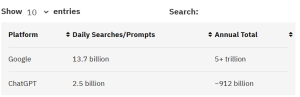
By mid-2025, ChatGPT was handling about 2.5 billion prompts per day. That puts it at close to 18% of Google’s estimated 13.7 billion daily searches. In raw activity terms, conversational AI has reached a scale that few would have predicted just a few years ago.
Even at that scale, activity alone does not define search. Google’s more than 5 trillion searches a year are built around discovery through links. ChatGPT works as an interactive layer, taking in questions and delivering answers directly inside the product.
What Counts as Search in an AI System
A key question is how much of ChatGPT’s activity resembles traditional search behavior.
Research from OpenAI and Harvard, based on 1.5 million conversations, found that only 24% of prompts were direct fact-finding searches.
Another 51.6% were categorized as “asking intent,” meaning users sought advice or context rather than a single answer
The analysis challenges that framing.
Many activities excluded from the search category, such as translation, calculations, and coding help, have historically been handled through search engines. When those are included, an estimated 65% of ChatGPT usage aligns with what people once searched for on Google.
Using that broader definition, ChatGPT now handles roughly 1.6 billion search-like queries per day. That equals nearly 12% of Google’s comparable search volume and exceeds estimated daily searches on Bing, marking a clear shift in how users approach information tasks.
Traffic Tells a Very Different Story
Despite this surge in usage, the flow of traffic to websites remains heavily concentrated around Google.
Data from Ahrefs Web Analytics, covering 76,000 sites, shows Google delivers nearly 40% of all web traffic. ChatGPT accounts for just 0.21%.
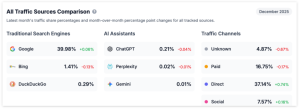
Put another way, Google sends about 190 times more visitors to websites than ChatGPT does today
This gap is not incidental. It reflects a structural difference between the two systems. Google’s success depends on sending users outward. ChatGPT’s design favors self-contained answers that reduce the need to leave the conversation.
Why Click-Through Rates Matter More Than Volume
Click-through rates make the contrast even clearer.
Google’s estimated average click-through rate stands at around 29%. ChatGPT’s rate, even when considering only search-like prompts, is closer to 1.3%. That represents a drop of roughly 96 percent compared with Google.
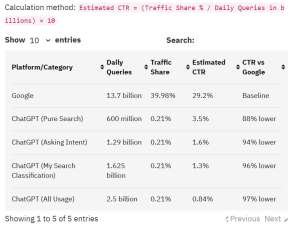
This is not a flaw in ChatGPT’s performance. It is a feature of its model. Users come to ChatGPT to resolve questions quickly and completely, not to browse multiple sources. As a result, the system captures attention but releases far fewer clicks.
What This Shift Signals for the Open Web
The data points to two distinct economic models. Google acts as an intermediary that connects users with external publishers. ChatGPT, by contrast, concentrates answers within its own interface.
If conversational AI continues to absorb a larger share of informational queries, the pressure on website traffic will increase, particularly for content that can be summarized or explained without external context.
While this is happening, Google’s role as the primary distributor of web traffic remains largely intact, even as its share of total queries faces new competition.
Implications for Publishers and Businesses
Website owners should resist the temptation to measure AI platforms by search volume alone.
Visibility inside AI tools does not yet replace the referral value of traditional search. Google optimization continues to matter for traffic, revenue, and reach.
At the same time, being referenced by AI systems may shape perception, authority, and brand awareness in ways that are harder to quantify. Publishers may need to track influence separately from visits and prepare for a future where attention and traffic do not always move together.
Key Takeaways
- ChatGPT processes about 2.5 billion prompts per day.
- Around 65 percent of its usage resembles traditional search behavior.
- Google sends roughly 190 times more traffic to websites.
- ChatGPT’s click-through rate is about 96 percent lower than Google’s.
- The platforms reflect different priorities: conversation versus referral.

Zulekha
AuthorZulekha is an emerging leader in the content marketing industry from India. She began her career in 2019 as a freelancer and, with over five years of experience, has made a significant impact in content writing. Recognized for her innovative approaches, deep knowledge of SEO, and exceptional storytelling skills, she continues to set new standards in the field. Her keen interest in news and current events, which started during an internship with The New Indian Express, further enriches her content. As an author and continuous learner, she has transformed numerous websites and digital marketing companies with customized content writing and marketing strategies.
