
You’ve probably noticed it. You search less on Google than you used to. Maybe you ask ChatGPT a question instead, something about a medical term, a coding fix, a product comparison, and you get what you need. No links. No ads. Just an answer.
Now the numbers confirm what millions are already turning away from traditional search engines and toward AI chat interfaces.
ChatGPT has become the dominant force in AI search, commanding an extraordinary 80.1% of all traffic in that category, according to new data from Similarweb.

ChatGPT’s Takeover
Six months ago, ChatGPT already held a solid lead in AI-driven search. But recent data shows it’s not just holding steady, it’s growing.
After a brief dip to 77.6%, its share rebounded in April to 80.1%. That means four out of every five AI search interactions go through ChatGPT.
The competition is nowhere close:
- DeepSeek: 6.5% (down from 7.6%)
- Google’s AI tools (like Bard): 5.6% (slightly up from 5.5%)
- Grok (from X/Twitter): 2.6% (down from 3.2%)
- Perplexity: 1.5% (down from 1.9%)
Despite their resources, none of these challengers have managed to build the consistency, usability, or trust that ChatGPT has established.
GenAI Traffic Share update —
🗓️ 6 months ago:
ChatGPT: 86.7%
Google: 6.2%
Perplexity: 1.9%🗓️ 3 months ago:
ChatGPT: 79.8%
DeepSeek: 9.2%
Google: 4.9%
Perplexity: 1.8%🗓️ 1 month ago:
ChatGPT: 77.6%
DeepSeek: 7.6%
Google: 5.5%
Grok: 3.2%
Perplexity: 1.9%🗓️ Today:
ChatGPT:… pic.twitter.com/EQgBBNRf3U— Similarweb (@Similarweb) May 7, 2025
What’s Happening to Traditional Search?
Even though Google still has far more users than ChatGPT, roughly seven times as many, its usage is declining. Not sharply, but steadily.
According to Similarweb, Google traffic is down 2% compared to a year ago.
That trend is more pronounced elsewhere:
- Bing: Down 18% year-over-year, after once enjoying an 18% surge in January
- Yahoo: Down 11%
- DuckDuckGo: Down 6%
- Baidu: Down 12%
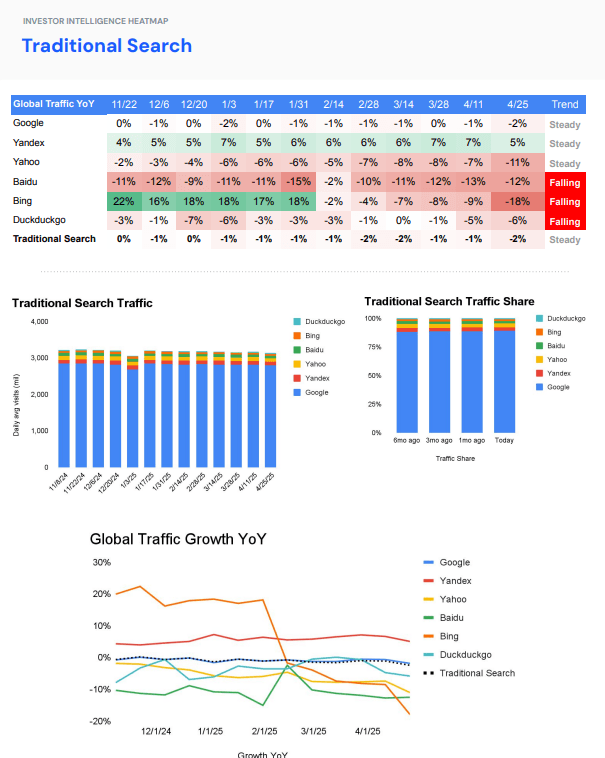
The bigger story here is the erosion of dominance. For years, these engines served as the internet’s main access points, now superseded by conversational interfaces that deliver answers directly.
Beyond Search: AI’s Winners and Losers
The shift in user habits is transforming entire digital industries. And while some areas of AI are booming, others are struggling to prove their worth.
Rising fast:
- DevOps & coding tools: +103% in traffic over 12 weeks
- General AI tools (like productivity assistants): +34%
- Music generation platforms: +12%
- Voice synthesis tools: +8%
Losing momentum:
- Writing and content generation tools: Down 12%
- Customer support AI platforms: Down 11%
- Legal AI platforms: Crashing with a 70% traffic decline
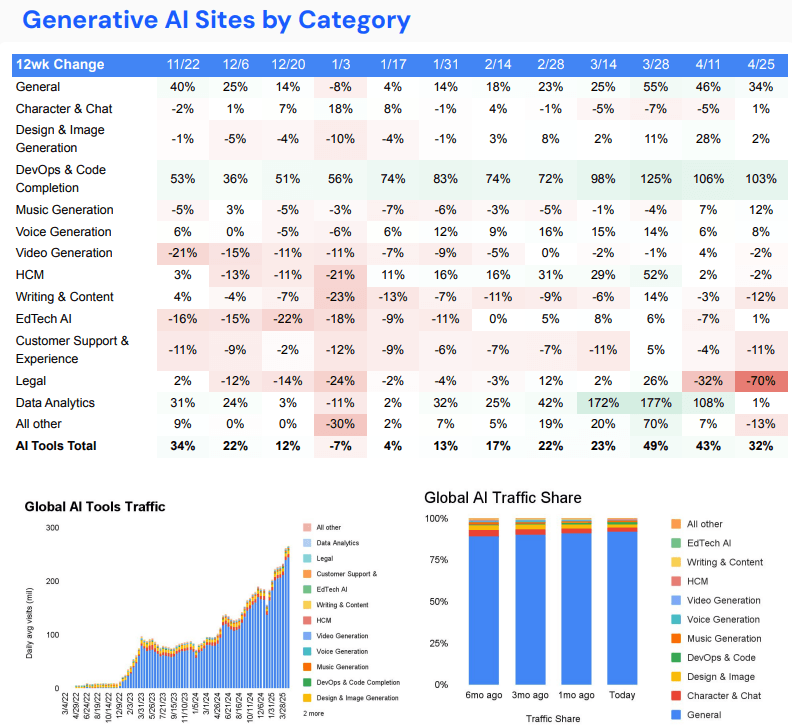
The decline in writing and support tools may reflect user dissatisfaction or the limits of current capabilities. In contrast, coding tools and assistants that support actual workflows seem to be thriving.
Disruption Beyond AI: Who’s Hurting?
As AI changes how we gather knowledge, other sectors that relied on search traffic or traditional engagement are feeling the pain. Education tech, freelance platforms, and DIY web services are all seeing major losses:
- Chegg: Down 66%
- CourseHero: Down 69%
- Freelance platforms overall: Down 19%
- Website builders: Down 13%
Design platforms, interestingly, are growing by 10%. Unlike static educational resources, design tools appear to work better when paired with AI, not replaced by it.
So Why ChatGPT?
Why is ChatGPT surging while others stall? Part of the answer is timing.
OpenAI was among the first to offer a usable, responsive, free AI interface to the public. But there’s more to it.
ChatGPT is intuitive. It gives answers that feel complete and contextual. It remembers what you ask. It refines your queries. And in its premium version, it integrates access to real-time data and third-party tools, giving it both breadth and depth.
By contrast, other tools either arrived late, struggled with interface design, or failed to keep users engaged.
Google, despite launching Gemini, still routes users through search pages filled with ads. That doesn’t feel like innovation.
What This Means for Users and Marketers
The change may feel subtle now, but it’s deep. SEO is still relevant, but less influential. Content needs to be crafted for AI discovery, not just search engines. It must answer questions directly, clearly, and comprehensively.
Marketers and creators need to rethink how they distribute and present information. Being cited in an AI response might soon become more valuable than appearing on the first page of Google.
And users? They’re already choosing ease and clarity over habit. Ask, get the answer, move on.
Smart Moves You Can Make Today
To keep up with the way online search is changing, it’s time to rethink your approach. Start by creating content that’s clear, straightforward, and easy to understand.
AI tools are most effective with clearly organized information that directly addresses questions, so ensure your content aligns with this standard.
Don’t rely on Google alone. Share your work across multiple platforms, especially those AI systems might use to pull information. The more visible your content is across the web, the more likely it is to show up in AI-generated answers.
It also helps to spend time using AI tools yourself. The more familiar you are with how they respond, what kind of information they favor, and where they fall short, the better equipped you’ll be to create content that stands out.
Keep an eye on how people are finding your content. Your audience may already be coming from new sources, not just traditional search engines. Pay attention to that shift, and be ready to adjust your strategy.
Most importantly, always think from the user’s perspective. Today’s users don’t want to scroll through pages of links; what I mean is, they want clear, helpful answers fast. If your content does that, it’s far more likely to succeed in an AI-first world.
Key Takeaways
- ChatGPT now owns 80.1% of AI search traffic.
- Google and Bing are steadily losing user share.
- Dev-focused AI tools are thriving; content and legal AI are shrinking.
- Entire digital sectors, from EdTech to freelancing, are being reshaped.
- Users are replacing search queries with AI conversations and they’re not going back.

Dileep Thekkethil
AuthorDileep Thekkethil is the Director of Marketing at Stan Ventures, where he applies over 15 years of SEO and digital marketing expertise to drive growth and authority. A former journalist with six years of experience, he combines strategic storytelling with technical know-how to help brands navigate the shift toward AI-driven search and generative engines. Dileep is a strong advocate for Google’s EEAT standards, regularly sharing real-world use cases and scenarios to demystify complex marketing trends. He is an avid gardener of tropical fruits, a motor enthusiast, and a dedicated caretaker of his pair of cockatiels.
