The content management system (CMS) world just got an update and it tells a story few expected to read.
WordPress, the powerhouse that has ruled web publishing for nearly two decades, is finally showing signs of slowing down.
According to the latest W3Techs report (October 2025), WordPress powers 43.3% of all websites and holds 60.7% of the CMS market, down sharply from its 2022 peak of 65.2%.
That might not sound catastrophic, until you realize this is the first sustained decline WordPress has faced since its rise to dominance in the early 2000s.
Meanwhile, SaaS-based CMS platforms like Shopify, Wix and Squarespace are growing steadily, reshaping the future of how websites are built and managed.
Let’s see what it means for businesses and how the changing CMS landscape could redefine SEO and digital strategy.
How Big Is the CMS Market in 2025?
According to W3Techs and Netcraft, about 71.4% of all websites now use a CMS — a total of roughly 200 million websites worldwide. The remaining 28.6% are coded manually or run without a CMS, a number that continues to fall each year.
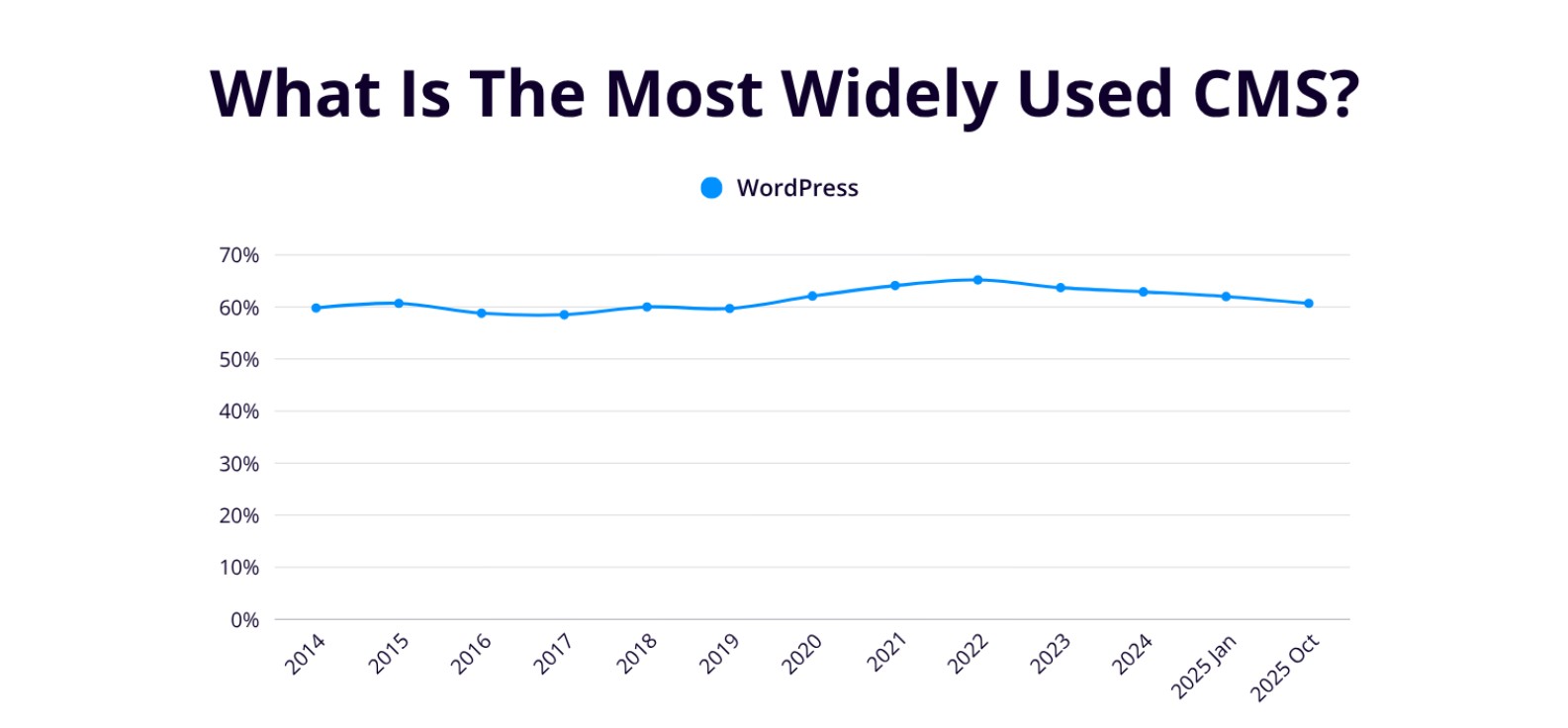
This means that structured, managed platforms have become the web’s default. Whether it’s a blog, ecommerce store, or enterprise site, the age of “no CMS” is fading fast.
And yet, one fact remains, WordPress still holds more than half the CMS market. It’s not disappearing anytime soon.
But the rate of decline tells us something deeper: the industry’s priorities are changing.
Why Is WordPress Losing Market Share?
For two decades, WordPress has been the cornerstone of web publishing and powering everything from personal blogs to enterprise portals.
But in 2025, cracks are starting to show.
The challenges? Maintenance, security, and complexity.
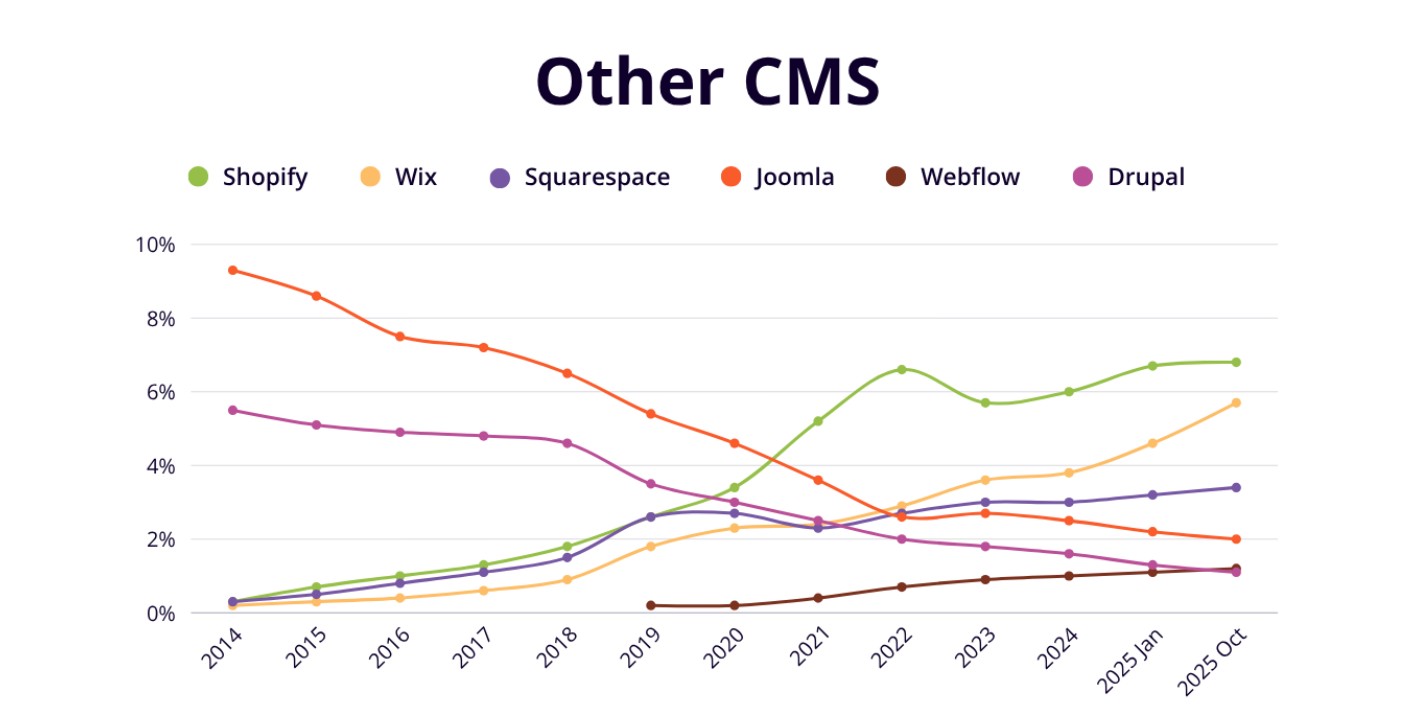
While WordPress remains open-source and highly flexible, that flexibility comes with overhead frequent core updates, plugin conflicts and rising cybersecurity risks. For small businesses, this creates friction.
Platforms like Wix, Shopify and Squarespace are winning precisely because they offer what WordPress does not: simplicity.
They handle hosting, security and technical updates, letting users focus purely on design and content.
As one Shopify developer put it recently, “People don’t want to manage a website anymore, they want to manage a business.” It’s a subtle but defining shift.
Who Are the Fastest-Growing CMS Players in 2025?
Let’s look at the latest global CMS rankings (October 2025):
| Rank | CMS | Market Share | Type |
| 1 | WordPress | 60.7% | Open Source |
| 2 | Shopify | 6.8% | SaaS |
| 3 | Wix | 5.7% | SaaS |
| 4 | Squarespace | 3.4% | SaaS |
| 5 | Joomla | 2.0% | Open Source |
| 6 | Webflow | 1.2% | SaaS |
| 7 | Drupal | 1.1% | Open Source |
| 8 | Tilda | 1.1% | SaaS |
| 9 | Adobe Systems | 1.0% | Enterprise |
| 10 | Duda | 1.0% | SaaS |
Together, these platforms account for over 71% of the CMS market, with SaaS builders collectively claiming almost one-fifth, which is a record high.
Shopify’s steady 6.8% share shows how ecommerce-first systems continue to disrupt traditional publishing models. Wix’s 5.7% and Squarespace’s 3.4% shares highlight a clear consumer preference for no-code and design-first systems.
Even Webflow, once seen as a niche designer’s tool, has gained momentum and crossing the 1% threshold and proving that professional-grade design control without backend stress is a compelling value proposition.
Why Are Joomla and Drupal Fading from the Spotlight?
It was not long ago that Joomla and Drupal were considered WordPress’s main rivals. In 2014, they collectively held nearly 15% of the CMS market. Today, that’s down to just over 3%.
The reason? Complexity and developer dependency.
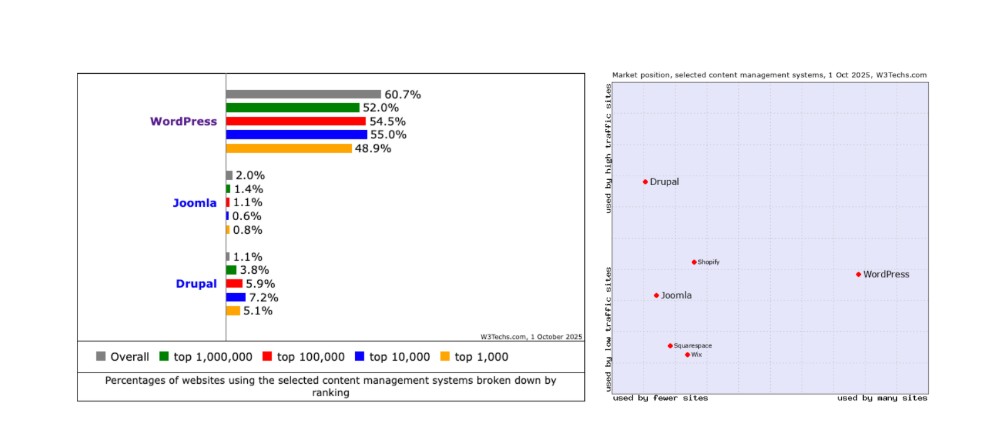
Joomla and Drupal have always appealed to technically skilled users, but their steeper learning curve and limited ecosystem support have made them less attractive in the SaaS era.
In contrast, new-generation builders like Wix and Webflow speak the language of visual creativity and instant deployment.
No FTP clients, no database configuration, just drag, drop, and launch.
It is not that Joomla and Drupal are gone, they are still trusted by institutions that value control and customization but they have lost the mainstream audience to faster, simpler alternatives.
How Are Website Builders Changing the Market?
Here is the headline: Wix grew 32.6%, Squarespace rose 9.7%, and Shopify climbed 4.6% between October 2024 and October 2025.
Together, these gains paint a clear picture, the future of website creation is hosted, visual and managed.
Wix and Squarespace, in particular, are thriving among small businesses and independent creators. Their ease of use, modern templates, and built-in analytics remove the barriers that WordPress still struggles with.
And then there’s Elementor, a WordPress page builder that has quietly become a giant in its own right. Installed on 18.1% of all websites using a CMS, Elementor bridges the gap between open-source flexibility and drag-and-drop convenience.
If anything, Elementor’s success suggests that users love WordPress but wish it felt more like a builder.
What’s Driving Shopify’s Continued Dominance in E-Commerce?
Shopify’s rise remains one of the most remarkable stories in the CMS space.
With 6.8% CMS market share and 4.8% usage across all websites, Shopify has become the go-to platform for ecommerce entrepreneurs.
Its appeal lies in the details including Core Web Vitals compliance, built-in SEO, and powerful integrations for inventory, payments and analytics. Shopify isn’t just a CMS; it’s a growth engine.
By contrast, WooCommerce, the leading ecommerce plugin for WordPress, still holds a much larger base 12.4% CMS share and 8.9% total usage.
But as a plugin, WooCommerce depends on WordPress’s broader ecosystem.
That means the fate of WooCommerce is tied to the future of WordPress itself. And if WordPress’s decline continues, we may eventually see Shopify closing that gap.
Why Does CMS Market Share Matter for SEO and Digital Strategy?
CMS choice isn’t just a technical decision, it’s a business strategy.
The platform you choose defines how easily your team can:
- Optimize for search engines
- Implement schema and structured data
- Maintain site security
- Scale content publishing
- Adapt to Core Web Vitals and UX standards
For example, Shopify’s hosted infrastructure ensures strong performance out of the box, while Wix and Squarespace simplify visual optimization for non-technical users.
On the other hand, WordPress still offers unmatched plugin ecosystems for professional SEO optimization but at the cost of complexity.
The decline in “no CMS” websites (now just 28.6%) also reflects a larger truth: structured content systems are no longer optional.
For most organizations, CMS adoption directly correlates with SEO stability, site performance, and content scalability.
What’s Next for the CMS Industry?
The 2025 CMS report tells a fascinating story of market maturity and diversification.
- WordPress remains the leader but it’s entering a slower growth phase.
- SaaS platforms are growing faster especially those prioritizing design, simplicity, and integrated hosting.
- Traditional open-source rivals like Joomla and Drupal are becoming niche players.
- The middle ground hybrid tools like Webflow and Elementor might define the next decade.
The market is not collapsing, it is recalibrating.
And as businesses prioritize speed, automation and security over backend control, we might soon see a web where most sites are built, hosted, and optimized entirely in the cloud.
The Future Belongs to Simplicity
So, where does that leave us?
If WordPress’s story was about empowering creators, the next chapter belongs to empowering efficiency.
As brands focus on performance, automation, and low maintenance, CMS platforms that deliver speed and simplicity without sacrificing flexibility will lead the way.
For businesses and SEO professionals alike, this is the moment to diversify to master not just WordPress but also Shopify, Wix, and emerging players like Webflow.
Because as the data shows, the web is changing and those who adapt to simpler systems may just move faster than those who cling to legacy ones.

Dileep Thekkethil
AuthorDileep Thekkethil is the Director of Marketing at Stan Ventures, where he applies over 15 years of SEO and digital marketing expertise to drive growth and authority. A former journalist with six years of experience, he combines strategic storytelling with technical know-how to help brands navigate the shift toward AI-driven search and generative engines. Dileep is a strong advocate for Google’s EEAT standards, regularly sharing real-world use cases and scenarios to demystify complex marketing trends. He is an avid gardener of tropical fruits, a motor enthusiast, and a dedicated caretaker of his pair of cockatiels.