
Google rolls out a major upgrade to Gemini 3 Deep Think, widening access to advanced AI reasoning for science and engineering.
Google on Wednesday released a significant upgrade to Gemini 3 Deep Think, its most advanced reasoning mode, aiming to support complex work across science, research, and engineering.
The update is now available to Google AI Ultra subscribers through the Gemini app, while early access via the Gemini API is being offered to selected researchers, engineers, and enterprises, the company said.
The release reflects Google’s push to position Gemini not only as a general assistant but also as a tool capable of handling open-ended research problems where data can be incomplete, and answers are rarely clear-cut.
According to the company, the latest version of Deep Think was developed in close collaboration with scientists and engineers to ensure it aligns with real research conditions rather than idealized benchmarks alone.
Designed for Hard Problems With No Easy Answers
Google describes Gemini 3 Deep Think as a specialized reasoning system built for tasks that demand sustained logic, mathematical precision, and domain knowledge. These include areas where traditional machine learning systems often struggle, such as theoretical research, advanced mathematics, and engineering design.
The company says early users are already applying Deep Think to live research challenges. One example cited involves a mathematician using the system to review a highly technical paper in high-energy physics.
In that case, Deep Think identified a subtle logical flaw that had passed through human peer review, highlighting its potential role as a support tool for experts rather than an automated decision-maker.
Strong Results on Demanding Benchmarks
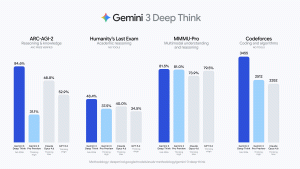
Google backed the update with a series of benchmark results intended to demonstrate gains in reasoning ability.
The upgraded Deep Think achieved 48.4% on Humanity’s Last Exam without tools, a test designed to probe the limits of advanced AI models. It also scored 84.6% on ARC-AGI-2, a result verified by the ARC Prize Foundation.
In competitive programming, the system reached an Elo rating of 3455 on Codeforces, and Google said it achieved gold-medal-level performance on the International Math Olympiad 2025.
These results are meant to signal that Deep Think can sustain long chains of reasoning under pressure, a key requirement for research-grade applications.
Broader Gains in Physics and Chemistry
The update also extends Deep Think’s capabilities beyond mathematics and coding.
Google said the system now delivers gold-level performance on the written sections of the 2025 International Physics Olympiad and Chemistry Olympiad. It also recorded a score of 50.5% on the CMT-Benchmark, which focuses on advanced theoretical physics.
These results suggest Google is aiming to position Deep Think as a cross-disciplinary reasoning tool that can operate across scientific fields without being narrowly specialized.
Focus on Practical Engineering Use
Alongside benchmark improvements, Google emphasized practical engineering applications. Deep Think is designed to help researchers interpret complex data and assist engineers in modelling physical systems through code.
One example highlighted by the company shows the system analyzing a hand-drawn sketch, converting it into a digital model, and generating a file suitable for 3D printing.
Google says this reflects a broader effort to connect advanced reasoning directly with real-world production workflows, particularly through access to the Gemini API.
Wider Access Through App and API
Google AI Ultra subscribers can access the updated Deep Think mode immediately through the Gemini app.
At the same time, the company has opened an early access program for the Gemini API, allowing selected organizations to integrate Deep Think into their own research and engineering environments.
By expanding access beyond a limited research preview, Google appears to be positioning Deep Think as part of its core AI infrastructure for advanced technical work.
What Users Should Expect
Google stresses that Gemini 3 Deep Think is not positioned as an authority that delivers final answers. Instead, it is designed to support experts by helping them explore assumptions, test reasoning paths, and surface inconsistencies that may be easy to miss.
For researchers and engineers, the system’s value lies in its ability to operate in uncertain conditions, where verification remains essential, and conclusions must still be checked by humans.
Google’s framing suggests that the next phase of AI adoption in science and engineering will depend less on fluency and more on reliability, depth, and usefulness under real constraints.
Key Takeaways
- Gemini 3 Deep Think is designed for advanced reasoning in science, research, and engineering.
- The update shows strong results across math, physics, chemistry, and programming benchmarks.
- Early testers are using it to review research and identify logical issues.
- Practical engineering use cases, including 3D modeling, are a major focus.
- Access now extends through the Gemini app and an early API program.

Zulekha
AuthorZulekha is an emerging leader in the content marketing industry from India. She began her career in 2019 as a freelancer and, with over five years of experience, has made a significant impact in content writing. Recognized for her innovative approaches, deep knowledge of SEO, and exceptional storytelling skills, she continues to set new standards in the field. Her keen interest in news and current events, which started during an internship with The New Indian Express, further enriches her content. As an author and continuous learner, she has transformed numerous websites and digital marketing companies with customized content writing and marketing strategies.
