Google has officially made Grounding with Google Maps in Vertex AI generally available, giving developers worldwide a new way to build AI tools that answer questions with live, real-world location data. From recommending dinner spots to helping house-hunters explore neighborhoods, the integration could reshape how AI feels in everyday use.
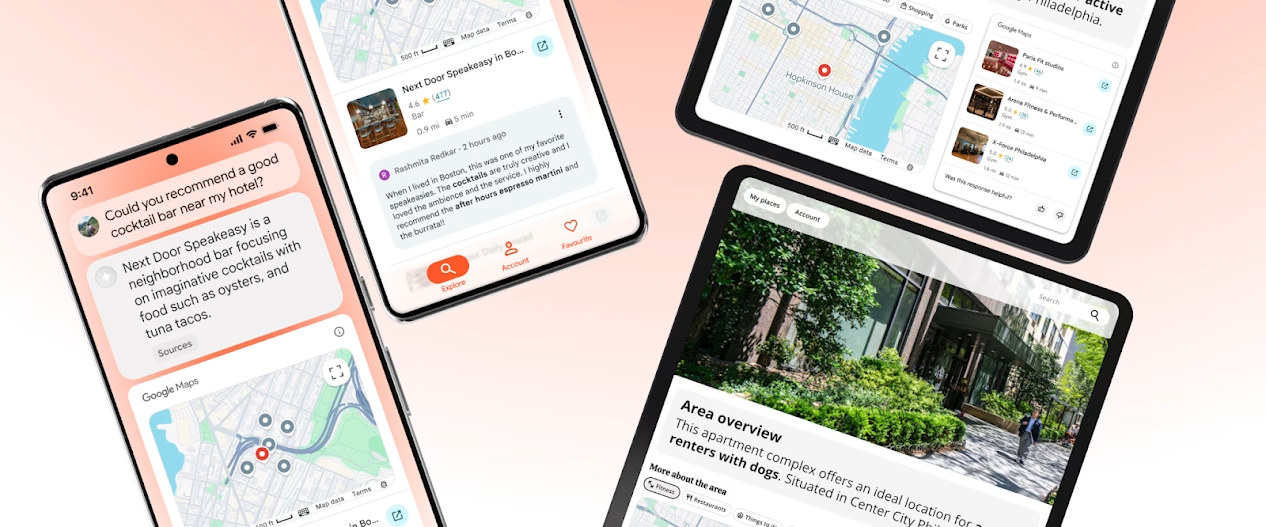
Think about the last time you asked an AI tool for local advice.
Maybe you wanted to know if a restaurant was open late or whether a café was good for working quietly. Chances are, the answer felt a little shaky. Sometimes it was right, sometimes way off.
That’s the problem Google is trying to solve.
With Grounding, developers can now connect their AI applications to Google Maps data. Instead of relying on vague or outdated information, the AI can check directly against real business hours, user reviews, and local updates.
In other words, the AI stops guessing and starts speaking like someone who actually knows the neighborhood.
What Grounding Actually Means
“Grounding” is Google’s way of describing how AI ties its answers back to trusted sources.
Large language models are famously good at writing smooth sentences, but they don’t always know if what they’re saying is true. They generate fluent responses, but without context, they may fabricate details.
In everyday life, that could mean suggesting a café that closed months ago or describing a “quiet park” that sits next to a construction site.
Grounding changes that. By linking Gemini, Google’s AI model, to trusted data sources such as Maps, developers can reduce errors and improve trust.
Imagine asking, “Is this bakery open right now?” and getting an answer based on up-to-date business hours, not static text scraped from months-old websites.
Developers now have access to more than 250 million businesses and landmarks worldwide, with local insights continually refreshed by Google Maps contributors. This gives AI applications a living feed of what’s happening on the ground, which is especially valuable when users rely on the information to make choices in real time.
From Facts to Feelings
One of the most intriguing parts is how grounding can handle more subjective questions.
Let’s say you’re traveling and want to know, “What’s the vibe of this café?” Normally, AI might give you a generic description.
Now, it can tap into user reviews, telling you whether people find it cozy, noisy, artsy, or perfect for late-night chats.
Google has even linked Maps with Search, so the AI can mix and match depending on the question.
If you ask about a concert, Search can tell you who’s performing and venue policies, while Maps adds details about nearby parking or whether the place is stroller-friendly. Together, they give a fuller picture.
At launch, some of these subjective features work only in the U.S. and India, but Google is clearly testing the waters for broader reach.
Where Businesses See Potential
It’s easy to imagine why different industries are excited.
1. Travel and Hotels
Marriott, for example, says this kind of integration can change how people plan trips. Peggy Roe, the company’s Chief Customer Officer, called it a way to “deepen engagement” with guests. Instead of handing travelers a generic list of attractions, AI could help them build itineraries that match personal interests and local insights.

2. Real Estate
Compass, the real estate brokerage, is also jumping in. Buyers often want to know more than square footage — they care about schools, nightlife, or commute options. Yotam Lemberger, a VP at Compass, says grounding with Maps will let agents provide richer neighborhood stories for clients, powered by both company data and Google’s.
3. Consumer Tech
Smart assistants are another obvious fit. For years, devices promised to answer, “What’s good nearby?” but often failed. With this upgrade, the answers should finally feel reliable.
4. Social Apps
Even group planning could get easier. Instead of endless back-and-forth texts, friends might ask an app, “Where can five of us eat tonight that’s vegetarian-friendly and not too loud?” The AI could filter options in real time.
Building With It
The barrier to entry isn’t high for developers. In Vertex AI, they can simply add the Maps tool to the Gemini API. From there, their applications can call Maps whenever a query needs local context.
That means a travel app can handle both general questions like “Top attractions in Barcelona” and precise ones like “Is Sagrada Familia open right now?” without switching systems.
To encourage experimentation, Google is also offering a free tier: 10,000 prompts with Gemini Pro. That lowers the risk for smaller teams curious about what grounding could add to their projects.
The Trust Question
Generative AI has dazzled people with its creativity but frustrated them with errors. If users can’t rely on answers, they’re less likely to build it into daily life.
Grounding is Google’s answer to that skepticism. By rooting responses in Maps or Search, the company is betting people will see AI less as a novelty and more as a dependable tool.
But it’s not without responsibility. Developers need to safeguard user data, especially when dealing with sensitive location information. Google emphasizes enterprise readiness, but actual adoption will be the real test.
Everyday Scenarios
It’s easy to picture how this could play out:
- A parent planning dinner checks if a restaurant has high chairs and sees reviews confirming it’s kid-friendly.
- A traveler in a new city asks for a morning jog route and gets suggestions based on nearby parks and paths.
- A couple looking to buy a house gets a summary of nearby schools, grocery stores, and cafes — without manually searching for each.
- A neighborhood shop integrates it into customer support, answering instantly whether delivery covers someone’s address.
Advice for Developers and Businesses
If you’re thinking of testing it, a few simple tips help:
- Experiment first. Use the free tier to see how grounding changes your results.
- Mix sources. Combine Maps with your own data to give users richer context.
- Design for real questions. Think about how people actually ask, not how you want them to.
- Respect privacy. Be clear about how you use location data.
- Keep it updated. Since Maps refreshes daily, your application should keep pace.
What Comes Next
This launch lines up with Google’s broader push to anchor AI in reliable, verifiable sources. As AI becomes part of daily decisions, accuracy will matter more than novelty.
Other companies are exploring similar integrations, but Google holds a unique card: years of Maps data and a global user base that constantly contributes updates. That gives it an edge as developers look for trustworthy building blocks.
The big question is whether grounding will shift how people see AI. If it succeeds, we may stop thinking of AI as something that occasionally helps — and start seeing it as a consistent partner in everyday choices.
Key Takeaways
- Grounding with Google Maps is now generally available in Vertex AI.
- Developers can build apps that reference real-time data from over 250 million places.
- Travel, real estate, devices, and social platforms are early adopters.
- A free tier makes it easy to experiment.
- Trust and privacy will determine how widely it’s embraced.

Dileep Thekkethil
AuthorDileep Thekkethil is the Director of Marketing at Stan Ventures, where he applies over 15 years of SEO and digital marketing expertise to drive growth and authority. A former journalist with six years of experience, he combines strategic storytelling with technical know-how to help brands navigate the shift toward AI-driven search and generative engines. Dileep is a strong advocate for Google’s EEAT standards, regularly sharing real-world use cases and scenarios to demystify complex marketing trends. He is an avid gardener of tropical fruits, a motor enthusiast, and a dedicated caretaker of his pair of cockatiels.
