
Google has pushed back on growing speculation around LLMs.txt files found on several of its websites, clarifying that the files are not connected to AI discovery or how large language models access content. The clarification comes after renewed discussion in the SEO community about why the files remain live weeks after first appearing.

Roughly a month ago, SEO professionals and developers noticed something unusual across parts of Google’s online ecosystem.
Files named LLMs.txt had appeared on a number of Google-owned sites, including documentation and developer resources.
One high-profile appearance on Google Search developer documentation was short-lived. The file was removed within a day.
But that was not the end of it.
On several other Google sites, the files stayed live. That uneven cleanup sparked fresh questions about intent, timing, and whether the files hinted at a new way for AI systems to locate or interpret content.
Those questions resurfaced in a recent Reddit discussion, prompting a direct response from John Mueller.
Why Google Says the Files Are Not for Discovery
Mueller’s explanation focused on where the files are placed. According to him, the LLMs.txt files are not located at the top level of the sites where they exist. That detail matters because files intended to guide discovery are typically easy for systems to find.
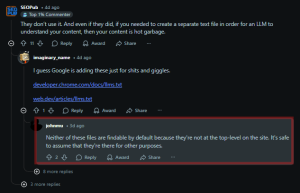
Because these files are buried deeper in site structures, Mueller said it is safe to assume they are not meant to help large language models discover or consume Google content.
He added that their presence should not be interpreted as a signal related to search, crawling, or AI indexing behavior.
While Mueller did not spell out the exact internal purpose of the files, his message was unambiguous on one point. They are not part of a public-facing AI discovery effort.
How the Files Appeared Across Google Sites
The origin of the files is far less dramatic than many assumed. When the issue first came up, Mueller explained that the LLMs.txt files were introduced through a broad content management system update that affected many Google properties at once.
Teams responsible for individual sites were largely unaware of the change as it rolled out.
Because Mueller directly manages the Search developer documentation, he was able to remove the file there quickly. Other Google sites, overseen by different internal teams, still have the files in place, which explains their continued visibility.
What This Means for Site Owners and Marketers
This situation reinforces an important lesson for site owners. Not every technical detail that shows up on a large platform signals a change that needs a response. Reacting too quickly can pull teams toward distractions that have little or no real impact.
Google’s comments bring the focus back to basics that continue to matter. Strong content, clear site structure, and well-documented optimization practices remain the areas where time and effort pay off. Unexplained signals, especially those without official guidance, rarely influence outcomes.
This is also a reminder that AI-related topics tend to amplify uncertainty. Clear confirmation from Google should carry more weight than assumptions drawn from file names or partial rollouts.
What Site Owners Should Do Next
Here are a few grounded ways to respond when similar situations arise:
- Check whether a file is publicly accessible and easy to discover before assigning meaning
- Look for confirmation from official Google representatives, not just community theories
- Avoid copying unexplained configurations into your own site
- Keep focus on proven areas such as technical hygiene and content optimization
Key Takeaways
- Google says LLMs.txt files are not intended for AI discovery
- The files appeared due to a broad CMS update, not a policy change
- Some Google sites removed the files, while others did not
- File placement indicates they are not meant to guide crawling or indexing
- Google’s clarification removes SEO and AI implications

Zulekha
AuthorZulekha is an emerging leader in the content marketing industry from India. She began her career in 2019 as a freelancer and, with over five years of experience, has made a significant impact in content writing. Recognized for her innovative approaches, deep knowledge of SEO, and exceptional storytelling skills, she continues to set new standards in the field. Her keen interest in news and current events, which started during an internship with The New Indian Express, further enriches her content. As an author and continuous learner, she has transformed numerous websites and digital marketing companies with customized content writing and marketing strategies.
