
Google has launched its December spam update, marking the final push in a year of sweeping changes to its search algorithms.
Expected to be completed within a week, the update wraps up a transformative 2024 aimed at tackling spam and boosting content quality.
This latest rollout follows closely on the heels of December’s core update, intensifying the focus on authentic, high-value content.
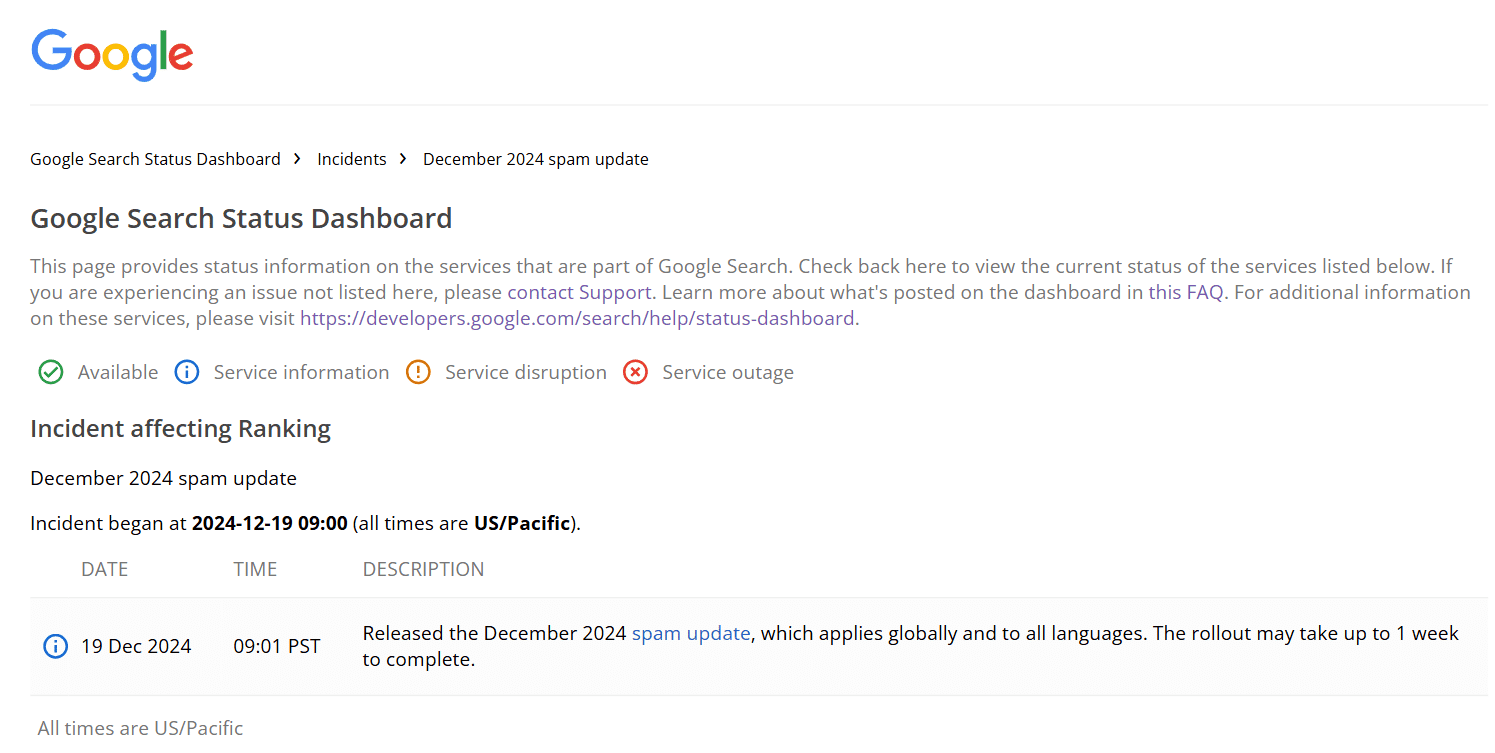
Today we released the December 2024 spam update.
It may take up to 1 week to complete, and we’ll post on the Google Search Status Dashboard when the rollout is done: https://t.co/L7n9n3Nh6X
— Google Search Central (@googlesearchc) December 19, 2024
Ending the Year with a Major Algorithm Shift
2024 has been a year of relentless Google updates. This December spam update joins earlier efforts, such as June’s Spam Update and a string of core updates in March, August, November, and earlier this December. Each update has reshaped SEO practices, taking aim at spammy, unhelpful content and redefining the standards for online publishing.
These updates haven’t gone unnoticed by the SEO community. Experts have shared their thoughts on the latest changes, blending humor with observations:
November core update, December core update, now a SPAM UPDATE. Happy Holidays everyone! 🙂 Stay tuned. https://t.co/q4UscCyevW
— Glenn Gabe (@glenngabe) December 19, 2024
Never. Ending. Story. 😅 pic.twitter.com/WeTi63xdZJ
— Aleyda Solis 🕊️ (@aleyda) December 19, 2024
End of year deadlines, anyone? https://t.co/yoUTNqvuxh
— Lily Ray 😏 (@lilyraynyc) December 19, 2024
The August 2024 core update was notable for its emphasis on high-quality content while penalizing low-value SEO practices. In contrast, the December core update expedited enhancements throughout Google’s systems, resulting in ongoing effects on search results rankings.
Policies That Changed the Game
This year saw Google introduce game-changing policies to combat content manipulation:
- Cracking Down on Site Reputation Abuse: Google’s May 2024 policy targeted misuse of established domains’ authority. High-profile casualties included major publishers penalized for hosting poorly supervised third-party reviews, expansive coupon sections, and AI-generated sports content.
- Tackling Expired Domain Exploits: The focus shifted to expired domains used for backlink schemes, unrelated content, and ranking manipulation. These practices saw major penalties as Google tightened its grip.
- Scaling Back Scaled Content: Rebranded as “scaled content abuse,” this policy cracked down on mass-produced, AI-generated, and automated content manipulation.
Mixed Reactions and Industry Impacts
The December spam update highlights Google’s commitment to user-focused content. While some praise these measures as long overdue, others struggle to adapt to the rapid pace of change.
Publishers must understand that oversight and originality are essential. The manual penalties imposed on major players highlight the necessity for stringent enforcement compliance.
The broader conversation centers on AI’s role in content creation. While AI tools hold promise, scaled production often falls short of Google’s quality benchmarks, leaving businesses to balance innovation with authenticity.
What’s Next for 2025?
The December spam update sets the tone for a future where quality reigns supreme. Key implications include:
Stronger Editorial Standards: Publishers must ensure oversight of all content, particularly third-party contributions.
Shift in SEO Tactics: Strategies must prioritize authenticity over shortcuts like domain squatting and mass link schemes.
AI in Focus: AI tools need to align with Google’s quality benchmarks, ensuring they add real value.
Staying Ahead of the Curve
Here’s how webmasters can adapt to the new normal:
Regularly Audit and Update Content
Webmasters should consistently review content for accuracy, relevance, and originality. It’s essential to ensure that content aligns with Google’s E-E-A-T guidelines to maintain quality and credibility. Tools like Google Analytics and Search Console are crucial for monitoring performance and identifying outdated pages that need refreshing.
Supervise Third-Party Contributions
When working with third-party contributors, webmasters must vet them carefully to ensure high-quality content. Establishing clear content guidelines and reviewing third-party material for compliance ensures that all content meets the website’s standards and Google’s requirements.
Avoid Manipulative SEO Tactics
To maintain sustainable SEO practices, webmasters should focus on organic link-building and avoid manipulative tactics like backlink manipulation. It’s important to steer clear of keyword stuffing and domain squatting, as these practices can harm long-term SEO efforts. Prioritizing content that offers genuine value over shortcuts is key to building a trusted online presence.
Leverage AI Tools Responsibly
AI tools can be incredibly useful for content idea generation or research, but it’s important to maintain human oversight. AI-generated content should be carefully tailored to match the brand’s voice while ensuring it adheres to Google’s quality standards for better performance and user experience.
Stay Informed and Adapt to Algorithm Changes
Webmasters should stay updated with resources like Google’s Search Central Blog and keep an eye on SEO news to adjust strategies as needed. When rankings drop, it’s crucial to analyze the situation and refine the focus on quality content and user experience to regain traction.
Key Takeaways
- Google’s December spam update concludes a year of transformative algorithm changes.
- Policies on site reputation abuse, expired domains, and scaled content redefined SEO.
- Publishers face increased scrutiny for content quality.
- AI-generated content remains under Google’s microscope.
- The path forward is clear: authenticity and user value come first.

Dileep Thekkethil
AuthorDileep Thekkethil is the Director of Marketing at Stan Ventures, where he applies over 15 years of SEO and digital marketing expertise to drive growth and authority. A former journalist with six years of experience, he combines strategic storytelling with technical know-how to help brands navigate the shift toward AI-driven search and generative engines. Dileep is a strong advocate for Google’s EEAT standards, regularly sharing real-world use cases and scenarios to demystify complex marketing trends. He is an avid gardener of tropical fruits, a motor enthusiast, and a dedicated caretaker of his pair of cockatiels.
