According to the latest BrightEdge AI Market Pulse report (October 2025), Google’s global search market share climbed from 90.54% to 90.71%, which is a modest 0.17-point gain that, in real terms, translates to billions of dollars in potential revenue.
It is Google’s first rebound since the AI search boom began and the timing could not be more significant.
Just as competitors like ChatGPT, Perplexity and Claude were expected to chip away at traditional search dominance, the tide may be turning or at least stabilizing.
Let’s see what this means for Google, for the search industry, and for marketers trying to navigate the blurred lines between traditional SEO and AI-driven discovery.
Why Is Google’s Market Share Rebound So Important?
On the surface, a 0.17% increase might seem trivial. But in Google’s world, every decimal point represents massive financial impact.
Search remains the company’s biggest cash cow and generates hundreds of billions in ad revenue annually. A slight uptick in user engagement or retention means billions in profit.
But the real story here isn’t just about numbers. It is about momentum.
After nearly a year of slow decline driven by the rise of generative AI tools and alternative search platforms, Google’s small rebound marks a psychological and strategic win. It shows that Google’s AI integration strategy, including the rollout of its AI Mode and Search Generative Experience (SGE) might finally be working.
According to BrightEdge’s analysis, Google’s recovery is closely tied to long-tail queries including complex, conversational searches increasingly handled through its new AI interface.
That suggests users are experimenting with AI-driven search inside Google, not outside of it. In short: Google didn’t lose users to AI, it absorbed AI into its ecosystem.
Are AI Search Competitors Losing Steam?
BrightEdge’s referral analysis revealed that the entire AI search ecosystem including ChatGPT, Perplexity, Gemini and Claude accounts for less than 1% of total search referrals. Even more striking: this collective group actually lost market share for the first time.
Despite the media hype around AI-powered search assistants, the numbers tell a more grounded story, users are curious, but not converting.
According to the data:
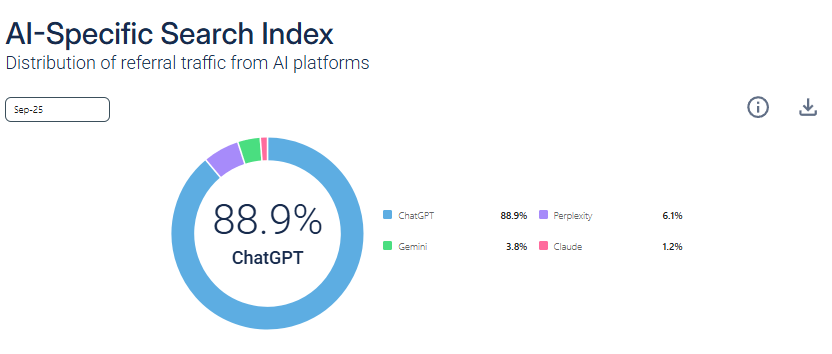
- ChatGPT dominates AI-driven referrals with 88.9% share,
- Perplexity holds 6.1%,
- Gemini (Google’s own AI assistant) captures 3.8%,
- and Claude, Anthropic’s LLM, trails at just 1.2%.
In perspective, Claude’s referrals are 60 times smaller than ChatGPT’s, and Elon Musk’s Grok (not even listed in BrightEdge’s top four) lags 200 times smaller.
The takeaway? The AI search market is fragmented, experimental, and far from maturity.
What’s Fueling Google’s Comeback?
BrightEdge’s CEO, Jim Yu, summed it up best:
“In the last year, we have seen Google do a solid job of staving off the AI bleed… For the first time, Google is gaining market share, demonstrating their strategy for durable success.”
So, what’s behind that durability? Three key factors stand out:
AI Integration Without Disruption:
Google’s rollout of AI Mode and SGE wasn’t about replacing traditional search, it was about enhancing it. Users searching for complex answers or product recommendations now experience richer, AI-driven summaries without leaving Google.
Entrenched Ecosystem:
Unlike startups, Google’s search data, advertising backbone and browser integration give it a near-unbreakable moat. Even as users explore AI tools, most of those explorations still start on Google.
Brand Trust and Familiarity:
Search is habit-forming. For billions, “Googling” is synonymous with finding answers. Even AI can’t rewrite a 20-year behavior overnight.
Is the AI Search Boom Slowing Down Already?
It depends on how you look at it. Yes, the AI discovery market is growing but not at the rate early analysts predicted. In 2024, AI-driven assistants like ChatGPT’s Browse mode and Perplexity Pro were expected to take measurable chunks of traffic away from Google and Bing.
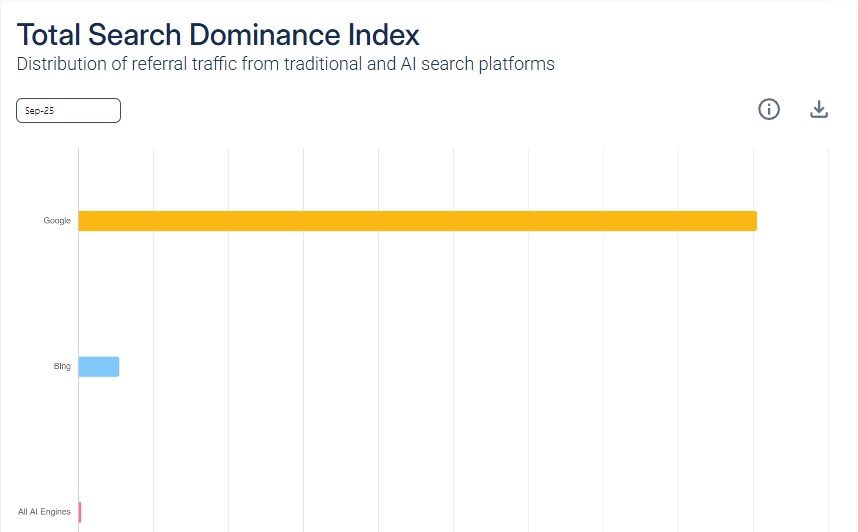
Instead, the reality looks different. BrightEdge’s new data shows AI search referrals not only stagnating but slightly declining.
Why?
Because discovery is not the same as habitual search.
Users may experiment with AI for summaries or brainstorming, but when it comes to transactions, products, and information trust, they go back to the familiar.
Google’s advantage isn’t just technology; it’s credibility, consistency, and commerce integration.
That is something even the most advanced LLMs have not cracked yet.
What Does This Mean for Digital Marketers?
For marketers, BrightEdge’s findings are both a relief and a warning.
Relief, because Google’s rebound confirms that SEO is far from dead.
And warning because the game is changing, and the lines between traditional SEO and AI optimization are blurring fast.
As BrightEdge put it:
“Today’s marketers must master two fronts: traditional search and AI-driven discovery. But as Google stabilizes, the winning strategy remains clear — optimize once, win everywhere.”
This means that optimizing for user intent, clarity, and contextual authority continues to pay off, whether your audience finds you via Google Search or through an AI summary on ChatGPT or Gemini.
The companies that succeed will be those who:
- Monitor cross-platform visibility (Google, ChatGPT, Perplexity)
- Adapt their content for AI readability and structured data
- Use tools like BrightEdge’s AI Catalyst to track brand mentions and citations in AI responses
Because in this new landscape, ranking is not enough, being cited by AI is the next frontier.
What’s at Stake in the Search Market Battle?
Even with its 90%+ dominance, Google faces a fragmented future. The remaining 10% of global search represents an enormous commercial opportunity for AI-first engines.
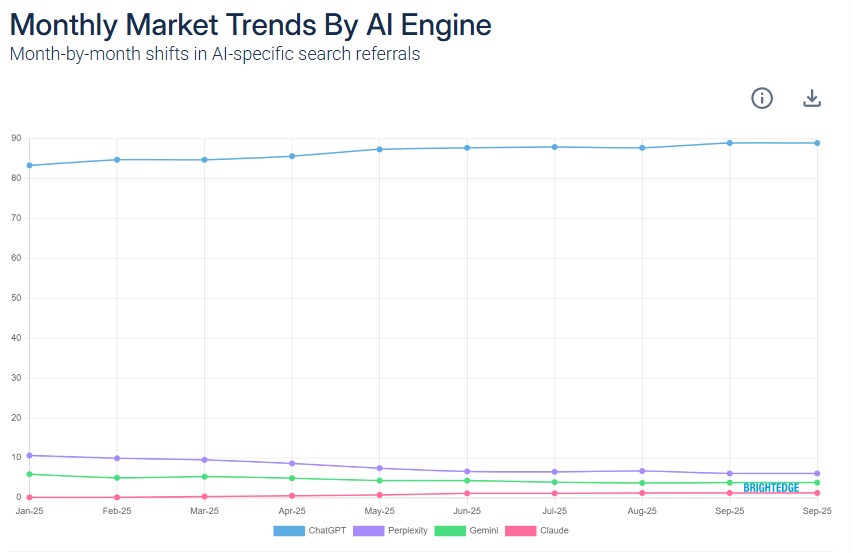
But as BrightEdge’s latest numbers show, breaking that barrier is proving harder than expected.
ChatGPT’s heavy traffic does not necessarily convert into referrals or revenue. Its closed-loop environment, where answers are generated, not linked, limits the flow of traffic to external websites.
That’s a fundamental difference from Google’s search-driven ecosystem, where clicks drive the internet’s economy.
As a result, marketers still view Google as the more measurable and monetizable channel.
In contrast, the emerging AI engines are still finding their footing and experimenting with monetization models, ads, and partnerships.
Could This Be Google’s Turning Point in the AI Era?
It’s too early to call it a comeback story, but this small rebound could be the start of something bigger.
For Google, the message is clear: AI does not have to destroy search, it can redefine it.
For the rest of the industry, the lesson is even clearer: innovation must meet adoption. Hype alone does not move markets, users do.
As BrightEdge’s Jim Yu noted, the key to long-term success isn’t just adding AI, it is aligning it with human intent.
“Google’s strategy for durable success isn’t just about increasing searches; it’s about evolving how discovery works and seamlessly blending AI into everyday search experiences.”
Key Takeaways / TL;DR
- Google’s market share rebounded from 90.54% to 90.71%, its first increase in nine months.
- The AI search ecosystem (ChatGPT, Perplexity, Gemini, Claude) accounts for less than 1% of total search referrals and collectively lost market share for the first time.
- ChatGPT dominates AI search referrals (88.9%), but engagement is not translating into referral traffic.
- Google’s AI Mode and SGE rollout helped recapture users through long-tail, conversational searches.
- The search landscape is stabilizing, signaling that AI is an enhancement, not a replacement, for organic search.

Dileep Thekkethil
AuthorDileep Thekkethil is the Director of Marketing at Stan Ventures, where he applies over 15 years of SEO and digital marketing expertise to drive growth and authority. A former journalist with six years of experience, he combines strategic storytelling with technical know-how to help brands navigate the shift toward AI-driven search and generative engines. Dileep is a strong advocate for Google’s EEAT standards, regularly sharing real-world use cases and scenarios to demystify complex marketing trends. He is an avid gardener of tropical fruits, a motor enthusiast, and a dedicated caretaker of his pair of cockatiels.
