Scammers are exploiting Google reviews to pressure small businesses into paying to remove fake one-star ratings. In response, Google has launched a reporting form specifically for extortion-related reviews, and early signs show that it’s working. Businesses are already seeing fraudulent reviews disappear after using the new tool.

Across cities and industries, local businesses are facing a troubling new form of digital blackmail. Fake reviews suddenly appear on a company’s Google Business Profile. Shortly after, an email or message arrives. The sender claims they can remove those reviews for a fee.
These scams have surged in recent months, preying on the fear that one-star ratings can cripple a business’s reputation overnight.
A single bad review can deter potential customers, lower search visibility, and undermine years of trust. Scammers know that panic often leads to payment.
How the Extortion Plays Out
The pattern is disturbingly consistent.
Businesses notice a cluster of negative reviews that don’t match any real customer experience. Within hours or days, someone reaches out offering a quick fix, for a price. They may promise to delete the reviews, prevent new ones, or “clean up” the business’s reputation.
Many of these messages come from disposable accounts, making it difficult to trace the sender.
The language is often polite at first, then turns threatening.
Business owners who ignore the message may see more fake reviews appear. Those who respond can find themselves in an escalating exchange that feels impossible to control.
Google’s New Reporting Tool Shows Results
Google recently rolled out a specific form that lets business owners report reviews tied to extortion attempts.
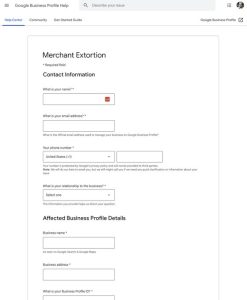
Unlike general spam reports, this form asks for proof that the reviewer or contact demanded money in exchange for removing or altering a review.
Some users in local SEO forums have shared positive experiences.
One business owner described how Google removed several one-star reviews after they submitted screenshots of an email thread showing the payment request. They also shared a valuable piece of advice: avoid replying publicly to fake reviews until the case is under review. Public replies alert the scammer that their plan is working, often triggering further harassment.
Why Businesses Are So Vulnerable
Small and local businesses rely heavily on reviews to build credibility.
A single star rating can influence how often their listing appears in search results. Attackers take advantage of that dependence, knowing a flood of fake reviews can hurt both ranking and revenue.
Many owners lack the time or knowledge to dispute reviews effectively. Panic often leads them to pay, just to make the problem disappear.
Unfortunately, that only rewards the scammer and invites more attacks. Once a business pays once, it often gets targeted again.
Protecting Your Business
Every business owner needs a plan for handling review manipulation. These steps can help you respond effectively without feeding the scam:
- Document everything. Take screenshots of fake reviews, messages, and payment requests. Keep records even if they seem minor, as small details can help prove a pattern later.
- Report the incident. Use Google’s “Report a Review for Extortion” form and attach any evidence that shows someone offered to remove or alter reviews for money.
- File a secondary report. Submit a standard review removal request as well. This helps in cases where the reviews don’t meet extortion criteria but still break Google’s policies.
- Contact local authorities. Report the scam if it involves threats, persistent harassment, or significant payment demands. Even smaller cases matter; official complaints create a record that can protect others.
- Communicate with calm transparency. If your page is hit with sudden bad reviews, post a short message on your website or social channels. Let customers know you’re addressing false reviews and working with Google to resolve the issue.
Lessons Learned From Early Cases
The first few reports show that Google’s tool can work quickly when businesses provide clear evidence. In several instances, reviews were removed within days.
However, the process still depends on proving the connection between the fake review and the payment request, which can be tricky if the scammer hides behind fake accounts.
Users also noted that interacting with the scammer long enough to collect evidence is risky but sometimes necessary. The key is to do so safely. Never send money, share sensitive information, or engage emotionally. Keep all messages factual and brief, solely for documentation.
Staying Ahead of Review Scams
Reputation monitoring is no longer optional. Set up alerts for new reviews on your Google Business Profile so suspicious activity is spotted early. Encourage real customers to leave feedback regularly, which helps drown out fake reviews and strengthens credibility.
Training employees is also important. Staff should recognize signs of fake review threats and know who to alert internally. Quick, coordinated responses make a difference in stopping these scams before they escalate.
Key Takeaways
- Scammers are posting fake negative reviews, then demanding money to remove them.
- Google has created a special form to report review extortion, and early users report success.
- Never pay an extortionist or reply publicly to fake reviews—it can worsen the attack.
- Collect proof such as screenshots or emails before filing a report.
- Regular monitoring and honest customer reviews are the best long-term defense.

Zulekha
AuthorZulekha is an emerging leader in the content marketing industry from India. She began her career in 2019 as a freelancer and, with over five years of experience, has made a significant impact in content writing. Recognized for her innovative approaches, deep knowledge of SEO, and exceptional storytelling skills, she continues to set new standards in the field. Her keen interest in news and current events, which started during an internship with The New Indian Express, further enriches her content. As an author and continuous learner, she has transformed numerous websites and digital marketing companies with customized content writing and marketing strategies.
