Google is warning developers not to overthink AI crawling. According to the company’s search team, serving special Markdown pages to AI bots strips away structure, breaks context, and solves a problem that does not appear to exist.
Google Search Advocate John Mueller has publicly criticized the idea of serving Markdown-only versions of web pages to AI crawlers, calling the approach misguided and unsupported by evidence.
His comments come as some developers experiment with ways to reduce the amount of data AI systems need to process when scanning websites.
The discussion surfaced after a developer shared a test on Reddit’s r/TechSEO forum. Using Next.js middleware, the developer described detecting AI user agents such as GPTBot and ClaudeBot and serving them raw Markdown files instead of full HTML and React pages.
Discussion: What is the actual risk/reward impact of serving raw Markdown to LLM bots?
byu/Ok_Veterinarian446 inTechSEO
Early benchmarks, according to the developer, showed a dramatic reduction in token usage per page.
The hope was that lighter files would allow AI systems to ingest more content, especially for retrieval-augmented generation workflows.
Mueller was not persuaded.
Why Google Thinks the Idea Falls Apart
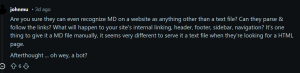
In his Reddit replies, Mueller questioned the basic assumptions behind the experiment. He asked whether AI crawlers would even recognize Markdown as anything more than plain text. He also raised concerns about whether links would be followed correctly and what would happen to internal navigation, headers, footers, and other structural elements that help both users and machines understand a site.
From Google’s perspective, those elements matter. Removing them may simplify a page, but it also removes context.
Mueller pointed out that handing an AI a Markdown file directly is very different from serving that file in place of a normal HTML page that a crawler expects to see.
His tone sharpened further on Bluesky.
Stop turning your website into markdown.
Meaning lives in structure, hierarchy and context. Flatten it and you don’t make it machine-friendly, you make it meaningless.
Yes, AI might fetch your .md file. That’s convenience, not trust, and it won’t scale.
www.jonoalderson.com/conjecture/m…
— Jono Alderson (@jono.id) February 3, 2026 at 8:19 PM
Responding to SEO consultant Jono Alderson, who argued that flattening pages into Markdown removes meaning and hierarchy, Mueller dismissed the entire idea outright. He mocked the logic by suggesting that if simplification were the goal, turning websites into images would follow the same reasoning.

No Proof That Markdown Helps AI Visibility
Other voices in the Reddit discussion weren’t convinced either. Some pushed back on the idea that serving alternate formats would help at all, suggesting it could just as easily confuse crawlers or reduce how much of a site gets picked up. Others noted there is no public evidence that AI systems reward content simply because it is easier or cheaper to parse.
The developer behind the experiment argued that LLMs should be comfortable with Markdown because so much of their training data comes from code repositories. That may sound reasonable on the surface. What’s missing is proof that AI crawlers treat Markdown pages on the open web as something special or even desirable.
That skepticism lines up with how John Mueller has handled similar ideas in the past. He has repeatedly warned against creating separate versions of pages just for bots, whether in Markdown or JSON. His advice has barely changed over time: publish clean HTML and use structured data only where platforms have clearly said they support it.
Data backs up that position.
A large-scale analysis by SE Ranking found no connection between the use of llms.txt files and how often domains are cited in AI-generated answers. Mueller has previously compared llms.txt to the old keywords meta tag, a format that existed long before platforms had any reason to use it.
What Google Recommends Instead
Right now, no major AI company is asking publishers to provide Markdown versions of their pages. Without that kind of signal, Google’s position is simple: there’s no reason to rebuild the web for a hypothetical use case.
The guidance hasn’t changed much. Publish clear HTML. Make sure key content loads without getting trapped behind layers of JavaScript. Use structured data where platforms have explicitly said it’s supported.
According to Google, creating separate, bot-only versions of pages may feel like getting ahead of the curve. More often, it just adds technical debt, with little evidence it actually helps.
What Site Owners Can Do Today
Here are steps site owners can take today to keep their pages readable for humans, search engines, and AI crawlers without adding unnecessary complexity.
- Serve the same high-quality HTML to users and bots.
- Preserve internal linking, navigation, and page hierarchy.
- Use structured data that search and AI platforms explicitly support.
- Avoid building separate content formats without published specifications.
- Test crawlability using real-world tools rather than assumptions.
Key Takeaways
- Google does not support serving Markdown pages to AI crawlers.
- Token reduction alone does not equal better AI visibility.
- Page structure and links remain essential for understanding content.
- Bot-only formats lack documented platform backing.
- Clean HTML remains the safest long-term approach.

Zulekha
AuthorZulekha is an emerging leader in the content marketing industry from India. She began her career in 2019 as a freelancer and, with over five years of experience, has made a significant impact in content writing. Recognized for her innovative approaches, deep knowledge of SEO, and exceptional storytelling skills, she continues to set new standards in the field. Her keen interest in news and current events, which started during an internship with The New Indian Express, further enriches her content. As an author and continuous learner, she has transformed numerous websites and digital marketing companies with customized content writing and marketing strategies.
