Key Takeaways
- Adoption is high and rising. HubSpot’s 2024 Agency Benchmark Report found that 61% of agencies already outsource at least one core SEO service, with 29% planning to increase the amount they outsource in the coming year.
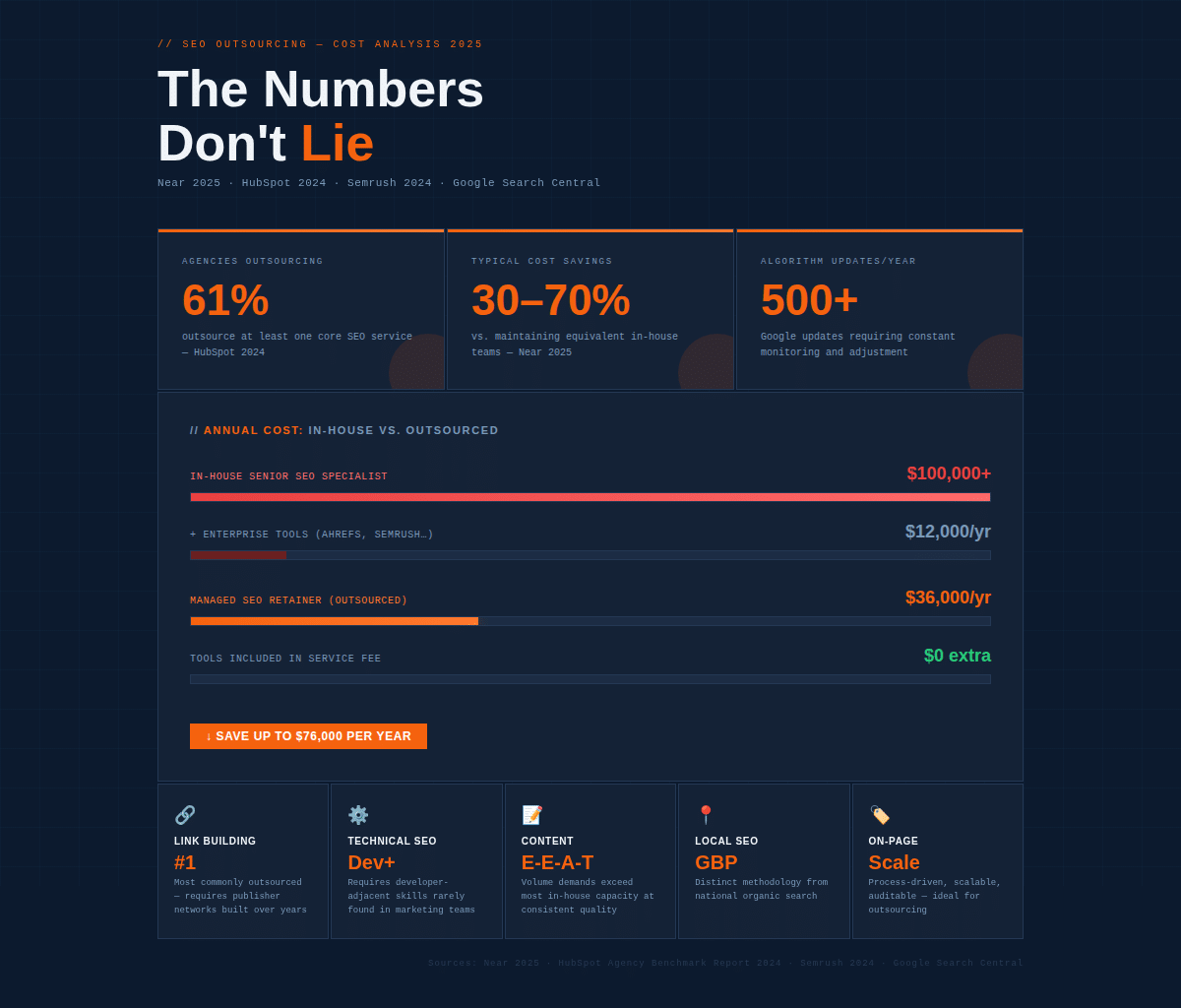
- Cost savings are significant. Companies that outsource SEO save between 30–70% compared to maintaining equivalent in-house teams, according to Near’s 2025 SEO outsourcing analysis. A single US-based technical SEO specialist costs $80,000–$100,000 annually before tools and overhead.
- Expertise and scalability are the primary drivers. A 2024 Semrush survey found that 62% of businesses outsourcing SEO cited access to expertise as the primary reason, and 53% prioritised scalability — the ability to increase delivery capacity without hiring.
- Partner selection is the critical variable. The quality of outsourced SEO outcomes is almost entirely determined by how thoroughly the partner is vetted before engagement begins, and how clearly the scope of work and quality standards are defined upfront.
- White-label outsourcing protects agency relationships. Reputable white-label SEO services operate invisibly — all reporting and deliverables carry the agency’s brand, with no client-side visibility into the fulfilment partner.
Outsourcing SEO gives businesses and agencies access to specialist expertise, enterprise-grade tools, and scalable delivery capacity — without the overhead of building an in-house team.
This guide covers what search engine optimization outsourcing involves, when it makes strategic sense, how to select the right partner, and how to manage outsourced SEO projects to consistently deliver measurable results.
- 61% Of agencies outsource at least one core SEO service — HubSpot 2024
- 30–70% Cost savings vs. equivalent in-house teams — Near 2025
- 500–600 Google algorithm updates per year — Google Search Central
- $7.5B+ Global SEO market projected for 2025 — industry analysis
Managing SEO in-house is operationally expensive, technically demanding, and increasingly difficult to scale. Google implements 500 to 600 algorithm updates per year, each requiring monitoring, analysis, and strategy adjustment.
Staying current with these changes while simultaneously delivering on-page optimisation, content production, link building, and technical work across multiple clients or business units is a substantial operational commitment, something that most businesses cannot sustain without dedicated headcount and significant tooling investment.
Search engine optimization outsourcing resolves this challenge by delegating execution to specialist partners while retaining strategic control internally. When the right framework is in place, outsourced SEO is not a compromise — it is a structural advantage that unlocks capacity, expertise, and delivery speed that in-house teams rarely achieve at equivalent cost.
What Is SEO Outsourcing?
SEO outsourcing is the practice of hiring a third-party agency, consultant, or specialist team to manage some or all of a business’s search engine optimization work. Rather than handling keyword research, content creation, link building, and technical optimisation entirely in-house, the business delegates these activities to external professionals with the relevant expertise and tooling.
The scope of what gets outsourced varies considerably. Some businesses outsource a single service — off-page link building, for example — while continuing to manage on-page and technical SEO internally.
Others outsource the full SEO function, retaining only strategic oversight and client relationship management in-house. For agencies, white label SEO outsourcing — where an external partner fulfills client deliverables under the agency’s brand — is a widely adopted model for scaling service delivery without proportional headcount growth.
The distinction between outsourcing and simply buying a service matters. Effective SEO outsourcing is a managed, ongoing relationship with clear KPIs, defined quality standards, and regular communication, which means not a series of one-off transactions. The goal is to extend your operational capacity with a partner who understands your business context and adapts their work to it.
Why Businesses and Agencies Choose to Outsource SEO
Access to specialist expertise across every SEO discipline
SEO spans multiple distinct disciplines — technical architecture, on-page content strategy, off-page authority building, local optimisation, and now AI search visibility — each requiring deep, current knowledge that is difficult to maintain across a small in-house team.
Google’s algorithm changes constantly, and the specialists at outsourcing agencies track these changes as a core part of their work — not as an additional responsibility alongside client delivery. When you outsource SEO services, you access that accumulated expertise without the recruitment, training, and retention costs required to build it internally.
Significant and measurable cost reduction
Hiring a full-time, in-house SEO team capable of delivering across all disciplines requires substantial investment. A single senior SEO specialist in the US costs $80,000–$100,000 annually in salary alone, before accounting for employer taxes, benefits, and management overhead.
Enterprise-level SEO tools — Ahrefs, Semrush, Screaming Frog, and others — add a further $500–$1,000+ per month. SEO outsourcing agencies carry these costs across their entire client base, passing the benefit of scale to individual clients.
Near’s 2025 analysis of SEO outsourcing costs found that companies typically save 30–70% compared to maintaining equivalent in-house capability — a figure that compounds significantly for agencies managing multiple client accounts simultaneously.
Scalability without the operational drag of hiring
In-house team capacity is tied to headcount. Scaling up requires a hiring cycle that typically takes 30–60 days, followed by an onboarding period before the new hire is fully productive. Scaling down requires redundancy processes that are expensive, time-consuming, and damaging to team morale.
Outsourced SEO services operate on flexible engagement models — retainer or project-based — that allow delivery capacity to increase or decrease in response to client demand, seasonal priorities, or budget changes, without any of the structural overhead.
This elasticity is particularly valuable for agencies whose client roster fluctuates, and for businesses in growth phases where SEO investment needs to scale ahead of revenue.
Access to advanced tools without subscription costs
Data-driven SEO requires access to tools that most in-house teams cannot individually justify purchasing at the enterprise tier.
Reputable SEO outsourcing companies maintain enterprise-level subscriptions to Ahrefs, Semrush, Majestic, Google Search Console APIs, and specialist technical audit tools — and the knowledge to extract actionable insight from them.
When you outsource search engine optimization, you receive the benefit of this tooling without the direct subscription cost, typically included within the service fee.
“The best argument for SEO outsourcing is not cost reduction — it is expertise density. A specialist agency does in hours what an overextended in-house team does in days.”
What SEO Services Are Typically Outsourced?
The following are the most commonly outsourced SEO services, each suited to different stages of a campaign and different in-house capability gaps.
On-Page SEO
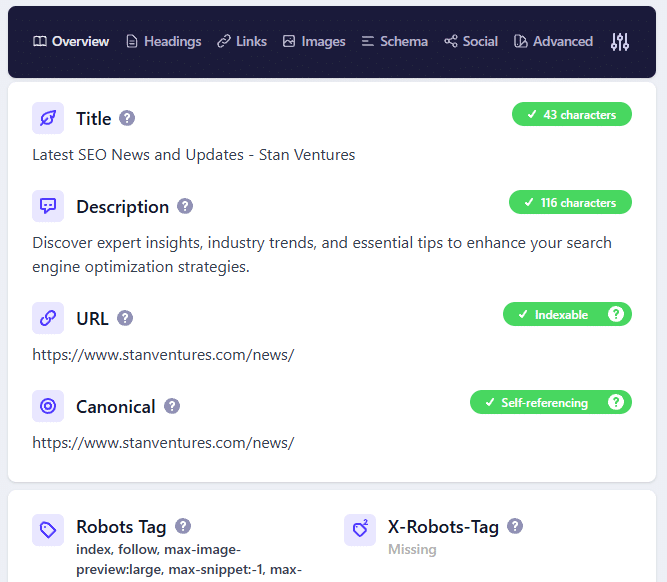
On-page SEO covers the optimisation of individual pages to improve their relevance and ranking potential. This includes title tags, meta descriptions, heading structures, internal linking, content optimisation for target keywords, and schema markup implementation.
On-page work is well-suited to outsourcing because it is process-driven, highly scalable, and produces auditable deliverables. It is typically one of the first SEO functions agencies outsource when their client roster grows beyond their internal capacity to manage individually.
Off-Page SEO (Link Building)
Off-page SEO — primarily link building — is the most commonly outsourced SEO service because it requires the one input most in-house teams cannot economically replicate: an established publisher network. Building authority through high-quality backlinks from topically relevant, editorially governed sites requires ongoing outreach relationships that take years to develop at scale.
Reputable outsource SEO link building services maintain networks of thousands of vetted publishers, enabling placement volume and quality that would be operationally impossible for a single in-house team to achieve.
Choosing the wrong provider here carries the greatest penalty risk — PBNs and low-quality link schemes remain the most common cause of manual actions against outsourced SEO clients.
Technical SEO
Technical SEO addresses the infrastructure that determines whether search engines can efficiently crawl, index, and understand a site. Core deliverables include site speed optimisation, mobile-friendliness, structured data implementation, crawl budget management, and Core Web Vitals improvement.
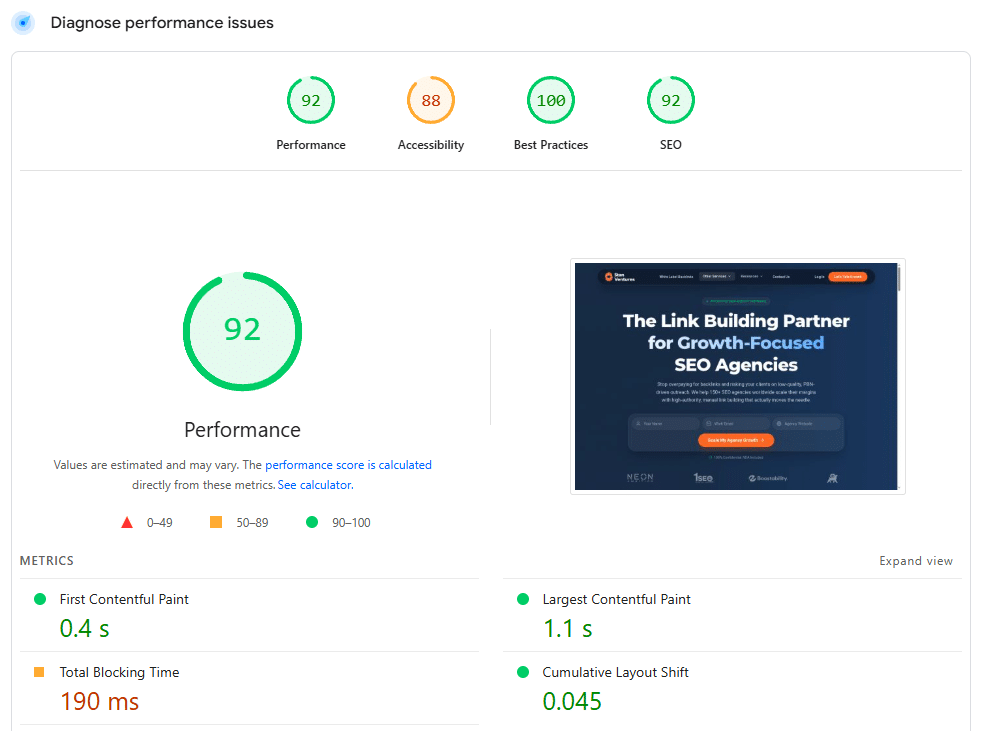
Technical SEO requires developer-adjacent skills that many marketing teams do not have in-house. Outsourcing this function to specialists who work across a wide range of site architectures gives access to a depth of pattern recognition — common error types, efficient fix sequences, CMS-specific constraints — that generalist in-house hires rarely accumulate.
Local SEO
Businesses targeting location-based searches can also outsource local SEO — including Google Business Profile management, local citation building, review strategy, and localised content creation.
Local SEO has its own distinct methodology that differs meaningfully from national organic search, and specialist outsourcing partners bring established workflows for the citation-building and GBP optimisation tasks that drive local pack visibility.
For agencies managing multiple location-based clients simultaneously, outsourcing local SEO fulfilment is one of the most efficient ways to maintain quality at scale without a proportional increase in internal headcount.
Content Creation and Optimisation
SEO-optimised content production — blog posts, landing pages, long-form guides — is frequently outsourced to specialist writers with niche expertise and SEO knowledge.
The volume demands of an active content programme across multiple clients or business units typically exceed what an in-house team can sustain at consistent quality.
Outsourced content that performs well in search must demonstrate genuine expertise, address specific user intent, and meet Google’s E-E-A-T standards.
Specialist blog writing services with niche-specific writers and editorial quality control processes consistently outperform generalist content mills on these criteria.
Fully Managed SEO
For businesses without an internal SEO function, or agencies that want to offer SEO as a white-label service without managing fulfillment, fully managed SEO outsourcing delegates the complete programme — strategy, technical work, content, and link building — to a single partner who operates as an extension of the internal team.
This model requires the highest level of partner trust and the most clearly defined scope of work and KPI framework, since the client retains only strategic oversight and reporting review rather than day-to-day execution oversight.
Outsourcing vs. In-House SEO: A Practical Comparison
The decision to outsource SEO versus building or maintaining an in-house team is not binary — many organisations use a hybrid model, keeping strategy and client relationships in-house while outsourcing fulfillment.
The comparison below covers the key operational and financial dimensions that inform that decision.
| Dimension | In-House SEO Team | Outsourced SEO |
| Cost structure | Fixed — salaries, benefits, tools, training regardless of output volume | Variable — pay for deliverables only; scales with demand |
| Expertise breadth | Limited to the skills of 1–3 hires across all SEO disciplines | Full team of specialists: technical, content, link building, local |
| Tool access | Direct subscription cost: $500–$1,000+/month for enterprise tools | Included in service cost; provider maintains subscriptions |
| Scalability | Slow — requires 30–60 day hiring cycles to expand capacity | Immediate — adjust scope within days, not weeks |
| Control | Full visibility into daily activity and task execution | Strategy-level control; partner manages execution |
| Algorithm response time | Dependent on individual team members’ monitoring habits | Agency tracks updates as core function; adjusts proactively |
| Publisher network access | Must be built from scratch — years of outreach investment | Immediate access to established publisher relationships |
| Onboarding time | 30–90 days before new hires reach full productivity | Days — structured onboarding with experienced teams |
The verdict from most practitioners is consistent with the data: in-house gives you granular daily control, while outsourcing gives you efficiency, expertise, breadth, and scalability.
The hybrid model — retaining strategic and client-facing work in-house, outsourcing high-volume or specialist execution — is the structure that most growing agencies ultimately converge on.
How to Choose the Right SEO Outsourcing Company
Partner selection is the single highest-leverage decision in SEO outsourcing. A provider who cuts corners on link quality, uses AI-generated content without disclosure, or fails to maintain communication will damage client relationships and domain authority — outcomes that are costly and slow to reverse.
The following framework covers the criteria that distinguish reliable SEO outsourcing services from those that underdeliver.
What to evaluate before engaging any outsourcing SEO company
- Proven track record with verifiable results: Ask for case studies with specific, measurable outcomes — organic traffic growth percentages, ranking improvements for target keywords, domain authority trajectory over a defined period. Vague claims of “increased visibility” are not sufficient evidence. Look for case studies in your specific niche or vertical, since SEO performance varies significantly by industry.
- Transparent methodology: A credible partner should be able to explain precisely how they will approach each service component — their link prospecting criteria, their content quality standards, their technical audit framework. Evasiveness about methodology is a reliable indicator of practices that would not withstand scrutiny.
- White-label reporting capability: For agencies, confirm that all deliverables — reports, dashboards, communications — can be presented under the agency’s brand with no indication of third-party involvement. Reputable providers sign NDAs as standard and have established white-label workflows.
- Explicit position on black-hat tactics: Ask directly whether the provider uses PBNs, link farms, or automated link schemes. A credible answer is an unambiguous no, with an explanation of the manual outreach process used instead. An evasive or qualified answer warrants further scrutiny before any commitment.
- Communication and project management standards: Understand the communication cadence upfront — frequency of reporting, format of deliverables, escalation process for issues. Dedicated account management, regular strategy calls, and transparent progress tracking are the standard at reputable outsourcing SEO companies and should not be treated as premium add-ons.
- Pricing clarity:Understand exactly what is included in the quoted price and what would incur additional charges. Revision costs, content fees, and replacement policies for lost links are common areas where hidden costs emerge. Request a full breakdown of the service scope before signing.
On evaluating SEO outsourcing companies at scale
For agencies evaluating multiple providers simultaneously, a structured RFP process pays dividends. Send identical briefs to each candidate, specifying the target niche, desired service scope, required reporting format, and quality standards.
The quality and specificity of responses — not just the pricing — is itself a strong signal of a provider’s capability and operational maturity.
Request a sample deliverable — an audit report, a sample link building report, or a content piece from a comparable client — before committing to any volume engagement. Providers who decline sample requests without explanation are likely managing expectations they cannot meet.
Managing Outsourced SEO Projects: Best Practices
The effectiveness of an SEO outsourcing engagement depends as much on how it is managed as on the quality of the provider.
Agencies and businesses that invest in clear onboarding, structured communication, and disciplined performance tracking consistently achieve better outcomes from the same providers than those who adopt a hands-off approach after contract signature.
Define measurable KPIs before work begins
Establish the specific metrics that will determine whether the engagement is successful — organic traffic growth to target pages, keyword ranking movement for defined commercial terms, domain authority trajectory, and conversion rate changes attributable to organic.
Tie these KPIs to realistic timelines: SEO results from outsourced services typically begin to materialise within three to six months, with the most significant growth occurring between months six and twelve for competitive terms.
Setting these expectations in writing before engagement begins prevents disagreement about performance later.
Document quality standards and brand voice upfront
For content and on-page SEO, a detailed brief covering tone, vocabulary, audience persona, internal linking preferences, and structural requirements dramatically improves first-draft quality and reduces revision cycles.
For link building, document acceptable site quality thresholds — minimum traffic volume, geography requirements, niche relevance criteria, and excluded site types — so that the partner’s outreach targets your standards rather than their defaults.
Treat the outsourcing relationship as a partnership, not a transaction
Share business context — upcoming product launches, seasonal priorities, brand positioning changes, competitor movements — with your SEO partner so they can align their work to your current goals rather than executing a static plan.
Scaling agency SEO delivery sustainably requires a partner who understands your client base and adapts to changes in it, not one who simply fulfills a fixed monthly task list.
Monitor performance independently, not just through provider reports
Use Google Search Console, Ahrefs, or Semrush to verify ranking movements and traffic changes independently of the data your provider supplies.
For link building specifically, audit delivered placements using a third-party backlink checker to confirm that links are live, do-follow, implemented cleanly without redirects, and placed on sites that match the agreed quality criteria.
Providers who deliver high-quality work welcome independent verification. Those who discourage it warrant scrutiny.
Common Challenges in SEO Outsourcing — and How to Prevent Them
Quality inconsistency across deliverables
The most common complaint about outsourced SEO is inconsistent quality — strong outputs followed by weaker ones, depending on which team member is assigned or whether volume pressure has led to shortcuts.
Preventing this requires documented quality standards, a formal review process for all deliverables before client presentation, and a structured feedback loop with the provider so that corrections are applied systematically rather than individually. Providers with documented Standard Operating Procedures (SOPs) for each service type tend to deliver more consistent quality than those relying on individual writer or specialist judgment.
Communication gaps and time zone friction
Working across time zones is standard in SEO outsourcing — many of the most capable and cost-effective providers operate from different regions. The risk is not the time difference itself but the absence of a communication structure that accounts for it.
Establish a primary point of contact, a defined response time SLA for queries, and a scheduled weekly or fortnightly update cadence that gives both parties a predictable rhythm regardless of geography.
Overexposure to a single provider
Concentrating all SEO fulfilment with one external partner introduces concentration risk: if that partner experiences capacity issues, quality deterioration, or pricing changes, the agency has limited leverage and limited time to find alternatives.
Maintaining relationships with two or three vetted providers — even if only one is active at any given time — preserves operational resilience without the overhead of managing multiple active engagements simultaneously.
Frequently Asked Questions
How much does it cost to outsource SEO?
Pricing for outsourced SEO services varies by scope, geography, and service model. For small to mid-sized businesses using a managed SEO retainer, typical monthly investment ranges from $1,000 to $5,000. Individual service components — link building, technical audits, content creation — are priced separately when purchased on a project basis.
This compares favourably to the $80,000–$100,000 annual cost of a single senior in-house SEO specialist in the US, before tools and overhead. The relevant comparison is not the monthly fee in isolation, but the cost per unit of quality output achieved relative to the in-house alternative.
What is the difference between SEO outsourcing and white-label SEO?
SEO outsourcing is the broad practice of using external providers for SEO work. White-label SEO is a specific model within that, where the provider delivers work under the agency’s brand — reports, communications, and deliverables carry the agency’s logo with no reference to the fulfilment partner. White-label outsourcing is particularly common among digital agencies that want to offer SEO services to clients without building the delivery capability in-house. The provider operates invisibly; the agency takes full credit for the results.
Is it safe to outsource link building?
Yes, when the outsourcing partner uses manual outreach to independently operated, topically relevant websites and applies documented site quality criteria to every placement. The risk in outsourced link building comes from providers using private blog networks (PBNs), automated link schemes, or low-traffic directories — practices that Google’s spam systems are actively designed to identify and penalise. Before committing to any backlink building service, verify the partner’s methodology explicitly, request sample reports showing past placements, and confirm their policy on PBNs in writing. Ethical, manual-outreach-based link building is both safe and effective when delivered by a credible provider.
How long does it take to see results from outsourced SEO?
SEO delivers results over months, not days. For most businesses, measurable ranking movement from a well-executed outsourced SEO programme begins within three to six months, with significant organic traffic growth typically occurring between months six and twelve. The exact timeline depends on the competitiveness of the target keywords, the domain’s starting authority, the consistency of monthly delivery, and whether technical barriers to crawling and indexing have been resolved. Businesses and agencies that maintain realistic timeline expectations and measure progress against baseline data at 30-day intervals are better positioned to assess and optimise their outsourcing investment over time.
What is search engine optimization outsourcing best suited to?
Search engine optimization outsourcing delivers the most value in three scenarios. First, when an in-house team lacks specific expertise — particularly in off-page link building and technical SEO — that would take significant time or cost to develop internally. Second, when delivery volume consistently exceeds internal capacity, leading to quality trade-offs or missed deadlines. Third, when the business is in a growth phase that requires rapid scaling of SEO output ahead of proportional headcount growth. For agencies specifically, outsourcing the execution layer while retaining client strategy and relationship management in-house is the model that most effectively balances quality, cost, and operational control.
Can outsourced SEO services be combined with an in-house team?
A hybrid model is both operationally sound and widely adopted. In-house teams typically retain ownership of client strategy, account management, competitive analysis, and brand voice — areas where direct knowledge of the business and its relationships is the primary value driver. Outsourced SEO services handle the execution-intensive components where specialist expertise, publisher network access, and volume capacity are the critical inputs. This combination allows businesses and agencies to deliver a complete, high-quality SEO programme without carrying the full overhead of building every capability internally. The key to making a hybrid model work is clear delineation of responsibilities and a consistent brief that keeps both internal and external teams aligned on priorities and standards.

Dileep Thekkethil
AuthorDileep Thekkethil is the Director of Marketing at Stan Ventures, where he applies over 15 years of SEO and digital marketing expertise to drive growth and authority. A former journalist with six years of experience, he combines strategic storytelling with technical know-how to help brands navigate the shift toward AI-driven search and generative engines. Dileep is a strong advocate for Google’s EEAT standards, regularly sharing real-world use cases and scenarios to demystify complex marketing trends. He is an avid gardener of tropical fruits, a motor enthusiast, and a dedicated caretaker of his pair of cockatiels.