
In a recent response on Reddit, Google’s John Mueller explained how sitemaps in Google Search Console (GSC) are handled, emphasizing that while submitting a sitemap is useful, it does not guarantee immediate crawling of URLs.
Nor is there a fixed timeline for when Googlebot will revisit those links.
This revelation sparks the question: if uploading sitemaps is not enough to trigger instant crawling, what control do website owners actually have?
The Question That Started It All
The discussion began when a member of the r/TechSEO community on Reddit asked about sitemap submissions in Google Search Console. \
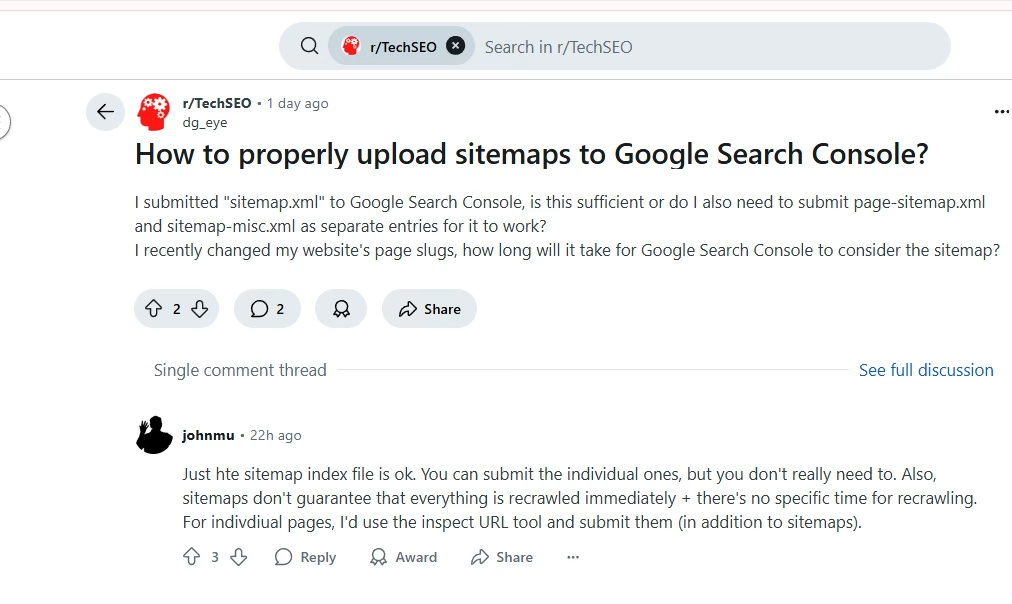
The user had recently changed their website’s page slugs (URL file names) and wanted clarity on the best practice for resubmission.
Their question was simple yet relatable to countless SEOs:
“I submitted sitemap.xml to Google Search Console. Is this sufficient or do I also need to submit page-sitemap.xml and sitemap-misc.xml as separate entries for it to work? I recently changed my website’s page slugs, how long will it take for Google Search Console to consider the sitemap?”
In other words, should you rely solely on the sitemap index file (which points to all other granular sitemaps) or upload each smaller sitemap individually to ensure URLs are crawled more quickly?
Mueller’s Response – A Mix of Clarity and Frustration
John Mueller responded with his trademark candor. He reassured the user that submitting the sitemap index file (sitemap.xml) was enough. Googlebot would naturally discover the nested sitemaps from there, which make individual submissions unnecessary.
But then came the statement that grabbed attention:
“You can submit the individual ones, but you don’t really need to. Also, sitemaps don’t guarantee that everything is recrawled immediately + there’s no specific time for recrawling. For individual pages, I’d use the Inspect URL tool and submit them (in addition to sitemaps).”
In other words, submitting a sitemap is not a fast-track ticket to instant crawling. Googlebot decides when and what to crawl, based on its own signals and algorithms.
And that raises a natural frustration for site owners: If even a sitemap can’t push Google to reindex updated URLs quickly, what can?
Why Doesn’t Google Crawl Immediately?
It is easy to wonder why Google does not just crawl sitemap URLs right after submission. After all, that would save SEOs countless headaches. The reason, however, lies in how Google manages resources and prioritizes the web.
Crawling billions of pages daily is a massive computational task. Googlebot allocates its crawl budget based on signals like site authority, page importance, frequency of updates and server health.
For example:
- A breaking news article on CNN will be crawled and indexed within minutes.
- A small blog that just updated 20 product URLs may take days—or weeks—to reflect those changes in search.
Sitemaps are hints, not directives. They tell Google what’s available, but they don’t force action.
The Value of Uploading All Sitemaps
So, does Mueller’s advice mean SEOs should stop uploading all individual sitemaps? Not necessarily.
From Google’s side, the index sitemap is sufficient. But from an SEO’s perspective, submitting granular sitemaps can feel like an extra safeguard. It provides more visibility in GSC reports and allows you to see indexing errors at a more detailed level.
For instance, if you maintain separate sitemaps for blogs, products and media, uploading them individually means you can diagnose indexing problems faster.
Maybe your product sitemap shows 60% of URLs indexed while your blog sitemap shows 95%. That level of detail can guide optimization strategies.
So, while Mueller is right that Googlebot doesn’t “need” them, many practitioners still find value in submitting multiple files.
The Role of the URL Inspection Tool
Mueller also suggested using the URL Inspection tool for critical pages. This tool allows site owners to request crawling of a specific URL and see the status of indexing.
The catch? It is manual and one URL at a time. That means it works well for a handful of priority pages, like a newly launched landing page or a rebranded homepage but is impractical for bulk updates.
For example, if an e-commerce site updates 5,000 product URLs, manually submitting each through the inspection tool is impossible. Here, sitemaps remain the practical way to signal changes at scale, even if crawling isn’t immediate.
How Long Does It Really Take for Google to Crawl Updates?
That’s the million-dollar question and frustratingly, there is no universal answer.
Some anecdotal data from the SEO community suggests that:
- High-authority sites may see changes indexed in a matter of hours.
- Medium-tier publishers often wait a few days.
- Small sites or brand-new domains may wait weeks before seeing sitemap updates reflected.
Case studies also show variance based on content type. News articles, product inventory updates and time-sensitive pages are often picked up more quickly, while evergreen content like blog posts can lag.
This unpredictability is precisely why Mueller avoided giving a timeline because there is not one.
Why This Matters More in 2025
The debate around sitemaps feels especially relevant now. With AI-driven search summaries and zero-click answers becoming more common, speed of indexing is more critical than ever.
If your fresh content is not crawled promptly, it risks being absent from Google’s AI-driven features altogether.
For businesses, this can mean lost visibility in a landscape where competition for attention is already fierce. For example, a local event organizer updating ticketing information needs that change reflected quickly in Google. A two-week lag could mean thousands of missed clicks.
This is why SEOs are increasingly frustrated by Google’s vague approach to crawling timelines.
Practical Takeaways for Site Owners
So, what should site owners actually do? Let’s see.
First, always submit your sitemap index file and that’s the minimum requirement. For added peace of mind and diagnostic insight, consider also submitting granular sitemaps (like page-sitemap.xml or product-sitemap.xml). While not strictly necessary, it gives you more visibility.
Second, for urgent changes, use the URL Inspection tool to request crawling of critical pages. It is slow for bulk use but powerful for high-value URLs.
Finally, remember that sitemaps are signals, not guarantees. Crawling speed will depend on your site’s authority, update frequency and crawl budget. The best long-term strategy is to focus on building strong content and technical foundations so that Google naturally prioritizes your site.
So, what do we make of John Mueller’s comments? In many ways, they are less a revelation and more a reminder. Google has always maintained that sitemaps help discovery but don’t control crawling timelines.
For SEOs, the frustration lies in the lack of certainty. But maybe that is the point: SEO has never been about quick fixes or instant indexing. It’s about consistent quality, structure and signals that make Googlebot want to prioritize your site.

Dileep Thekkethil
AuthorDileep Thekkethil is the Director of Marketing at Stan Ventures, where he applies over 15 years of SEO and digital marketing expertise to drive growth and authority. A former journalist with six years of experience, he combines strategic storytelling with technical know-how to help brands navigate the shift toward AI-driven search and generative engines. Dileep is a strong advocate for Google’s EEAT standards, regularly sharing real-world use cases and scenarios to demystify complex marketing trends. He is an avid gardener of tropical fruits, a motor enthusiast, and a dedicated caretaker of his pair of cockatiels.
