
According to recent interface leaks and internal testing banners, the company is developing a new feature called “Gemini Agent”. It is an intelligent automation layer built into Gemini that can browse, interact with websites, execute multi-step instructions and even maintain continuous sessions across tasks.
This is not just another chat upgrade. It is a signal that Google is moving toward a more agentic AI future, one where your assistant does not just answer questions but does the work for you.
Let’s see what this means for everyday users, where Google is heading with this experiment and how it could reshape the next era of web interaction.
What Is a Gemini Agent and How Does It Work?
In essence, Gemini Agent is Google’s attempt to turn conversational AI into an action-based system.
Unlike traditional chatbots that respond passively, this Agent can perform multi-step web actions, think of it as an AI capable of:
- Researching topics online
- Comparing products
- Booking flights or hotels
- Filling forms
- Gathering data across multiple pages
- Keeping you logged in across sessions
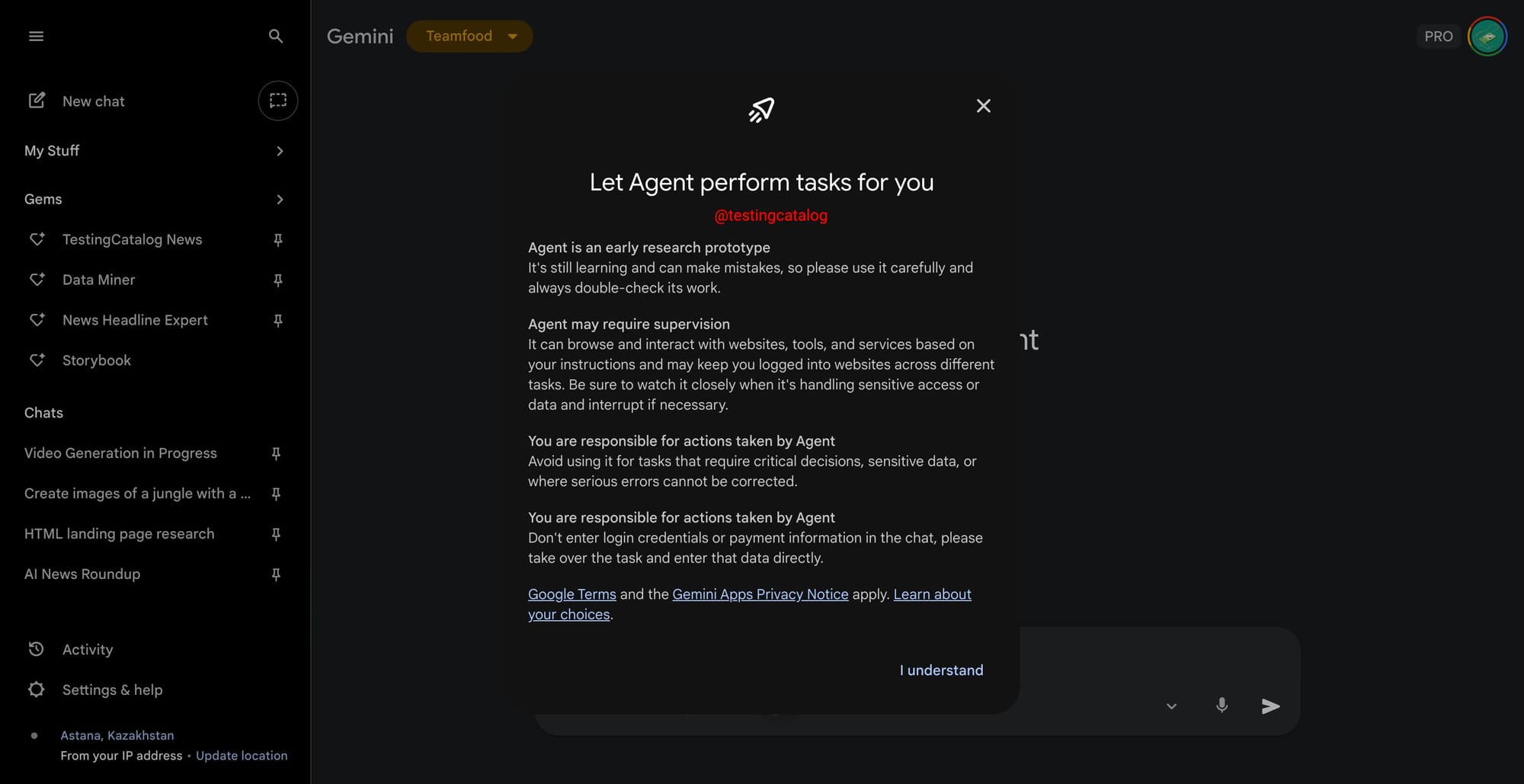
From the details shared by early testers, the Agent prototype appears as an experimental mode within Gemini’s interface, labeled as a “research tool”. It comes with visible warnings reminding users not to share sensitive data like passwords or payment details and a sign that Google is proceeding cautiously, mindful of the fine line between automation and privacy risk.
What makes this notable is its session persistence.
Unlike chatbots that forget once you close the window, Gemini Agent can remember the ongoing task, like continuing research you started the previous day or resuming a multi-step form submission.
This continuous workflow hints at a major step forward: a version of Gemini that doesn’t just generate text, but executes tasks over time.
Why Is Google Building a Task-Performing Agent Now?
It is a fair question. After all, Gemini already powers conversational and multimodal experiences, so why add automation?

The answer lies in the race toward agentic AI. It is the next competitive frontier for companies like Google, OpenAI and Anthropic.
Each is trying to move beyond “question-and-answer” models toward AI systems that can handle real-world complexity.
In the last year alone:
- OpenAI has teased autonomous “GPTs” capable of running mini-tasks and browsing independently.
- Anthropic’s Claude Projects introduced memory and file handling for deeper workflows.
- Perplexity AI launched copilots that can navigate the web and perform comparative research.
With Gemini Agent, Google seems ready to join and potentially leapfrog this race.
The timing makes sense. As generative AI matures, user expectations are shifting from getting answers to achieving outcomes. People no longer want their AI to explain how to do something, they want it to just do it.
If Gemini Agent delivers on this promise, it could redefine productivity for millions of users, from researchers and marketers to business professionals managing complex workflows online.
What Makes Gemini Agent Different from Regular Gemini Models?
The early clues suggest that Gemini Agent runs on a dedicated backend, possibly tied to Gemini 3 or a specialized, browser-optimized variant.
Notably, the prototype’s interface does not show a model selector (like Gemini Pro or Gemini Flash), implying that the Agent will be powered by a distinct model designed for task execution, not just text generation.
That means:
- Deeper integration with Chrome and Workspace apps, allowing it to interact directly with documents, sheets and emails.
- Persistent sessions across browser tabs and apps, meaning your Agent can stay logged in and “remember” progress.
- Multi-modal understanding, combining natural language, visual data, and real-time web context.
In other words, Gemini Agent is not just a smarter chatbot, it is the foundation of Google’s next-generation productivity AI.
How Is Google Handling Privacy and Security?
AI that can browse, click and perform web actions raises serious privacy and security questions.
Google’s interface banner makes this clear. It warns users not to share passwords, payment information, or other sensitive credentials in chat.
The system encourages “supervised automation,” where the user reviews or confirms steps before completion.
This transparency-first approach reflects Google’s cautious AI rollout philosophy, which contrasts with the more experimental tone of OpenAI’s ecosystem.
By labeling Gemini Agent as a “research feature”, Google can collect feedback and refine guardrails before introducing public or enterprise versions.
It is a slow, deliberate move but one that aligns with the company’s focus on trust and safety, especially after global regulatory scrutiny around AI autonomy.
For now, Agent remains confined to testing environments and selects early adopters. But the infrastructure being built with continuous sessions, contextual browsing, API hooks suggests Google is preparing for a much broader rollout in the coming months.
What Could Gemini Agent Mean for Everyday Users?
Imagine that you are planning a work trip. Instead of toggling between 10 tabs, you simply tell Gemini,
“Book me a two-day trip to New York next week and find the best flight under $300 and a hotel near our office.”
The Agent could then:
- Search for flight options
- Compare hotels
- Auto-fill booking forms
- Confirm reservations, while maintaining your session and preferences
That’s the kind of seamless, end-to-end experience Google appears to be targeting. For business users, the implications are even bigger. Gemini Agent could:
- Compile market research
- Monitor competitor websites
- Draft reports
- Sync data into Sheets or Docs
- Trigger email workflows through Workspace
It is not hard to imagine how such automation could reshape digital work, essentially turning Gemini into a self-managing digital employee.
How Does This Align with Google’s AI Vision?
Gemini Agent aligns perfectly with Google’s broader goal of making AI more integrated and context-aware.
Since the launch of Gemini 1, Google’s messaging has revolved around “helping users get things done.” Gemini 2 introduced multi-modality. Gemini 3, expected soon focuses on contextual persistence and deeper system integration.
Agent appears to be the natural next step in that progression which is a bridge between AI conversation and real-world action.
This fits neatly into Google’s ecosystem strategy:
- Android + Chrome: Unified browsing and session memory
- Workspace: Task execution inside productivity apps
- Search + Gemini: Blended discovery and automation
Essentially, the Agent could become Google’s connective tissue and unify its scattered services into one coherent, AI-driven experience.
What Challenges Lie Ahead for Gemini Agent?
Despite its promise, Gemini Agent faces big hurdles.
First, there is user trust. Allowing an AI to “act” on your behalf online is a leap of faith one that depends on Google’s ability to guarantee security and transparency.
Second, there is the issue of data compliance. Persistent sessions and multi-site automation mean the Agent will handle user credentials indirectly, an area heavily scrutinized by privacy regulators in the EU and elsewhere.
Lastly, there’s the AI reliability problem. Even with advanced reasoning, LLMs can still hallucinate or misinterpret instructions which is a dangerous risk when dealing with real transactions or bookings.
That’s why Google is starting small, focusing on the “research” label, enforcing user supervision, and introducing gradual access.

Dileep Thekkethil
AuthorDileep Thekkethil is the Director of Marketing at Stan Ventures, where he applies over 15 years of SEO and digital marketing expertise to drive growth and authority. A former journalist with six years of experience, he combines strategic storytelling with technical know-how to help brands navigate the shift toward AI-driven search and generative engines. Dileep is a strong advocate for Google’s EEAT standards, regularly sharing real-world use cases and scenarios to demystify complex marketing trends. He is an avid gardener of tropical fruits, a motor enthusiast, and a dedicated caretaker of his pair of cockatiels.
