
Google’s next major AI model, Gemini 3, is on the verge of release and early signals suggest it is one of the company’s most ambitious leaps yet.
If you have been playing around in AI Studio lately, you might have already noticed subtle hints of it being tested in the background.
According to multiple reports, the official launch date is set for October month and this update is not just another incremental improvement. It is a foundational shift that could redefine not only how developers build applications but also how users experience them.
Let’s see how Gemini 3 is shaping up to change the AI and app ecosystem, and why Google seems more confident than ever about this release.
What’s Inside Gemini 3?
Early testers have been impressed and that is putting it lightly. Gemini 3 appears to be a powerhouse in coding and logical reasoning, areas where precision matters most.
Developers have shared examples of the model generating SVGs (scalable vector graphics) complex visual elements written entirely in code. It is a subtle but meaningful benchmark.
Why? Because generating accurate SVGs requires more than just creativity; it demands structural understanding, spatial reasoning and mathematical accuracy.
The results so far suggest that Gemini 3 not only outperforms Gemini 2.5, but in several early tests, it even edges out Anthropic’s Sonnet 4.5, particularly in code generation tasks.
Handling SVGs seamlessly often reflects the model’s deeper grasp of logic and the same reasoning framework that powers software development, algorithmic problem-solving and visual layout generation.
If Gemini 2.5 made developers experiment, Gemini 3 might make them rethink how AI fits into their entire workflow.
The Ecosystem Is Evolving Alongside Gemini 3
Gemini 3 is not launching in isolation. Reports suggest Google is orchestrating a wider ecosystem refresh to align with this new AI foundation.

Among the expected releases are:
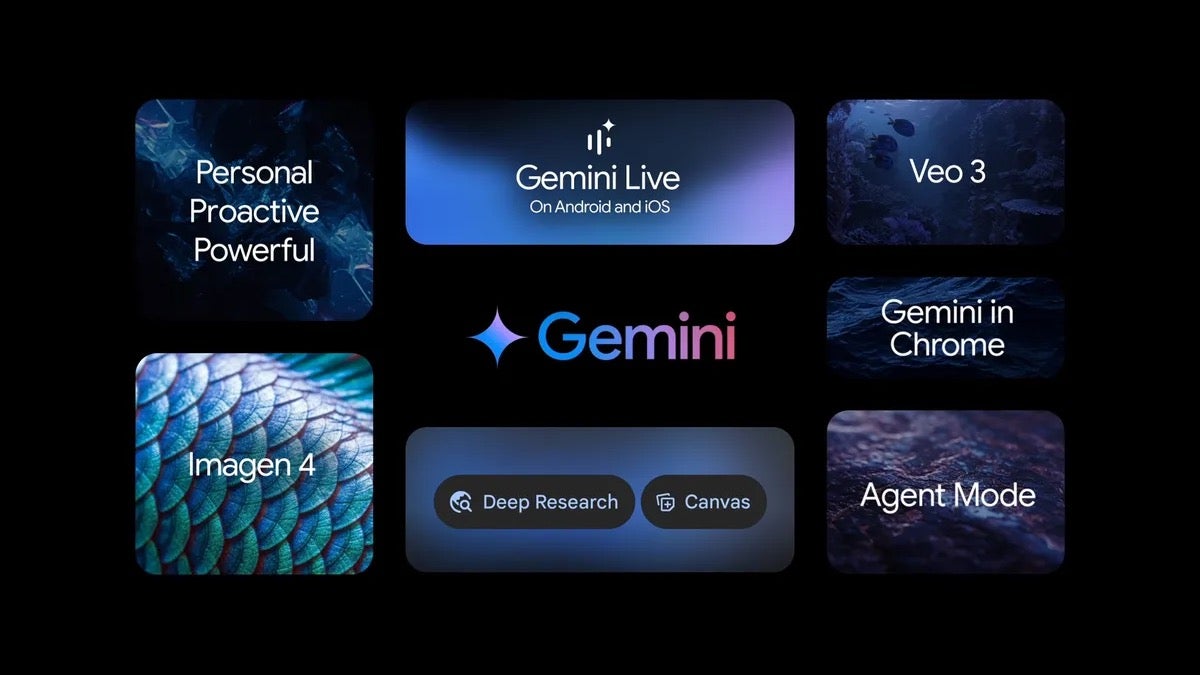
- Veo 3.1, the next-generation video model with upgraded multimodal capabilities.
- Nano Banana, a lightweight model reportedly built on Gemini 3 Pro instead of the earlier Flash variant.
This ecosystem shift signals something bigger: Google is consolidating its AI architecture so that whether you’re generating video, images, or text, you are interacting with the same intelligent core.
It is an ambitious move, unifying creative, analytical, and developmental tasks under one system of reasoning. Essentially, Gemini 3 is not just a model; it is a foundation for “Generative App Intelligence.”
What Is Generative App Intelligence?
At the core of Google’s Gemini 3 announcement is a bold new term: Generative App Intelligence (GAI).
The concept flips traditional app design on its head. Instead of static screens and predictable layouts, apps can now evolve in real time, adjusting their interfaces, workflows and even feature sets based on what users are doing.
Imagine opening a photo-editing app that instantly shifts its toolbar depending on whether you are retouching a portrait or enhancing a landscape.
Or a productivity suite that dynamically rearranges menus when it senses you’re drafting an email instead of a report.
That is the vision behind Generative App Intelligence, apps that generate, adapt and anticipate rather than just respond.
“The goal is no longer just to make apps smarter,” one Google engineer reportedly said. “It’s to make them self-reconfiguring.”
In short, Gemini 3’s multimodal reasoning allows apps to behave more like companions than tools adaptive, contextual, and deeply personal.
How Does Gemini 3 Enable Smart, Adaptive UX?
Gemini 3’s magic lies in how it blends multimodal understanding and combining text, visuals, voice and even environmental data with real-time reasoning.
Key capabilities include:
- Real-time layout generation, letting apps rearrange their design dynamically based on context.
- Multimodal input fusion, where voice, gestures and typed commands merge into one seamless input system.
- Predictive flow branching, helping apps anticipate user actions and surface shortcuts or next steps proactively.
- On-device fine-tuning, allowing personalization without relying entirely on cloud processing.
And while this may sound futuristic, Google’s underlying vision is simple: reduce friction between intent and interaction.
How Does Gemini 3 Compare to OpenAI’s Sora?
Naturally, comparisons to OpenAI’s Sora have already begun. Both models push the boundaries of AI-driven UX design, where interfaces are created or adapted by generative systems.
But here is where Google may have the upper hand, integration and reach. While Sora has shown impressive results in experimental UI prototyping, Google’s strength lies in its ability to embed Gemini 3 directly into Android, Chrome and Workspace tools.
That means a developer using Android Studio, or even Firebase, could soon access Gemini’s generative intelligence natively, without relying on external APIs.
In effect, Google’s approach looks more platform-first, whereas OpenAI’s feels model-first.
The winner? That depends on who can merge usability, intelligence and ethics most seamlessly.
Where Could Generative App Intelligence Be Applied?
This new wave of app intelligence is not confined to chatbots or assistants. It is built for everyday apps we already use.
Imagine:
- Productivity tools that customize interfaces as you write, present, or analyze data.
- Photo and video editors that shift filters and tools based on scene context.
- Health and fitness dashboards that adapt layouts to reflect changing biometric data.
- Smart home systems that reconfigure controls based on user presence or energy states.
The key takeaway? Apps will stop being rigid. Instead, they will begin to sense and shape themselves in real time.
How Is Google Preparing Developers for This Shift?
To ease adoption, Google is already enhancing its developer toolkit. Android Studio and Firebase are getting new features designed for intelligent UI workflows, including:
- Prompt-based layout prototyping
- AI-driven Lint rules to flag unstable generated designs
- Simulators for dynamic UI flows
- Remote debugging for runtime-generated layouts
The idea is to make Generative App Intelligence accessible without rewriting entire codebases. Developers can gradually integrate it with testing, refining and scaling as the ecosystem matures.
How Do We Measure Success in Smart UX?
Traditional app metrics such as screen views, taps, or conversions won’t fully capture the effectiveness of generative interfaces.
Instead, Google hints at new experience metrics, such as:
- Layout stability (how often dynamic UIs shift unexpectedly)
- Predictive UX success (how accurately the app anticipates needs)
- User trust and comfort scores
It is a reminder that AI UX success is not just about efficiency, it is about emotional reliability. Users must feel the app understands them without losing control.

Dileep Thekkethil
AuthorDileep Thekkethil is the Director of Marketing at Stan Ventures, where he applies over 15 years of SEO and digital marketing expertise to drive growth and authority. A former journalist with six years of experience, he combines strategic storytelling with technical know-how to help brands navigate the shift toward AI-driven search and generative engines. Dileep is a strong advocate for Google’s EEAT standards, regularly sharing real-world use cases and scenarios to demystify complex marketing trends. He is an avid gardener of tropical fruits, a motor enthusiast, and a dedicated caretaker of his pair of cockatiels.
