
How many times have we seen businesses try to get creative with domain names, only to end up confusing search engines (and sometimes themselves)?
John Mueller, Google’s Search Advocate, stepped in once again to clear the air on a tricky SEO situation: using two different TLDs (Top-Level Domains) for one company.
The question surfaced on Reddit, where a company wanted to use its .co.uk domain for regular search and website traffic, while keeping its .digital domain active for marketing campaigns.
Mueller’s advice? Simple but strategic, do not let both domains compete for visibility. Pick your main TLD, migrate correctly and make it “super-obvious to search engines which domain you want.”
What this really means, why it matters for your SEO strategy, and how to avoid the common pitfalls of running multiple TLDs?
Google’s @JohnMu SEO advice on using two different TLDs for your company’s website https://t.co/PwGPuHneSa pic.twitter.com/sALcBcGh2j
— Barry Schwartz (@rustybrick) November 10, 2025
What Exactly Did Google’s John Mueller Say About Using Two Domains?
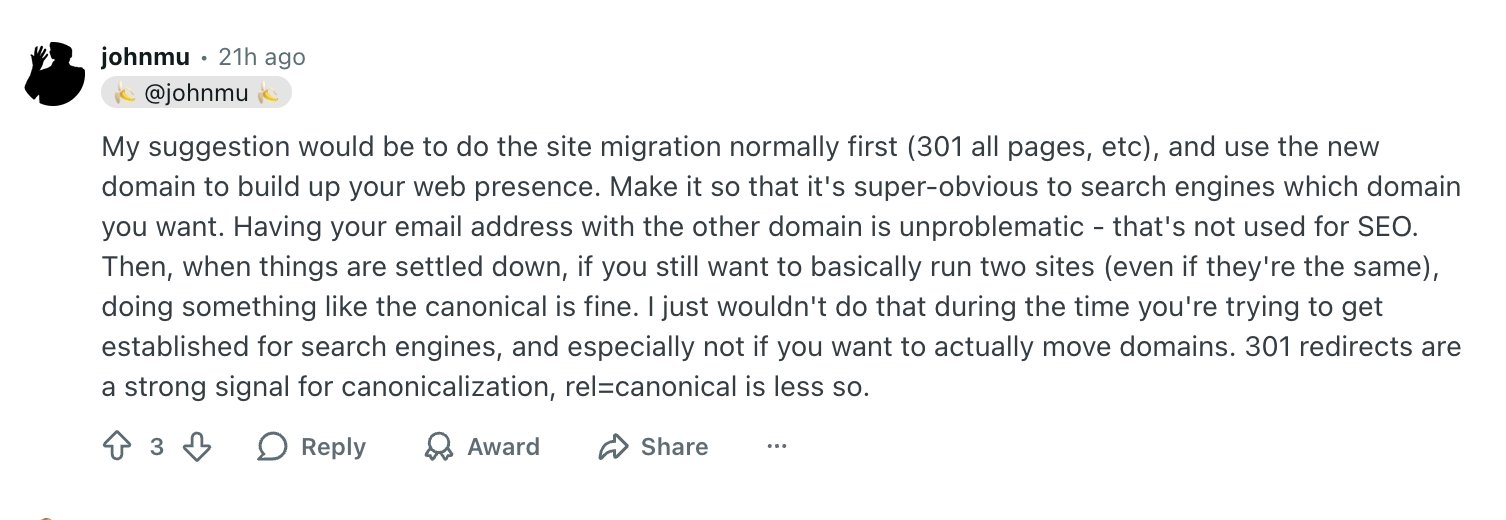
John Mueller responded directly to the question on Reddit, laying out a clear roadmap for managing two TLDs. His key advice can be summarized in five steps:
- Do a full site migration first — 301 redirect all pages from your secondary domain (in this case, .digital) to your primary one (.co.uk).
- Build your web presence on the main domain — focus all link-building, indexing, and authority signals on the one you want to rank.
- Make it obvious which domain matters most — ensure Google has no doubts about which TLD is your “home base.”
- Emails don’t matter for SEO — having your company email tied to another domain (like [email protected]) doesn’t affect rankings.
- Once things settle, you can run both sites — but only after your main domain is fully established. You can use canonical tags later, just not during migration.
He concluded by emphasizing a critical point:
“301 redirects are a strong signal for canonicalization. rel=canonical is less so.”
In short, don’t rely on canonical tags alone if you are consolidating domains. Redirects are your strongest weapon for telling Google what’s what.
Why Does This Matter for Businesses Using Multiple TLDs?
In 2025, domain flexibility has become a branding playground. From .ai and .tech to .digital and .xyz, companies are using creative TLDs to stand out.
But here is the catch: search engines don’t see branding, they see signals.
If both your domains are live, accessible, and share similar or duplicate content, Google’s crawlers might struggle to understand which one represents your primary identity. This can lead to:
- Diluted link equity (your backlinks split between two domains
- Indexing confusion (Google may rank the wrong domain)
- Crawl inefficiency (wasting crawl budget across duplicates)
Mueller’s response serves as a timely reminder that in SEO, clarity always beats creativity, especially when it comes to domain management.
How Should You Handle a Dual-Domain Setup the Right Way?
Here is how Mueller’s advice translates into actionable SEO steps, with some additional context.
1. Start with a clean 301 migration
If you have been using a .digital domain for campaigns or older pages, set up permanent 301 redirects to your .co.uk version. That tells Google, “Hey, we have officially moved.”
301s are powerful, they transfer most of your page authority (link juice) to the new domain and establish it as the canonical version.
2. Keep your focus on one web identity
While it is tempting to maintain both sites for marketing or branding reasons, Google prefers a single, consistent version. So, even if your campaigns use the .digital domain, make sure it ultimately redirects or links users to the main .co.uk site.
Think of it as a funnel, the .digital domain drives traffic, but all engagement and SEO strength feed the .co.uk domain.
3. Use canonicals later, not now
Mueller made this clear that don’t start adding rel=canonical tags until after your migration has stabilized. That is because during migration, Google needs strong, unambiguous signals and 301s are stronger than canonicals.
Once your main site has fully absorbed the SEO signals, you can use canonicals if you decide to maintain duplicate campaign pages later on.
4. Don’t worry about email domains
Using [email protected] while your site is on company.co.uk? Totally fine. Google does not use email domains for ranking signals, so you can freely keep your branding consistent across channels.
5. Keep the secondary domain invisible to search engines
Mueller’s final piece of advice is often overlooked, your secondary domain should be “virtually invisible” to crawlers. That means noindexing, blocking via robots.txt, or ensuring everything redirects to the main site.
Essentially, you want search engines to forget it ever existed as a standalone property.
Why 301 Redirects Still Reign Supreme in 2025
With all the changes in Google’s algorithm and AI-driven indexing systems, are 301 redirects still that powerful? According to Mueller, yes and for good reason.
A 301 redirect is a permanent signal that tells both users and crawlers, “This content has officially moved.” It consolidates signals, protects your rankings, and ensures backlinks from your old domain continue to count toward your new one.
Meanwhile, a canonical tag merely suggests which version Google should prefer but it does not guarantee compliance.
That’s why in a domain migration scenario, redirects are your first line of defense, and canonicals are your finishing touch once everything’s stable.
How Does This Impact SEO Strategy Going Forward?
For marketers, this advice reinforces one of SEO’s golden rules: consistency over complexity.
Running multiple domains might seem like a great branding play but if you don’t manage them correctly, it can hurt your organic visibility.
Here’s the takeaway:
- Choose one domain as your “main digital home.”
- Use creative TLDs only for campaigns, sub-brands, or short URLs but always funnel that traffic back to your main site.
- Let search engines see only one unified brand presence.
If you think about it, Mueller’s guidance fits perfectly into Google’s broader trend of simplifying crawl paths and rewarding clarity.
With AI now interpreting content intent, structured hierarchy and canonical domain identity matter more than ever.
What This Means for the SEO Community
This might feel like a small Reddit response, but it reflects something much bigger, Google’s evolving stance on domain authority consolidation.
In a world where AI search, SGE (Search Generative Experience), and entity-based indexing are redefining SEO, clarity about your domain signals is non-negotiable.
Having one strong, consistent TLD makes it easier for search engines to understand:
- Which brand you are
- Where to direct link authority
- And how to display your pages in AI-driven answers or snippets
Multiple domains, on the other hand, introduce uncertainty and Google’s algorithms don’t like uncertainty.
So, Should You Ever Use Two TLDs?
The short answer: Yes, but only with a plan.
If your second TLD serves a clear, functional purpose (like tracking marketing campaigns or offering country-specific experiences), that’s fine, as long as you ensure:
- It doesn’t compete in search
- It redirects properly
- And it supports, not splits, your main domain’s authority
Otherwise, you risk turning your brand into its own SEO competitor.
Mueller’s point is simple: “Your website should really only show one site, one TLD.”
That one line captures the essence of SEO simplicity, one source of truth for search engines to index, rank and trust.
TL;DR – Key Takeaways
- Google’s John Mueller advised that companies using multiple TLDs should always perform a 301 redirect migration to their primary domain.
- Build and maintain your main SEO presence on one TLD only.
- Email domains don’t matter for SEO.
- Avoid canonical tags during migration and use them later if needed.
- Ensure the secondary domain is virtually invisible to search engines.
- Remember: 301 redirects > canonicals when consolidating domains.

Dipti Arora
AuthorDipti Arora is a Senior Content Writer with over seven years of experience creating impactful content across Digital Marketing, SEO, technology, and business domains. She has a strong background in managing news verticals and delivering editorial excellence. Dipti has contributed to leading publications such as The Times of India and CEO News, where her research-driven storytelling and ability to simplify complex subjects have consistently stood out. She is passionate about crafting content that informs, engages, and drives meaningful results.
