
In a new update circulating across the SEO community this week, Google’s John Mueller has once again delivered a message he has been echoing for nearly ten years.
“Consistency is the biggest technical SEO factor.”
Mueller shared the reminder in a post on Bluesky, where he emphasized, yet again, that no amount of optimization can replace the importance of consistent signals across a website.
The statement is brief, but it carries the same weight it always has.
And it raises a familiar question: If this message has been repeated so many times, why has Google chosen to emphasize it again in 2025?
Why Did Google Reinforce the Consistency Message Again in 2025?
The first thing every SEO professional wondered after Mueller’s post is simple: Why now?
The industry has evolved dramatically over the past decade, AI-generated content has surged, sophisticated frameworks dominate the web and headless CMS setups are becoming the norm.
All of these modern digital structures create potential inconsistencies without developers even noticing.
As websites adopt more layers of automation, personalization, or dynamic rendering, Google faces a growing challenge.
Determining which version of content, URL, or metadata should be considered authoritative.
Mueller’s latest reminder is, essentially, a warning not to let technical complexity create contradictory SEO signals.
In other words, before adopting advanced AI or complicated site redesigns in 2025, Google wants web creators to fix the basics and consistency is the ultimate basic.
What Exactly Did John Mueller Say This Time?
Mueller’s Bluesky post was remarkably clear and direct:
“Consistency is the biggest technical SEO factor.”
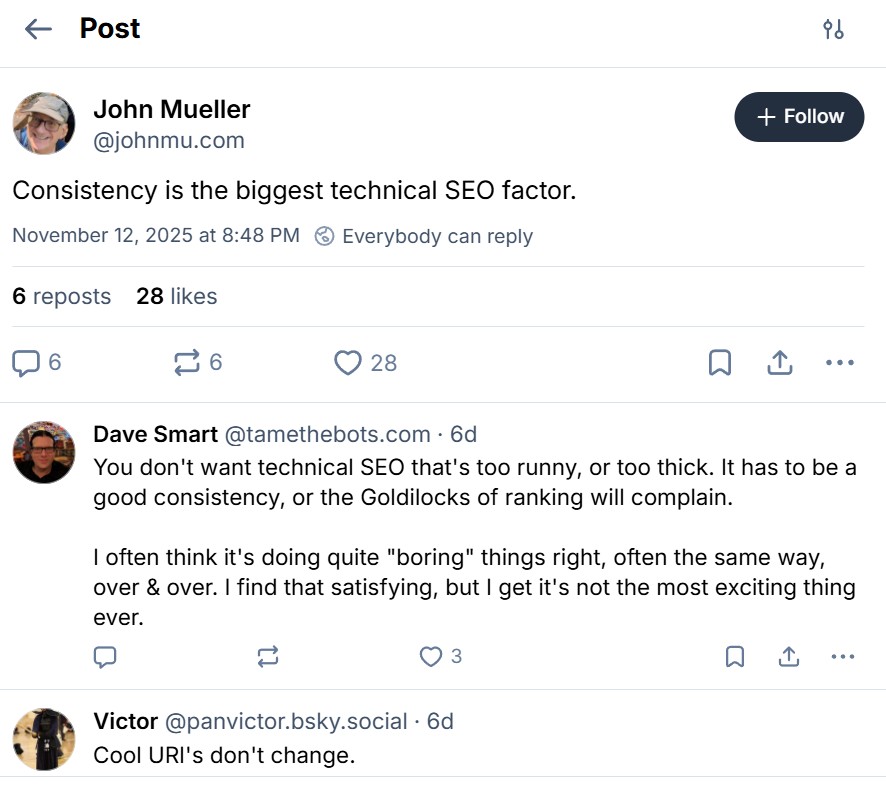
There was no added commentary, no side notes, just the reminder that the fundamentals still matter most.
His earlier statements echo the same message year after year, including remarks like “Top SEO Advice: Be Consistent,” “SEO Lives & Dies With Consistency,” and “Your job as an SEO is not to confuse search engines.”
These repeated reminders highlight one thing: Google is still struggling to interpret websites that send conflicting signals.
What Does Google Mean by Consistency in Technical SEO?
Google’s expectations revolve around the idea that every element of a website should agree with every other element.
When navigation links, canonical tags, structured data, metadata, and page content contradict each other, Google is left unsure which version of a page is correct.
A consistent website is easier to crawl, easier to understand, and easier to rank.
An inconsistent website forces Google to guess and guessing rarely leads to good ranking outcomes.
Consistent URL Structure
One of the most frequent issues comes from inconsistencies in URL formatting. Something as small as a trailing slash can create duplicate versions of the same page.
These differences may seem tiny to users, but to Google, they represent separate URLs with separate signals. Mueller has repeated for years: Pick a format and stick to it.
Canonicals and Internal Links Should Match
Problems arise when a site links internally to one URL but the canonical tag points to another version.
This immediately sends Google a contradictory message about which page should be indexed.
Google’s position is simple: navigation and canonical tags must reinforce one another.
Uniform Content Across All Page Versions
When a desktop page says one thing but the mobile or AMP version displays different content or when a PDF includes outdated information Google receives conflicting signals.
That inconsistency leads to uncertainty about which version should rank.
Structured Data Must Reflect Reality
Google penalizes pages that use schema markup disconnected from on-page content.
Marking up authors that don’t exist, products that aren’t detailed, or FAQs that aren’t displayed creates significant trust issues.
Sitemaps, Navigation, and Internal Linking Should Align
Sometimes a sitemap lists URLs that aren’t linked anywhere, or internal links point to pages missing from the sitemap.
These contradictions slow down Google’s understanding of a site and can cause pages to remain unindexed or outdated versions to linger in search.
What Happens When Websites Send Mixed SEO Signals?
Many site owners underestimate how harmful inconsistencies can be.
They can split ranking signals across multiple versions of the same page, cause crawl budget waste, confuse indexing decisions and lead Google to ignore canonical tags entirely.
In some cases, these contradictions trigger sudden drops in rankings or impressions, problems that are often misdiagnosed as algorithm updates or penalties when the real issue is internal inconsistency.
For large websites with thousands of URLs, the problem compounds quickly.
But even smaller sites can experience damaging effects if signals are not aligned.
How Should Site Owners Improve Consistency in 2025?
A website aiming for stronger technical SEO performance must prioritize internal uniformity before anything else.
The first step is a URL consistency audit: every URL should follow one standardized structure, and any outdated variations should redirect properly.
Next, canonicals should be reviewed to confirm that they match internal link targets.
Structured data must be checked against the reality of on-page content line by line.
Navigation menus, internal linking patterns, and sitemap entries should reflect the same set of authoritative URLs.
Without these foundational steps, no advanced optimization technique can deliver stable long-term results.
Why Consistency Still Matters More Than Ever in 2025
Despite the introduction of AI-enhanced ranking models and rapid algorithm evolution, Google continues to rely on clarity.
Search engines cannot confidently rank pages they do not fully understand.
Consistency eliminates uncertainty. And eliminating uncertainty enables Google to rank content with more confidence and stability.
As websites become more complex, the simplest rule becomes the most important: make every component of your website point in the same direction.
Will Google Keep Repeating This?
Almost definitely. As long as new frameworks, AI systems, and multi-version content complicate site architecture, Google will continue to remind everyone that AI SEO is built on predictable, aligned, and consistent signals.
And in 2025, this message is more relevant than ever.
If your website sends mixed signals, your rankings will eventually reflect that confusion.
TL;DR – Key Takeaways
- Google’s John Mueller reiterated in 2025 that consistency remains the most important technical SEO factor.
- Inconsistencies in URLs, canonicals, structured data, navigation, and content confuse Google’s indexing systems.
- Modern frameworks, AI content, and dynamic rendering increase the risk of contradictory signals.
- Consistent signals across all site elements lead to clearer indexing and stronger, more stable rankings.
- Google will continue reinforcing this message because inconsistent websites remain one of the biggest technical SEO problems.

Dipti Arora
AuthorDipti Arora is a Senior Content Writer with over seven years of experience creating impactful content across Digital Marketing, SEO, technology, and business domains. She has a strong background in managing news verticals and delivering editorial excellence. Dipti has contributed to leading publications such as The Times of India and CEO News, where her research-driven storytelling and ability to simplify complex subjects have consistently stood out. She is passionate about crafting content that informs, engages, and drives meaningful results.
