
A large study reviewing 300,000 domains shows that adding an llms.txt file does not appear to influence how often major AI systems reference a website. Adoption remains low, and current evidence suggests no direct visibility benefit.
A recent study from SE Ranking has added clarity to an ongoing question in SEO circles: Does using an llms.txt file help a website get cited more often by large language models?
According to their findings, the answer is no.
After reviewing about 300,000 domains across different traffic categories, the team found no measurable connection between the presence of llms.txt and citation rates in prominent AI systems.
What the Study Reveals
SE Ranking discovered that just over 10 percent of websites in their sample had implemented the llms.txt file.
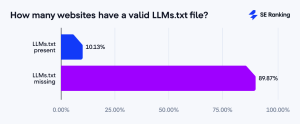
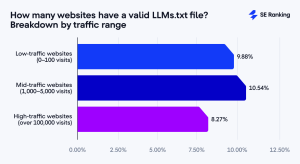
Despite occasional conversations positioning it as a new standard for AI visibility, adoption remains light. Their crawl also showed that usage is broadly spread across different types of sites.
High-traffic domains were slightly less likely to use it than mid-level sites, but the difference was small.
To understand whether the file influenced how often a site was referenced in AI responses, SE Ranking measured citation frequency and ran several statistical checks.
They also used an XGBoost model to understand which factors shaped citations.
When they removed the llms.txt variable from the model, predictions actually improved, which reinforced the idea that the file had no meaningful relationship with citation outcomes.
Simpler correlation tests supported the same conclusion.
How These Findings Align With Platform Guidance
The results also match what major AI companies have said publicly. Google has not identified llms.txt as a factor in AI Overviews or its AI-driven answer formats. Its documentation focuses instead on long-standing signals from Search.
Similarly, OpenAI’s crawler guidance places its emphasis on robots.txt rules and does not mention llms.txt as something that influences ranking or citations.
SE Ranking noted that some server logs show GPTBot occasionally fetching the file, but the behavior is rare and does not correlate with more frequent citations. This suggests that while some crawlers may read the file in certain cases, they do not appear to use it in a way that impacts AI output at scale.
What Website Owners Should Take Away
Adding an llms.txt file is simple and poses little technical risk. For teams that prefer to stay ready for potential future adoption, it can be added without disruption.
However, if the expectation is an immediate improvement in AI visibility, the data indicates that this is unlikely.
As with many early AI-visibility experiments, llms.txt may be worth testing, but it should not be positioned internally as a proven driver of results.
Strong content signals, technical stability, and crawl accessibility remain more influential priorities.
Helpful Suggestions for Your Strategy
Here are a few ways to move forward with clarity, especially if you want to make informed decisions without overextending your efforts.
- Add the file if it fits easily into your workflow and you want to stay prepared for potential changes later.
- Do not rely on it as a lever for improved AI references right now.
- Reinforce content quality and authoritative signals, which continue to matter across search and AI surfaces.
- Watch for updates from Google and OpenAI in case they decide to give llms.txt a more defined role in the future.
- Keep records of experiments so teams can track what genuinely influences performance.
- As more publishers study how AI systems interpret content, many are also exploring AI SEO to better understand what genuinely influences visibility in these newer environments.
Key Takeaways
- Only about one in ten domains reviewed had an llms.txt file.
- SE Ranking found no measurable connection between the file and AI citation frequency.
- Machine learning tests showed improved accuracy when the feature was removed.
- Google and OpenAI do not list llms.txt as a factor in their AI systems.
- The file is simple to add but does not provide immediate visibility benefits.

Zulekha
AuthorZulekha is an emerging leader in the content marketing industry from India. She began her career in 2019 as a freelancer and, with over five years of experience, has made a significant impact in content writing. Recognized for her innovative approaches, deep knowledge of SEO, and exceptional storytelling skills, she continues to set new standards in the field. Her keen interest in news and current events, which started during an internship with The New Indian Express, further enriches her content. As an author and continuous learner, she has transformed numerous websites and digital marketing companies with customized content writing and marketing strategies.
