
A study of 129,000 domains reveals that strong backlinks, high authority scores, long and updated content, technical performance, and brand presence across review and social platforms are the most consistent factors linked to ChatGPT citations. The findings challenge many assumptions in AI SEO and highlight where real results come from.
SE Ranking analyzed 129,000 domains and more than 216,000 pages across 20 industries.
The goal was to understand who ChatGPT tends to cite, which site properties lead to those citations, why certain sites get referenced more often, and how content and authority signals connect to ChatGPT’s decisions.
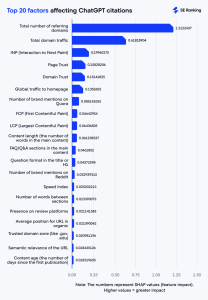
Backlinks and Authority Still Drive the Biggest Impact
Backlinks were the single strongest factor. Domains with up to 2,500 referring domains averaged around 1.6 to 1.8 citations. Sites with more than 350,000 referring domains averaged 8.4 citations.
The research identified a clear turning point at roughly 32,000 referring domains. Citation averages climbed from 2.9 to 5.6 after crossing that threshold.
Domain Trust followed the same pattern. Low-trust sites averaged 1.6 citations. Domains with scores above 90 averaged between 6 and 8.4 citations.
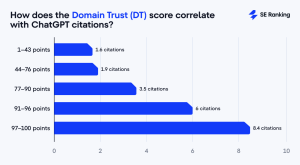
Page-level metrics played a smaller role. Strong domain authority mattered more than isolated page authority.
There was another surprise. .gov and .edu sites did not dominate automatically. Domain extension alone did not predict higher relevance or usefulness. Sites without government or educational extensions averaged slightly more citations at 4.0.
These results reinforce the fact that authority still matters most.
Traffic and Rankings Signaled Credibility Too
Traffic only had a meaningful effect at higher volumes. Sites receiving up to 190,000 monthly visitors behaved similarly. Once traffic climbed beyond that point, citations showed a stronger correlation. Domains with more than 10 million monthly visits averaged 8.5 citations.
The home page also played a unique role. A minimum of 7,900 organic visits to the homepage aligned with higher citation counts. This suggests the homepage remains a strong indicator of brand strength and trust.
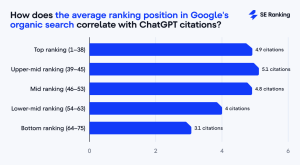
Google ranking was another signal. Pages ranking between positions 1 and 45 averaged 5 citations, while lower-ranked pages averaged around 3.1. The researchers make it clear that this does not prove ChatGPT uses Google directly, but the overlap hints that both reward strong authority indicators.
Content Quality Had a Measurable Influence
The study found that longer and better-structured content gets cited more often.
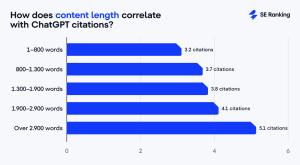
Pages with fewer than 800 words averaged 3.2 citations. Content above 2,900 words averaged 5.1.
Articles where sections between headings averaged 120 to 180 words performed best. Very short sections under 50 words averaged 2.7 citations. This suggests ChatGPT favors content that develops ideas clearly and in depth.
Expert-driven and data-supported content stood out. Pages with expert quotes averaged 4.1 citations. Pages containing 19 or more data points averaged 5.4 citations. Pages with weak data sources averaged only 2.8.
Freshness was one of the most decisive variables. Updated pages within the past three months averaged 6 citations. Outdated pages averaged 3.6. Regular updates send a signal of relevance and maintenance.
Interestingly, pages with FAQ sections had fewer citations in raw numbers, though the model still considered missing FAQs a small negative signal.
Question-style titles underperformed. Headings written as questions averaged 3.4 citations. Direct topic headings averaged 4.3. That runs against past voice-search advice and suggests AI prefers clear topic labeling.
Community Buzz Helps Newer Brands Compete
Reddit and Quora were surprisingly strong secondary signals, especially for smaller brands. Sites with only a few dozen mentions averaged 1.7 citations. High-activity domains averaged up to 7 citations.
Review platforms also correlated with more citations. Trustpilot, G2, Capterra, Yelp, and Sitejabber listings helped lift averages from 1.8 citations up to around 6.3.
Technical Speed Still Matters
Speed was a consistent performance predictor. Pages with First Contentful Paint under 0.4 seconds averaged 6.7 citations. Pages above 1.13 seconds averaged 2.1.
Speed Index showed similar gaps. A Speed Index under 1.14 seconds aligned with higher citation counts, while slower pages dropped noticeably.
Interaction to Next Paint delivered an unexpected twist. Very fast INP scores sometimes belonged to pages that were too simple or lacked substance. Moderately fast pages (0.8 to 1.0 seconds) averaged 4.5 citations, while ultra-fast pages averaged only 1.6.
URL and Title Findings Challenge Keyword Habits
A key insight challenges conventional keyword optimization strategies. URLs and titles that focused heavily on keywords performed worse. Pages with lower keyword matching averaged 6.4 citations. Pages with high matching averaged only 2.7. Titles followed the same pattern.
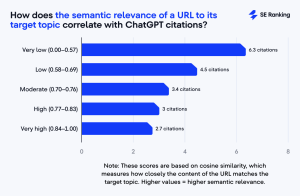
The takeaway is that models may value clarity over keyword stuffing.
Schema and AI-Targeted Tactics Had Limited Impact
The FAQ schema, outbound links, and LLMs.txt showed limited correlations.
The researchers emphasize that most of these tactics produce benefits only when the fundamentals are strong.
Actionable Guidance for Site Owners
Strong authority signals still dominate. That means backlinks, traffic growth, content depth, and technical performance remain foundational to AI SEO outcomes.
Newer brands can build authority through community platforms and review sites. Reddit, Quora, and product review platforms provide alternative channels that carry real weight.
Natural language titles and URLs appear more effective than keyword-loaded formats. Fresh content continues to outperform outdated assets.
It is also important to remember the limitations. The analysis focuses specifically on ChatGPT. Other AI systems might weigh factors differently. SE Ranking does not disclose which version of ChatGPT or which timeframe the data comes from. The patterns should therefore be read as correlations that point in a helpful direction, not as an exact formula to follow.
Key Takeaways
- Backlinks and Domain Trust were the strongest indicators of higher ChatGPT citations.
- Longer and updated content supported by experts performed far better.
- Reddit, Quora, and review sites helped smaller brands gain authority signals.
- Technical speed correlated with higher citation counts.
- Natural topic-based titles and URLs outperformed keyword-optimized ones.

Zulekha
AuthorZulekha is an emerging leader in the content marketing industry from India. She began her career in 2019 as a freelancer and, with over five years of experience, has made a significant impact in content writing. Recognized for her innovative approaches, deep knowledge of SEO, and exceptional storytelling skills, she continues to set new standards in the field. Her keen interest in news and current events, which started during an internship with The New Indian Express, further enriches her content. As an author and continuous learner, she has transformed numerous websites and digital marketing companies with customized content writing and marketing strategies.
