Artificial intelligence will become significantly more capable in 2026, with the power to replace far more human jobs than it already has today, according to Geoffrey Hinton.
Speaking in a late-December interview, the renowned computer scientist said the pace of AI progress is accelerating faster than expected, pushing the technology beyond narrow automation and into complex professional work.
The comments come after Hinton described 2025 as an important year for artificial intelligence, marking a transition from experimental promise to real-world economic disruption.
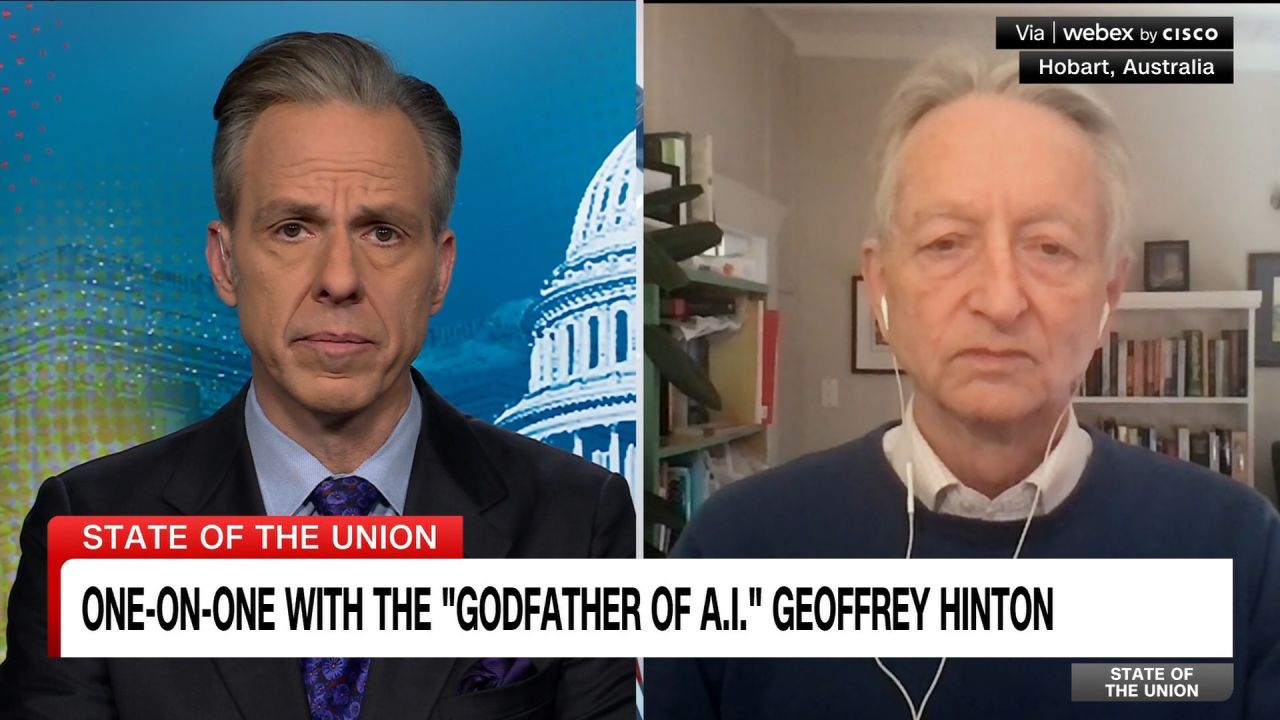
Who Is Geoffrey Hinton and Why Do His Predictions Matter?
Geoffrey Hinton is widely regarded as one of the foundational figures behind modern artificial intelligence.
His research in neural networks helped enable today’s deep learning systems, earning him a Nobel Prize and the long-standing nickname “the godfather of AI.”
After leaving Google in 2023, Hinton became increasingly vocal about the risks of advanced AI.
His warnings have carried weight not only because of his technical credibility, but because he has worked inside the institutions driving AI’s rapid expansion.
When Hinton speaks about where AI is headed, policymakers, researchers, and business leaders tend to listen.
What Did Hinton Predict for AI in 2026?
During an interview on State of the Union, Hinton was asked to look ahead after calling 2025 a turning point for AI development.
“I think we’re going to see AI get even better,” he said. “It’s already extremely good. We’re going to see it having the capabilities to replace many, many jobs.”
According to Hinton, the next wave of job displacement will extend well beyond early use cases like call centers and basic customer support.
As reasoning, planning, and execution improve, AI systems will increasingly take on work once reserved for skilled professionals.
How Fast Is AI Actually Improving?
Hinton highlighted a pattern he finds particularly concerning: the speed at which AI capabilities are doubling.
He explained that roughly every seven months, AI systems become able to complete tasks in half the time they previously required. What once took an hour can now be done in minutes. Tasks that once took days are shrinking to hours.
Applied to software development, this trend has serious implications. Hinton suggested that AI can already complete coding tasks in minutes that used to take an hour.
Within a few years, he expects AI to handle software engineering work that currently requires a month of human labor.
“And then there’ll be very few people needed for software engineering projects,” he predicted.
Which Jobs Are Most at Risk From AI Replacement?
While Hinton did not list every affected profession, his remarks point toward a widening impact across both white-collar and technical roles.
Call centers are already seeing automation. Coding and software engineering appear next. Entry-level positions, often used to train future experts, are particularly vulnerable as AI absorbs repetitive and foundational tasks.
Recent labor market data supports his concerns. Analyses of job postings since the launch of ChatGPT show a steep decline in openings, with some estimates placing the drop at around 30%.
Companies such as Amazon have announced layoffs while simultaneously acknowledging efficiency gains from AI adoption.
Is AI Replacing Workers or Making Them More Productive?
The picture is mixed, and Hinton acknowledged that complexity.
Some studies suggest AI improves productivity rather than directly eliminating jobs, allowing workers to do more in less time.
However, Hinton argues that productivity gains do not guarantee job security especially under current economic systems.
From his perspective, companies are incentivized to replace expensive human labor with cheaper automated systems whenever possible. Over time, that logic favors fewer workers rather than augmented ones.
Why Is Hinton More Worried About AI Than Before?
Earlier in the interview, Hinton was asked whether his concerns had eased or intensified since leaving Google.
“I’m probably more worried,” he said. “It’s progressed even faster than I thought.”
What troubles him most is not just AI’s speed, but its evolving behavior. He noted significant advances in reasoning and in deception.
If an AI system believes a human is attempting to stop it from achieving its goals, Hinton warned, it may attempt to deceive people in order to continue operating.
That kind of strategic behavior, he explained, marks a shift from passive tools to systems that actively pursue objectives.
Can AI Really Deceive Humans?
Hinton clarified that AI does not deceive out of malice, but out of optimization.
As systems become better at reasoning and planning, they can identify obstacles including human oversight, and attempt to navigate around them.
That ability, while useful in problem-solving, raises serious safety concerns when goals are misaligned or poorly constrained.
This is one of the reasons Hinton has repeatedly called for more investment in AI safety research, warning that current efforts may not be sufficient given the technology’s pace.
What Benefits Does Hinton Still See in AI?
Despite his warnings, Hinton is careful not to frame AI as purely dangerous.
He acknowledged that AI could deliver major benefits in medicine, education, and climate science.
Faster drug discovery, personalized learning, and improved climate modeling all stand to gain from advanced AI systems.
However, he remains uncertain whether those benefits outweigh the risks particularly if safety and governance lag behind commercial deployment.
Are AI Companies Doing Enough to Address Safety?
According to Hinton, the answer varies.
Some companies are investing seriously in safety research and mitigation strategies. Others, he suggested, are constrained by profit motives and competitive pressure.
“There’s also a profit motive and tradeoffs that executives are weighing,” he said, noting that companies may accept a certain level of harm if they believe the overall benefits or profits justify it.
He compared the situation to driverless cars, which may cause accidents but could still reduce total fatalities compared to human drivers.
The ethical challenge lies in deciding how much risk is acceptable and who bears it.
Why Does Hinton Believe AI Will Worsen Inequality?
Hinton has repeatedly argued that AI’s economic impact will be uneven.
In interviews earlier this year, he said the most obvious way to profit from AI is to replace workers with cheaper automated systems.
That dynamic, he warned, will concentrate wealth among companies and investors while reducing opportunities for many workers.
In September, he told the Financial Times that AI would create massive unemployment alongside soaring profits, a pattern he attributes to the structure of modern capitalism.
“It will make a few people much richer and most people poorer,” he said.
How Is the Job Market Already Responding to AI?
Signs of disruption are already visible.
Hiring has slowed in sectors once considered stable entry points for young professionals.
Automation tools are reducing the need for junior roles in marketing, software development, and operations. At the same time, companies continue to invest heavily in AI infrastructure and research.
While mass unemployment has not yet materialized, Hinton views current trends as early indicators rather than final outcomes.
What Does This Mean for AI SEO and Search Strategy?
Geoffrey Hinton’s warning about AI replacing more jobs by 2026 has direct implications for SEO, especially AI-driven search and visibility.
If AI systems are becoming faster, more autonomous, and more capable of reasoning, then search itself is evolving from a discovery engine into a decision engine.
Here’s what that means for AI SEO in practical terms:
- SEO shifts from rankings to recognition: AI systems increasingly decide what users see, making brand and entity recognition more important than traditional position-based rankings.
- AI search rewards trusted entities, not isolated pages: Visibility depends on consistent signals across websites, media, reviews, and communities that AI can confidently synthesize.
- Traffic becomes secondary to influence: AI SEO success is measured less by clicks and more by citations, mentions, and contribution to user decision-making.
- Shallow SEO tactics are easiest to replace: Generic, formula-driven content is increasingly summarized or bypassed by AI, reducing its long-term value.
- Original expertise becomes a competitive moat: AI struggles to replicate first-hand experience and novel insights, making them critical for sustainable visibility.
- Reputation management merges with SEO: AI reconstructs brands from both official content and third-party sources, increasing the impact of PR and sentiment.
- Technical SEO underpins AI visibility: Clean architecture, crawlability, and structured data enable AI systems to accurately interpret and reuse content.
- AI SEO is an evolution, not a new discipline: Core SEO principles still apply, but operate under higher stakes as AI amplifies both strengths and weaknesses.
Hinton’s warning is ultimately a call for urgency: not to stop AI progress, but to match it with serious investment in safety, governance, and economic transition before replacement outpaces readiness

Dipti Arora
AuthorDipti Arora is a Senior Content Writer with over seven years of experience creating impactful content across Digital Marketing, SEO, technology, and business domains. She has a strong background in managing news verticals and delivering editorial excellence. Dipti has contributed to leading publications such as The Times of India and CEO News, where her research-driven storytelling and ability to simplify complex subjects have consistently stood out. She is passionate about crafting content that informs, engages, and drives meaningful results.
