
Google has clarified a long-debated technical SEO issue following a recent discussion in the r/SEO Reddit community. The question centered on whether non-existent URLs should be redirected to the homepage or allowed to return a clean 404 or 410 status.
In response, Google confirmed that returning real 404s is not harmful to SEO and, in many cases, is the correct long-term approach.
The discussion gained traction after a site owner shared concerns about a growing number of 404 errors reported in Google Search Console.
The website, built on Next.js with a WordPress blog, was automatically redirecting invalid URLs to the homepage to avoid users encountering broken pages.
While the intent was user-friendly, the implementation raised red flags among SEO professionals and eventually drew clarification from Google itself.
Why Were So Many 404 URLs Appearing in Google Search Console?
According to the original post, Google Search Console showed a large volume of “Not found (404)” URLs under the All known pages report.
These URLs were not included in the sitemap and largely consisted of dynamically generated paths, test URLs and legacy slugs that no longer existed.
Despite this, Googlebot continued discovering and crawling them.
This is not unusual. As websites grow, URLs are often generated through internal testing, parameter variations, or historical content structures.
Over time, these URLs can surface through old links, external references, or automated crawling patterns.
To prevent users from landing on dead pages, the site implemented an automatic redirect. Invalid URLs would initially resolve as a 404, then immediately redirect to the homepage with a 200 status code.
The expectation was improved user experience and fewer visible errors.
However, Google Search Console continued reporting these URLs, prompting concerns about whether the redirect strategy was causing SEO issues.
Is Redirecting All 404 Pages to the Homepage Bad for SEO?
The SEO community response was direct and largely unanimous. Redirecting invalid URLs to the homepage was described as a poor long-term practice that creates confusion for both users and search engines.
Experienced SEOs pointed out that this approach often results in “soft 404s,” a classification Google uses when a page technically returns a successful status code but fails to deliver meaningful or relevant content for the requested URL.
In these cases, Google does not treat the redirect as helpful and continues to flag the URL as problematic.
Community members also emphasized that mass homepage redirects make it harder to detect genuine site issues.
When broken URLs are masked by redirects, site owners lose visibility into where and why errors are occurring.
On larger websites, this behavior can also lead to inefficient crawling and unnecessary use of crawl budgets.
What Is a Soft 404 and Why Does Google Flag It?
A soft 404 occurs when a URL appears to load normally but does not satisfy the intent of the request.
This commonly happens when a deleted product page redirects to a homepage, when a page returns a 200 status with “not found” content, or when redirects send users to unrelated destinations.
Google’s systems are designed to detect these mismatches. When they do, the URL is treated as invalid despite returning a successful response.
This means it will not be indexed and may continue appearing in Search Console reports.
In practical terms, soft 404s offer no SEO benefit. They do not consolidate ranking signals, they do not improve visibility and they often persist longer than clean 404s because Google must repeatedly evaluate the URL.
What Did Google Say About 404s and Redirects?
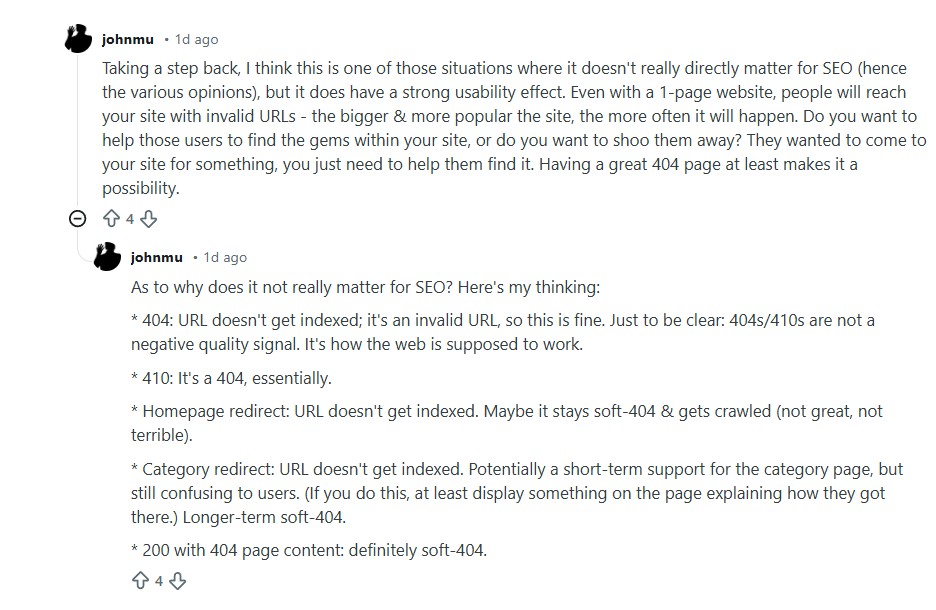
Google’s position became clearer when John Mueller responded to the discussion.
Rather than framing the issue as a ranking problem, Mueller explained that it is primarily a usability and clarity issue.
He noted that even small websites will receive traffic to invalid URLs, and larger, more popular sites will see this happen frequently.
The goal, he explained, should not be to eliminate 404s entirely but to handle them correctly.
Mueller clarified that returning a 404 or 410 status is not a negative quality signal. It simply tells Google that the URL does not exist, which is exactly how the web is designed to work.
From Google’s perspective, this is a clean and expected signal.
Do 404 or 410 Errors Hurt SEO Rankings?
One of the biggest misconceptions in SEO is that 404 errors harm rankings. Google has repeatedly stated that this is not true and Mueller reiterated it again in this discussion.
A real 404 means the URL will not be indexed. A 410 sends an even clearer signal that the page is permanently gone.
In both cases, Google processes the signal normally and moves on.
By contrast, homepage redirects and unrelated category redirects often keep URLs in a soft-404 state.
These URLs continue to be crawled but never indexed, creating unnecessary noise without delivering any benefit.
Mueller summarized the outcomes clearly: regardless of whether the URL returns a 404, a 410, or redirects to the homepage, the invalid URL does not get indexed. The difference lies in clarity, crawl efficiency, and user experience.
When Does Redirecting a Deleted URL Make Sense?
Redirects are not inherently bad. They are appropriate when there is a clear, direct replacement for the deleted URL.
For example, if a product page has moved or an article has been updated under a new URL, a one-to-one 301 redirect helps users and search engines reach the correct destination.
Problems arise when redirects are used indiscriminately. Sending users to the homepage or a generic category page without explanation often creates confusion.
Over time, Google tends to treat these redirects as soft 404s anyway.
If a category-level redirect is used temporarily, Mueller suggested that the destination page should clearly explain why the user landed there and what alternatives are available.
Without that context, the redirect fails both users and search engines.
Why a Proper 404 Page Is Better Than a Forced Redirect
One of the strongest points to emerge from Google’s response was the value of a well-designed 404 page.
Rather than hiding errors, a good 404 page helps users recover by offering navigation, search functionality, or links to relevant sections of the site.
This approach preserves clean technical signals while still supporting usability.
Users understand that the page does not exist, but they are not abandoned. Google, in turn, receives a clear signal that the URL is invalid and can stop wasting resources on it.
A proper 404 setup also keeps Search Console data meaningful, making it easier for site owners to identify real problems instead of chasing artifacts created by redirects.
What Is Google’s Recommended Long-Term Approach?
Based on the discussion and Google’s clarification, the recommended approach is straightforward:
- Return a clean 404 or 410 for URLs that no longer exist and have no direct replacement
- Use redirects only when there is a genuine one-to-one match that satisfies user intent
This strategy reduces crawl waste, avoids soft 404 classification, and aligns with how Google expects the web to function.
Final Takeaway
The Reddit discussion and Google’s response reinforce a simple but often ignored truth. 404 errors are not inherently bad, and trying to eliminate them through blanket redirects often creates more problems than it solves.
For long-term SEO health, clarity beats concealment. Clean status codes, intentional redirects, and user-friendly 404 pages remain the most effective way to manage invalid URLs, especially as sites scale and search systems become more sophisticated.

Dipti Arora
AuthorDipti Arora is a Senior Content Writer with over seven years of experience creating impactful content across Digital Marketing, SEO, technology, and business domains. She has a strong background in managing news verticals and delivering editorial excellence. Dipti has contributed to leading publications such as The Times of India and CEO News, where her research-driven storytelling and ability to simplify complex subjects have consistently stood out. She is passionate about crafting content that informs, engages, and drives meaningful results.
