
Adding years to URLs may boost short-term relevance, but it quietly damages long-term SEO by fragmenting authority and aging evergreen content. A stable, timeless URL is a stronger signal to search engines than annual redirects and cosmetic freshness.
Every year, marketers repeat the same SEO routine.
They update their best-performing blog posts, refresh examples and screenshots, and then make one small but costly change: they add the new year to the URL.
A post that once lived at /best-seo-tools/ suddenly becomes /best-seo-tools-2026/.
The reasoning feels logical. Search demand includes the current year. Users want fresh information. Google prioritizes relevance.
But while this approach may deliver a short-term perception boost, it creates long-term SEO problems that compound over time.
Hardcoding years into URLs introduces technical debt, weakens authority, complicates site maintenance, and works directly against evergreen content strategies.
Let’s break down why year-based URLs are usually a bad idea for SEO and how to signal freshness properly without sacrificing rankings, links, or long-term performance.
Why Do Marketers Add Years to URLs in the First Place?
To be fair, this practice didn’t come out of nowhere. Marketers usually add years to URLs to:
- Capture “best X in 2026” style searches
- Improve perceived relevance in competitive SERPs
- Differentiate updated content from older results
- Align URLs with annual editorial calendars
There’s also a psychological component. A year in the URL feels definitive and timely. It suggests that the content reflects current tools, algorithms, and market conditions.
And in some cases, especially news coverage or annual reports, dates do belong in URLs. The problem starts when educational, evergreen, or semi-evergreen content is treated like news.
For example, a SaaS company might update its article “Best SEO Tools” every January and change the URL from /best-seo-tools-2025/ to /best-seo-tools-2026/ to signal freshness, despite most of the content remaining unchanged.
How Year-Based URLs Instantly Age Your Content
The moment a year appears in a URL, the content starts aging, regardless of how often you update it.
Let’s say you publish: /best-seo-tools-2023/
You update it regularly. You add new tools. You remove outdated screenshots. You refresh examples. Internally, the content is current.
But externally, the URL still tells users and search engines this page belongs to 2023.
How This Impacts Click-Through Rate (CTR)
Search behavior is visual and comparative. When users scan SERPs, they subconsciously filter out anything that looks old.
If they see:
- /best-seo-tools-2023/
- /best-seo-tools/
They will almost always choose the second, even if both are equally updated.
CTR matters because it influences long-term performance. Pages that consistently underperform in clicks lose competitive momentum over time.
Why It Hurts Social Sharing and Brand Perception
Now imagine sharing that same link on LinkedIn or Slack in 2025. Even if the article is accurate, the year in the URL signals: “This might be outdated.”
For example, a growth lead sharing /best-seo-tools-2023/ in a Slack channel or internal email risks immediate skepticism from peers, even if the content is solid.
In professional spaces, people are cautious about recommending resources that appear old because it reflects on their judgment.
The result is fewer shares, reduced referral traffic, and weaker brand perception, not because the content lacks value, but because the URL makes it look irrelevant.
What Actually Happens When the Calendar Changes?
Here’s where theory becomes operational pain. When the year changes, your URL is no longer accurate. That forces a decision and none of the options are ideal.
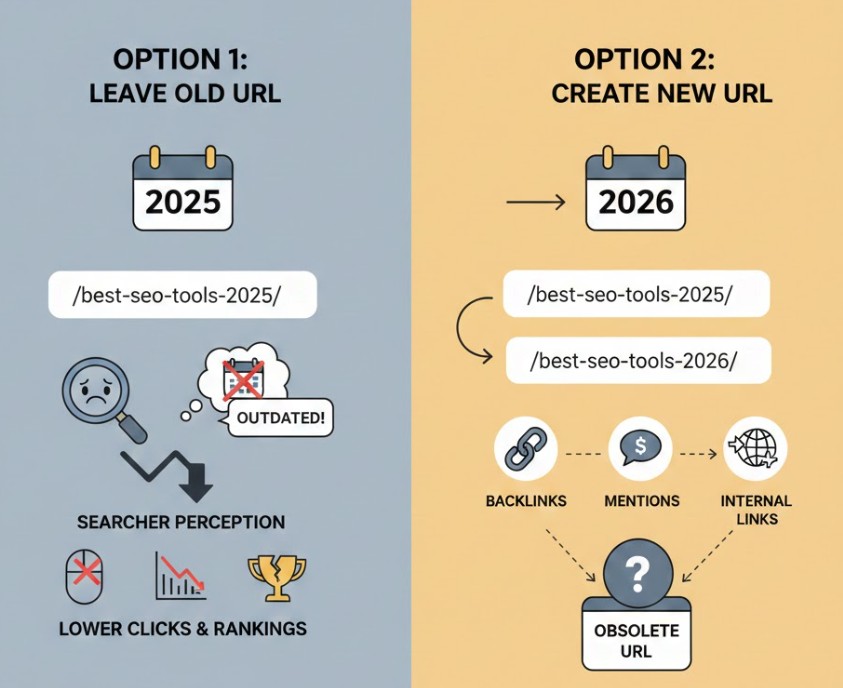
Option 1: Leave the Old URL Live
If you keep /best-seo-tools-2025/ live in 2026, the content immediately looks outdated, even if it was updated last week.
For example, a SaaS buyer searching in February 2026 sees your result labeled with “2025” in the URL and skips it in favor of a competitor whose URL doesn’t carry a visible year.
Over time, fewer clicks lead to lower engagement signals, and rankings gradually decline, not because the content is worse, but because perception has changed.
Option 2: Create a New URL for the New Year
This is the most common approach:
/best-seo-tools-2025/ → /best-seo-tools-2026/
On paper, this feels clean. In reality, it creates an obsolete URL that may already have:
- Editorial backlinks from industry blogs
- Mentions in newsletters or Slack communities
- Internal links from older articles and resource pages
For example, if /best-seo-tools-2025/ earned links from a popular SEO newsletter and several high-authority blogs, all of that equity now has to flow through a 301 redirect.
If even one internal link or external reference is missed, users hit a redirect or a broken path, and a portion of the accumulated value is lost.
To preserve rankings, you are forced to rely on redirects every single year, turning a simple content update into an ongoing technical dependency.
Why 301 Redirects Create an SEO “Tax”
Redirects are necessary tools but they are not neutral.
Link Equity Is Reduced With Every Redirect
Google passes most, but not all, link equity through a 301 redirect. Even a small loss becomes meaningful when it happens repeatedly.
For example, imagine a page at /best-seo-tools-2025/ that earns 100 high-quality backlinks from industry blogs, newsletters, and SaaS review sites.
When the URL is changed in 2025, all of that equity must pass through a redirect. When it is changed again in 2026, it passes through another redirect.
Each transition slightly weakens the page’s accumulated authority.
One redirect may be negligible. Annual redirects turn into a slow but consistent drain on ranking power, especially in competitive SERPs.
You Are Forcing Google to Re-Evaluate the Page Every Year
Changing the URL resets how Google processes the page. Each new URL forces Google to:
- Recrawl the page as a new address
- Re-index it under a different URL
- Re-associate existing backlinks
- Re-evaluate relevance and performance signals
For example, if /best-seo-tools-2025/ ranked in the top three for several competitive keywords, switching to /best-seo-tools-2026/ means Google must reassess whether the new URL deserves the same trust, even though the content is largely unchanged.
Instead of steadily strengthening one asset, you are asking Google to repeatedly “re-learn” the page.
Authority Fragmentation Is the Hidden Cost
Over time, the biggest damage isn’t the redirect itself, it is fragmentation.
Rather than one authoritative URL, you end up with multiple historical URLs connected by redirects.
SEO works best when authority compounds on a single, stable URL over many years.
Here’s how the difference plays out in practice:
| Evergreen URL Strategy | Year-Based URL Strategy |
| /best-seo-tools/ published once | /best-seo-tools-2024/, /2025/, /2026/ |
| Authority accumulates continuously | Authority resets partially every year |
| Backlinks point to one permanent URL | Backlinks spread across multiple URLs |
| Internal links remain stable | Internal links require constant updates |
| Strong long-term rankings | Rankings must be defended annually |
In the evergreen scenario, Google sees a durable, improving resource. In the year-based scenario, Google sees a series of replacements, each one slightly weaker than the last.
This is why redirects, when used as an annual habit rather than an exception, quietly tax your SEO performance instead of protecting it.
Why One Stable URL Beats Five Yearly URLs
Consider two scenarios.
Scenario A: Evergreen URL Strategy
/best-seo-tools/ Published in 2020, updated annually, earns links continuously.
By 2025, this URL has:
- Years of engagement signals
- Hundreds of backlinks
- Strong topical authority
Scenario B: Year-Based URL Strategy
- /best-seo-tools-2021/
- /best-seo-tools-2022/
- /best-seo-tools-2023/
- /best-seo-tools-2024/
- /best-seo-tools-2025/
Each version starts weaker than the last. Authority is diluted across redirects, and internal links constantly require maintenance. Search engines prefer continuity, not churn.
How Year-Based URLs Complicate Internal Linking
Internal linking is one of the most powerful SEO levers but dated URLs make it fragile.
Constant Internal Link Maintenance
Every time you change a URL, you must update: Blog posts, Resource pages, Category pages and Navigation links. Miss a few, and users hit redirects. Miss many, and Google crawls inefficiently.
Redirect Chains Slowly Degrade Performance
Over time, you create chains like:
2023 → 2024→ 2025 → 2026
Redirect chains:
- Slow down page load time
- Reduce crawl efficiency
- Dilute ranking signals
- Increase technical risk
Google explicitly recommends minimizing redirect chains. Year-based URLs practically guarantee them.
Why Year-Based URLs Undermine Evergreen Content Strategy
Evergreen content is designed to grow stronger over time. These are the pages that continue to attract traffic, earn backlinks, and hold rankings long after they’re published, as long as the content is kept current.
Examples include articles like how technical SEO works, a complete guide to keyword research, or best SEO tools.
The specifics may evolve, but the core value remains relevant year after year. When a year is added to the URL, it quietly works against this long-term value.
Even if the article is updated regularly, the URL makes it feel locked to a specific moment in time.
That often leads teams to treat the content as temporary rather than something to improve continuously.
As a result, instead of refining one strong page, teams end up replacing it every year. This prevents the content from reaching its full SEO potential and creates unnecessary duplication.
Search engines tend to reward pages that show:
- Long-term relevance rather than short-lived spikes
- Ongoing improvement instead of annual replacement
- Consistent URLs that accumulate authority over time
Year-based URLs signal the opposite. They suggest the content has a built-in expiration date, even when the topic itself doesn’t.
For evergreen content, keeping the URL timeless allows the page to grow into a lasting SEO asset.
How to Signal Freshness Without Changing the URL
Here’s the key insight: you don’t need the year in the URL to signal freshness to Google or users. There are better, safer, and more effective alternatives.
Use Evergreen URL Slugs
Keep URLs timeless and descriptive:
- /best-seo-tools/
- /seo-trends/
- /technical-seo-guide/
These URLs can remain relevant for a decade.
Update Title Tags and Headlines
Title tags are what users see in search results, not URLs.
For example:
- Title tag: Best SEO Tools for 2025 (Updated List)
- H1: The Best SEO Tools to Use in 2025
Same URL. Clear freshness signal.
Display “Last Updated” Information
Visible update dates reassure users and help search engines understand recency, especially when combined with structured data.
Refresh the Content Itself
Freshness is about substance, not timestamps.
Update:
- Statistics and benchmarks
- Examples and case studies
- Screenshots and tools
- Internal and external links
A stable URL with evolving content sends the strongest long-term signal.
Why This Approach Wins Long-Term SEO
Removing years from URLs:
Link Equity Compounds Over Time
Removing years from URLs allows all backlinks to strengthen a single, permanent page instead of being diluted across multiple yearly versions.
Click-Through Rates Stay Strong
A timeless URL never looks outdated in search results, helping maintain higher CTR even years after the page is published.
Internal Linking Becomes Simpler
Stable URLs eliminate the need to constantly update internal links to point to the “current” year’s version of a page.
Crawl Budget Is Used Efficiently
Search engines don’t waste resources processing repeated redirects or re-indexing new URLs for the same content.
Content Lifespan Is Extended
Pages can be improved and expanded over time instead of being replaced annually, allowing them to reach their full ranking potential.
SEO Authority Aligns With How Search Engines Evaluate Trust
Search engines reward consistency and stability, and evergreen URLs signal long-term relevance rather than temporary value.
Key Takeaway- Build URLs for the Next 10 Years
Adding a year to a URL feels tactical. It feels responsive. It feels SEO-smart. But in reality, it trades long-term authority for short-term perception.
Strong SEO strategies are built on durable infrastructure, URLs that don’t need to change every January.
If your site already suffers from year-based URLs, redirect chains, or fragmented authority, a structural audit can identify where value is leaking and how to consolidate it safely.
A comprehensive SEO audit from Stan Ventures can help future-proof your URL structure, reclaim lost equity, and turn annual updates into growth, not maintenance.
Because in the age of AI SEO, the goal isn’t to look fresh for one year. It’s to stay relevant for the next ten.
Frequently Asked Questions
1. Do year-based URLs hurt SEO rankings?
Yes. Year-based URLs can weaken long-term SEO by aging content, forcing redirects, and splitting link authority over time.
2. Should I remove the year from existing URLs?
If the content is evergreen, removing the year and redirecting to a stable URL can help consolidate authority and improve long-term performance.
3. Are year-based URLs ever good for SEO?
They work for news, event coverage, or annual reports, but not for evergreen or educational content that stays relevant year after year.
4. How can I show content freshness without changing the URL?
Use updated title tags, refreshed content, visible “last updated” dates, and structured data instead of adding years to URLs.

Dipti Arora
AuthorDipti Arora is a Senior Content Writer with over seven years of experience creating impactful content across Digital Marketing, SEO, technology, and business domains. She has a strong background in managing news verticals and delivering editorial excellence. Dipti has contributed to leading publications such as The Times of India and CEO News, where her research-driven storytelling and ability to simplify complex subjects have consistently stood out. She is passionate about crafting content that informs, engages, and drives meaningful results.
