Despite widespread claims that AI tools have replaced search engines, comprehensive traffic data shows that organic search remains stable and continues to play a central role in how people discover information online.
Since generative AI tools became part of everyday conversation, search has repeatedly been framed as a fading habi.
The introduction of ChatGPT in late 2022 intensified this belief, with many voices predicting that users would abandon search engines entirely and that organic traffic would shrink at a historic scale.
Those predictions sound convincing when repeated often enough, yet they struggle to survive contact with real usage data.
When traffic patterns across more than 40,000 of the largest websites in the United States are examined together, organic search does not show signs of collapse. Instead, year-over-year traffic declined by roughly 2.5%, a modest change that sits well outside the dramatic drops frequently cited in industry commentary.
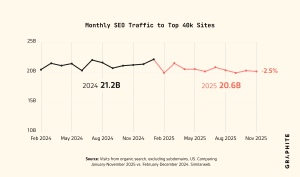
Search behavior is clearly adjusting, but it has not been displaced, replaced, or rendered irrelevant by AI-driven interfaces.
How the “Search Is Dying” Idea Gained Momentum
The belief that SEO no longer works rests on a collection of assumptions that reinforce one another without strong evidence.
A common claim suggests that most people now rely on large language models instead of search engines. Another argues that Google’s AI Overviews have stripped publishers of meaningful traffic. A third suggests that advertising has overtaken organic results entirely.
These arguments often lean on surveys, personal experience, or isolated examples from a small number of well-known sites.
While such inputs can highlight individual experiences, they are poorly suited to measuring broad behavioral change.
Surveys rely on memory and perception, which tend to blur when people are asked to estimate frequency or recall past actions. Small samples amplify extremes, turning specific losses into stories about universal decline.
What has been largely absent from these discussions is large-scale behavioral data that reflects what users actually do across millions of real browsing sessions.
What Large Datasets Reveal About Search Usage
When search traffic is measured at scale, the overall picture is far more stable than the headlines suggest.
Across tens of thousands of major sites, organic search traffic declined slightly but remained broadly consistent. Some of the largest platforms recorded modest gains, while the sharpest declines appeared among mid-sized sites rather than across the entire market.
Search engine usage itself has followed a similar pattern. Traffic increased during the early pandemic period, dipped slightly in 2022, and then stabilized. In 2025, visits to Google and to search engines collectively increased again, both in the United States and worldwide.
Google’s own disclosures reinforce this view, with the company reporting more than five trillion searches annually.
Independent estimates derived from visit and pageview data align closely with that figure, suggesting that search demand remains strong rather than eroding.
Uneven Impact Across Industries Explains the Confusion
Not every site or category has experienced search changes in the same way, which helps explain why perceptions differ so widely.
News, health, cooking, and entertainment sites saw steeper declines, in some cases exceeding ten percent. At the same time, shopping platforms, clothing retailers, and online marketplaces recorded growth.
This uneven distribution means that publishers operating in harder-hit categories may genuinely feel that search has weakened, even while the broader ecosystem remains stable. Individual outcomes vary, but they do not define the entire market.
AI Overviews Reshape Visibility Without Eliminating Value
AI Overviews do affect click behavior when they appear, with organic click-through rates dropping by around 35% on those result pages.
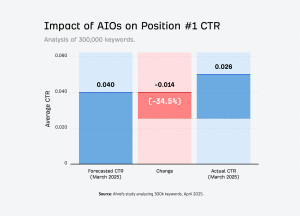
However, these summaries appear roughly 30% of the time and primarily target informational queries rather than searches tied to purchase decisions or high commercial intent.
Before AI Overviews were introduced, featured snippets already reduced clicks for many of the same queries.
In practice, the new format often replaced an existing one rather than introducing an entirely new loss. For brands focused on transactional or comparison-driven searches, the overall impact has been limited.
Organic Results Still Dominate User Clicks
Concerns that advertising has overtaken organic results are also not supported by the data.
While clicks to ads have increased slightly, organic listings continue to capture the vast majority of attention.
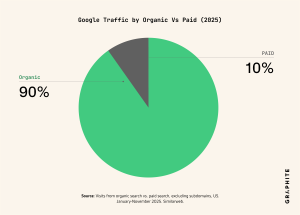
Roughly 90% of clicks from Google still go to organic results, leaving paid placements with a comparatively small share of user interaction.
Organic visibility remains the primary driver of discovery for most websites.
Why Personal Observations Often Mislead
Claims about abandoning search engines in favor of AI tools are especially common within technology-focused communities.
These perspectives feel persuasive because people tend to assume their habits reflect those of the wider population. This tendency is reinforced when peers share similar workflows, tools, and preferences.
Once AI tools become part of daily routines, they also receive disproportionate attention, creating the impression that they dominate behavior more than they actually do.
Large-scale usage data consistently shows that search engines continue to anchor how people navigate the web.
What This Means for the Future of Search and SEO
Search is changing in form, but not in purpose. Interfaces are evolving, summaries appear more often, and AI-assisted experiences increasingly shape how questions are framed.
None of these changes removes the need for reliable sources, clear answers, and trusted destinations.
The pressure is most visible on sites that depend heavily on broad informational traffic without depth or authority.
Sites that align closely with search intent, usefulness, and credibility continue to perform, even as presentation formats shift.
Guidance for Publishers and Marketers
Here are key considerations for publishers and marketers as search behavior continues to evolve alongside AI tools.
- Review performance at a granular level rather than relying on overall traffic trends, since intent, topic, and outcome-based segmentation reveals where real changes are actually happening.
- Separate informational, navigational, and transactional queries when analyzing impact, because AI-driven features affect these categories very differently.
- Strengthen content in areas where users still require explanation, comparison, validation, or reassurance, as these needs remain poorly served by summarized answers.
- Track visibility changes on pages where AI Overviews appear, instead of assuming universal click loss across the entire site.
- Diversify traffic sources thoughtfully without treating search as expendable, since organic discovery continues to be one of the most reliable long-term channels.
- Resist making strategic decisions based on exaggerated forecasts or anecdotal signals, which often misrepresent broader user behavior.
When internal data does not fully explain performance shifts, broader context can help clarify whether changes reflect structural movement or short-term volatility. This is where agencies working closely with evolving search systems can add value without reshaping strategy around every update.
At Stan Ventures, we offer AI SEO services focused on interpretation rather than reaction. By examining patterns across multiple sites and query types, we help teams make measured adjustments while preserving the consistency that long-term search visibility depends on.
Key Takeaways
- Organic search traffic has softened slightly rather than collapsing outright.
- Search engine usage remains stable and showed modest growth in 2025.
- AI Overviews affect clicks in limited contexts rather than universally.
- Organic results still receive the overwhelming majority of clicks.
- Large behavioral datasets offer a clearer picture than surveys or anecdotes.

Zulekha
AuthorZulekha is an emerging leader in the content marketing industry from India. She began her career in 2019 as a freelancer and, with over five years of experience, has made a significant impact in content writing. Recognized for her innovative approaches, deep knowledge of SEO, and exceptional storytelling skills, she continues to set new standards in the field. Her keen interest in news and current events, which started during an internship with The New Indian Express, further enriches her content. As an author and continuous learner, she has transformed numerous websites and digital marketing companies with customized content writing and marketing strategies.
