
As state data privacy laws are getting ready to roll out later this year, Google Ads is getting advertisers ready for some big changes to its Restricted Data Processing (RDP) controls.
They recently emailed U.S. advertisers who use Google Ads or Google Analytics, explaining the upcoming changes to follow the new rules.
This comes as people are increasingly concerned about their privacy and as more states are making their own privacy laws.
Key Privacy Changes
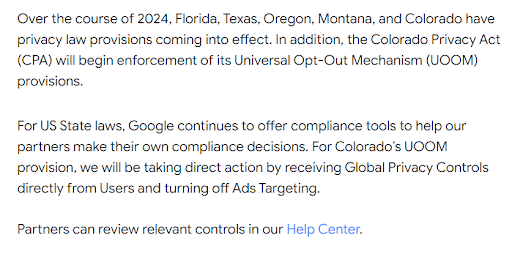
This year will witness two major updates in the U.S. privacy realm. Five states – Florida, Texas, Oregon, Montana, and Colorado – are set to implement their privacy law provisions.
These laws aim to provide consumers with more control over their personal data and how it is utilized by companies. Each state law has unique provisions, but they share common goals of enhancing transparency, user consent, and data protection.
Colorado will begin enforcing its Universal Opt-Out Mechanism (UOOM) provisions, which significantly enhance user control over data processing and ad targeting. The CPA (Colorado Privacy Act) includes specific measures such as Global Privacy Control (GPC) signals that automatically opt users out of ad targeting when sent to Google.
In response to these changes, Google is updating its privacy compliance tools and terms:
- Updated Terms: Google is revising the language in several key documents, including the Google Ads Data Processing Terms, Google Ads Controller-Controller Data Protection Terms, Google Measurement Controller-Controller Data Protection Terms, and the U.S. State Privacy Laws Addendum. Advertisers who have already agreed to these terms need not take further action. These updates aim to reflect the latest legal requirements and provide clear guidelines for advertisers.
- Role as Service Provider: Google will act as a service provider or processor while RDP is enabled for the affected states. This means Google will handle data in a manner that complies with state-specific privacy laws, limiting the use of data for personalized advertising unless explicit consent is given by the user. This RDP functionality will expand as other states introduce their own privacy laws.
Specific Changes for Colorado Advertisers
The Colorado Privacy Act requires that GPC signals automatically opt users out of ad targeting. When users send a GPC signal to Google, it will trigger RDP, effectively turning off ad targeting, data sale, and data sharing for those users. This change aims to give users more control over their personal data and how it is used by advertisers, ensuring that their privacy preferences are respected.
Implications for Advertisers
These upcoming changes in privacy regulations will significantly affect how advertisers operate. Here’s how:
- Less Personalized Ad Inventory: Advertisers will likely see a reduction in personalized ad inventory. The opt-out mechanisms will make it easier for users to avoid targeted advertising, impacting inventory, targeting efficiency, and bidding strategies. Advertisers may need to shift focus to broader targeting methods and contextual advertising.
- Impact on Customer Match: The match rate on Customer Match lists and other remarketing lists will likely decline due to the GPC signals. Users must consent to marketing updates, and those not logged into their Google accounts or who decline tracking will not be included in these lists. This could lead to a decrease in the effectiveness of remarketing campaigns.
- Performance Reporting Volatility: As personalized ads and remarketing capabilities are restricted, performance metrics such as conversions, campaign attributions, ROAS, and CPA may fluctuate. Advertisers should prepare for variability and consider focusing less on hard numbers in their reporting. They may need to adopt more flexible reporting methods that accommodate potential fluctuations in performance metrics.
Strategic Considerations for Advertisers
Google’s proactive stance on compliance reflects its ongoing commitment to user privacy, a journey that began with GDPR updates in the EEA and U.K. in 2018. By updating its tools and terms, Google helps advertisers understand the complexities of varying state laws, offering some relief amid stringent regulatory environments.
However, advertisers must remain vigilant. While Google provides substantial support, the onus of compliance ultimately lies with the advertisers. They should:
- Monitor Match Rates: Keep an eye on Customer Match and remarketing list performance to understand the impact of privacy changes. This will help in adjusting marketing strategies accordingly.
- Adapt Strategies: Be prepared to adjust bidding and targeting strategies in response to reduced personalized ad inventory. Advertisers might need to explore new audience segments and alternative advertising methods.
- Flexible Reporting: Embrace flexible reporting methods that accommodate potential fluctuations in performance metrics. This could involve setting up new KPIs that align with privacy-compliant advertising strategies.
The Bottom Line
Google’s updates to its compliance tools are a welcome step towards helping advertisers manage the upcoming data privacy laws. As the rules continue to change, advertisers must stay informed and adaptable, ensuring their strategies and practices align with new privacy standards. The changes underscore the importance of balancing effective advertising with robust privacy protections, a trend that is likely to shape the future of digital marketing. Advertisers who proactively adapt to these changes will be better positioned to maintain trust and achieve sustainable success in an increasingly privacy-conscious market.

Dileep Thekkethil
AuthorDileep Thekkethil is the Director of Marketing at Stan Ventures, where he applies over 15 years of SEO and digital marketing expertise to drive growth and authority. A former journalist with six years of experience, he combines strategic storytelling with technical know-how to help brands navigate the shift toward AI-driven search and generative engines. Dileep is a strong advocate for Google’s EEAT standards, regularly sharing real-world use cases and scenarios to demystify complex marketing trends. He is an avid gardener of tropical fruits, a motor enthusiast, and a dedicated caretaker of his pair of cockatiels.
