
Google quietly made a major technical change back in September: it deprecated the &num=100 search parameter, the query string SEO tools used for years to request deeper SERP results (up to 100 listings per query).
That single change disrupted how almost every ranking tool — Ahrefs included — pulled extended SERP data. As Google continued tightening how automated requests are handled, many rank trackers could only retrieve partial results, leading to incomplete visibility beyond page one.
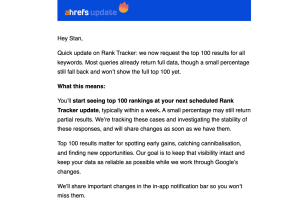
This week, Ahrefs confirmed that they’ve built a workaround and that Top 100 rankings are now returning for most keywords again.
Here’s what’s happening — and what it means for SEO teams.
Why Google Removed “num=100” (and why it broke rank tracking)
Google’s old &num=100 parameter allowed tools to request up to 100 organic results in a single call.
When Google shut it down, it was part of a wider effort to:
- Standardize SERP formats across devices
- Reduce automated scraping load
- Protect experimental result layouts (AI Overviews, Perspectives, modules, etc.)
- Make search results more dynamic and less predictable for automated tools
As a result:
- Tools could no longer request 100 results at once
- Some were limited to partial SERPs (10–20 results)
- Others received inconsistent data depending on query category and volatility
This is why many SEO teams saw fluctuating or incomplete keyword rankings from September onward.
Ahrefs’ update signals that they’ve implemented new collection logic to restore Top 100 depth without relying on the deprecated parameter.
What Ahrefs Just Fixed
Ahrefs shared that:
- They now request Top 100 results for every keyword using an alternative approach
- Most keywords already return complete Top 100 data
- A small percentage still fall back to partial results (due to SERP instability)
- Full data should appear during the next Rank Tracker refresh (usually within a week)
- They’re monitoring edge cases as Google continues to tweak SERPs
In short: the visibility gap created by Google’s parameter change is closing.
Why This Matters for SEO Professionals
1. Early Momentum Tracking Is Back
Ranking breakthroughs usually start around positions 30–70. Without deep SERPs, those gains were invisible — making forecasting harder and backlink building activities cumbersome. That visibility is now returning.
2. Cannibalization Detection Improves
Overlapping URLs often fight it out deeper in the SERPs. Spotting these earlier prevents traffic loss later.
3. Better Opportunity Discovery
Long-tail keywords, secondary intents, and rising variations typically appear in positions 20–100. Missing this layer means missing growth.
4. More Stable Reporting
Since September, weekly reports across the industry were inconsistent. With deeper SERPs restored, trend lines normalize again.
Stan Ventures’ Take
Google’s ongoing SERP experiments — from AI Overviews to collapsing organic modules — will keep pushing SEO tools to rethink how they fetch data.
Ahrefs restoring Top 100 visibility is a positive step, especially for:
- Forecasting
- Link-building prioritization
- Content gap analysis
- Momentum tracking
- Competitor benchmarking
Our internal teams have already integrated the update into our monitoring processes so client reporting stays stable and actionable.
Ahrefs will continue posting updates in their in-app notification bar as they refine their new SERP collection method. We’ll keep watching how this impacts keyword volatility, AI-driven SERP layouts, and the broader rank-tracking ecosystem.
We also hope other SEO tools such as SEMRush and Moz come up with similar workarounds in the coming days to fix the current gap in keyword tracking.

Dileep Thekkethil
AuthorDileep Thekkethil is the Director of Marketing at Stan Ventures, where he applies over 15 years of SEO and digital marketing expertise to drive growth and authority. A former journalist with six years of experience, he combines strategic storytelling with technical know-how to help brands navigate the shift toward AI-driven search and generative engines. Dileep is a strong advocate for Google’s EEAT standards, regularly sharing real-world use cases and scenarios to demystify complex marketing trends. He is an avid gardener of tropical fruits, a motor enthusiast, and a dedicated caretaker of his pair of cockatiels.
