
Google’s AI Overviews (AIOs) are no longer just an experiment but they are a seismic shift in the way users interact with the search interface.
With more than 1.5 billion monthly users in Q1 2025 alone, AIOs now reach nearly 26.6% of global internet users or about 18.3% of the entire global population.
That’s not just a trend but a major change in the way people access information from search engines.
Recently, Ahrefs released a surprising study that analyzed 55.8 million AIOs results across 590 million search terms. According to the findings, AIOs now show in over 54.6% of search queries.
Yes, you read that right. While AIOs only appear for 9.46% of all keywords tracked in the Ahrefs database they show up in over 54.61% of Google searches by total volume.
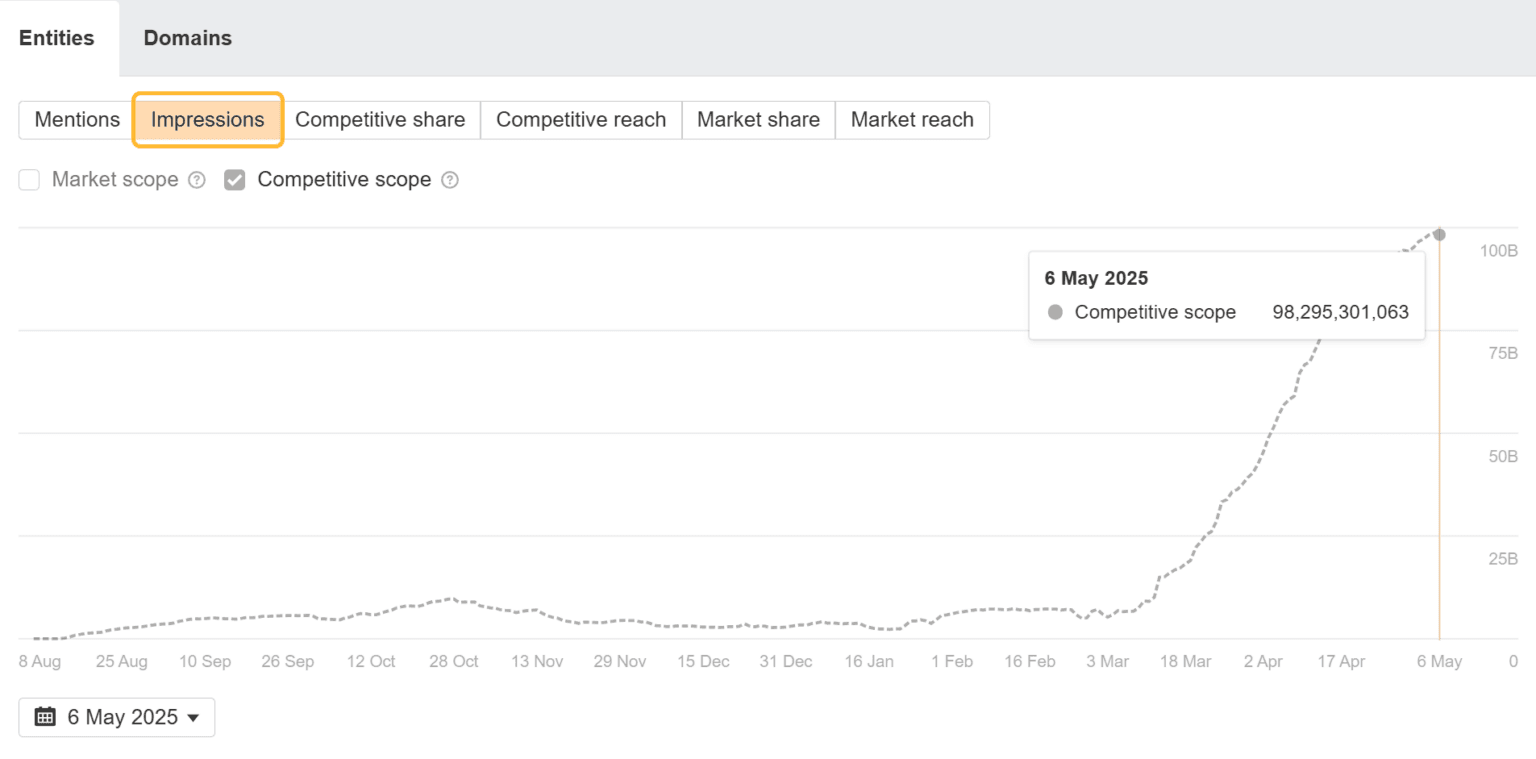
This means that while they might not appear on every keyword, they dominate the ones that matter most – those with the highest search volume.
Even more surprising – based on Ahrefs’ methodology, this could be a conservative estimate. They don’t track one-off or low-volume queries in their main index and AIOs frequently appear on those.
The real number could be closer to 75% of all Google searches.
If you are a marketer, SEO or brand relying on organic traffic. The rules are shifting fast. This means AI SEO Service should be in your radar to future-proof your website.
AIOs Are Everywhere—But Especially in the U.S., India and Brazil
AIOs have not fully rolled out globally but in the countries where they have, the impact is already dramatic:
- United States: 16% of all desktop keywords now show AIOs
- India: 16.5%
- Brazil: 15.5%
- United Kingdom: 12.5%
These numbers are pulled from the Ahrefs Big Data index and show a consistent pattern. AIOs are spreading and their visibility is accelerating.
In fact, March 2025 marked a sharp upward spike in AIO appearances across all tracked countries
Who’s Dominating the AIO Mentions?
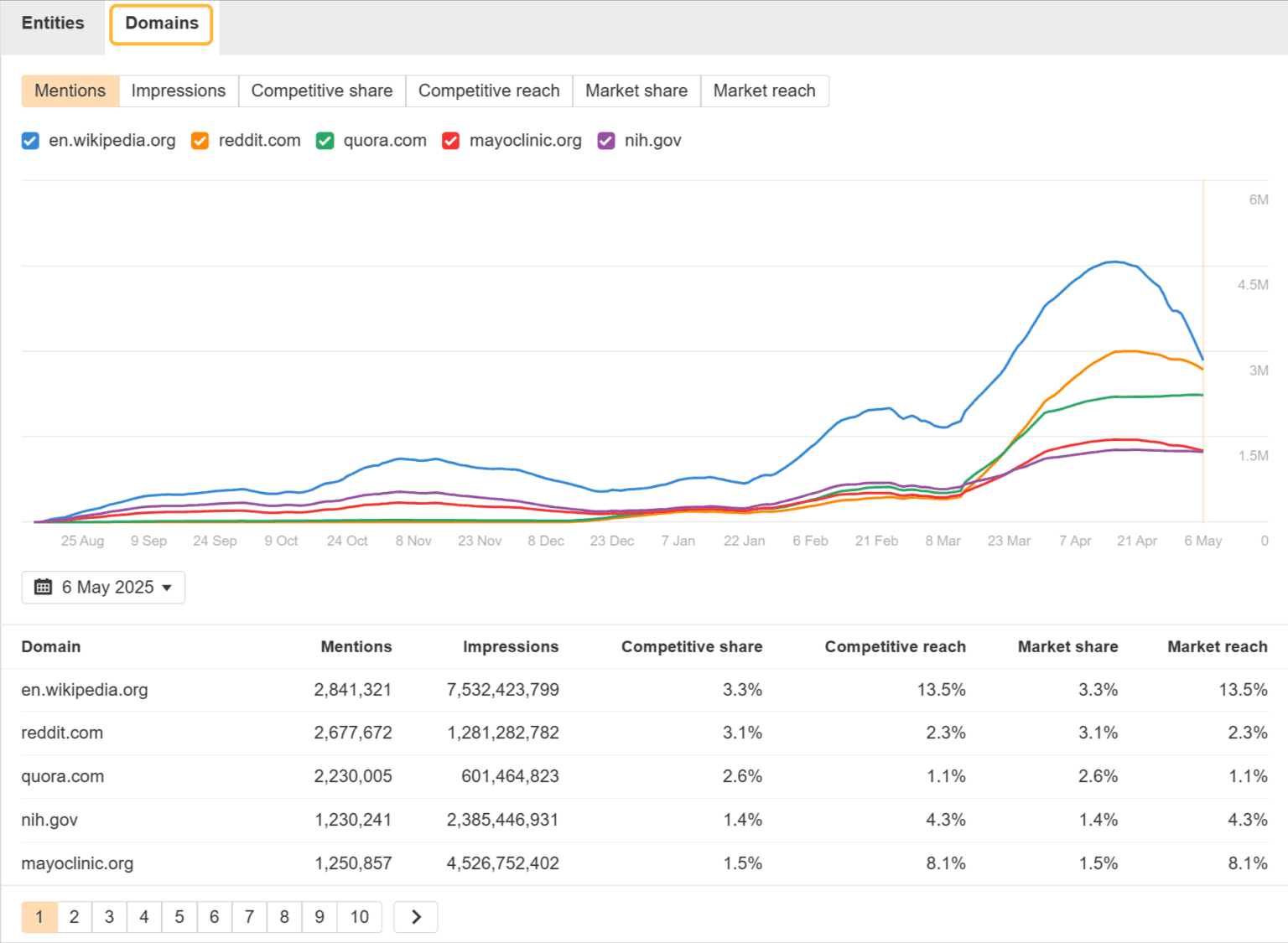
If you are wondering who is winning the AIO game so far, the answer is crystal clear:
| Domain | Mentions |
| Reddit.com | 2.97M |
| Wikipedia | 2.92M |
| Quora.com | 2.27M |
| YouTube | 2.06M |
| MayoClinic | 1.31M |
These sites alone hold a 28.9% share of all AIO mentions and they all have one thing in common: they are content-rich, community-driven and SEO optimized content.
Ahrefs also broke down those top 50 by category:
- Q&A & Community: 5.9%
- Health & Medical: 5.8%
- Knowledge & Reference: 4.4%
- Video & Social Media: 3.4%
- Search & Translation: 1.2%
- Education: 1.3%
- E-commerce & Tech: 1.1%
- News & Media: 0.6%
Think about that. AIOs favor long-form, informative, trustworthy content. If your content is not built for depth, discussion and discovery… it may simply be left out of the AI conversation.
What Types of Searches Are AIOs Targeting?
Let’s break this down:
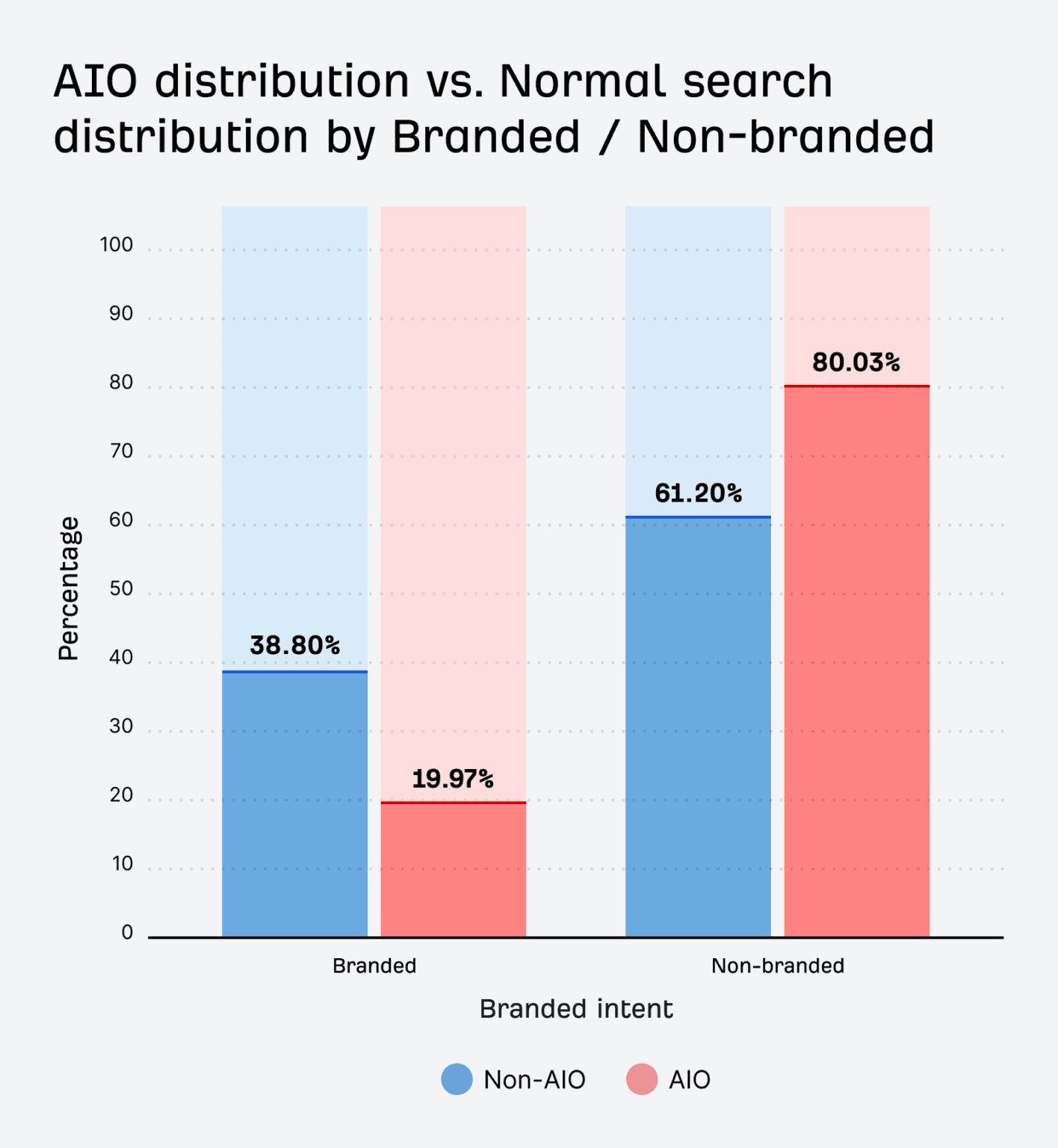
- 97.7% of AIOs show for informational intent
- Only 12.86% for commercial and 2.85% for transactional
- Non-branded queries makeup 80.03% of AIOs
That means AIOs are prioritizing “What is?”, “How to?” and “Why does?” kinds of questions over product pages or branded searches. For example:
- “How does blockchain work?” will likely trigger an AIO.
- “Buy Nike shoes online” likely will not.
If your content strategy is built around product-based keywords and quick conversions, it might be time to re-think your funnel.
AIOs Are Slashing Clicks—By Over 34%

Perhaps the most crucial stat of all: AIOs are reducing clicks by an average of 34.5%. Patrik Stox, the author of the Ahref study noted on X:
AIOs show mostly for informational queries that are not monetized.
Another @ahrefs study found that AIOs reduced clicks by 34.5%.
If the content wasn’t valuable enough to put $$$ behind it, how much will AIOs really impact the bottom line of companies?https://t.co/nxacI2WyXo pic.twitter.com/q8Onx9Ra8o
— Patrick Stox (@patrickstox) May 20, 2025
“AIOs show mostly for informational queries that are not monetized… If the content wasn’t valuable enough to put $$$ behind it, how much will AIOs really impact the bottom line of companies?”
Well, that is a million dollar question. If these queries were not monetized heavily before, does losing clicks really matter? The answer depends on your business model.
But there is a broader implication: the top of the funnel just got automated. And it is not your site doing the explaining but it is Google.
What Should Marketers and Brands Do Now?
Let’s see what this all really means.
- Double Down on Informational Content
AIOs prefer content that is exhaustive, educational and well structured. Brands that have invested in blog articles, whitepapers and explainer content are much more likely to get surfaced in AIOs.
- Make Your Content Mentions Count
Being quoted in an AIO is now as valuable as ranking on top organic spots. Monitor tools like Ahrefs’ Brand Radar to see where your content appears and what types of queries you are dominating.
- Track Share of Voice, Not Just SERP Rank
Traditional SERP positions are becoming less relevant. Your Share of Voice (SoV) and how often your brand appears in AIOs and how many impressions it earns may become the new benchmark.
- Adapt to Longer Queries
Google has quietly removed its 32-word limit on search. People are now typing or speaking full questions and getting immediate AI answers. Your SEO strategy needs to reflect this.
At last, If you are skeptical then consider Google says there are over 5 trillion searches per year. Even if AIOs only reach half of that, we are talking about 2.5 trillion AI-generated summaries annually.
One thing is certain: those who invest in building trusted, detailed, helpful content just like the top players on that domain list which may still win in the age of AI search.
But for the rest, the era of “ranking #1” may no longer guarantee a single click.

Dileep Thekkethil
AuthorDileep Thekkethil is the Director of Marketing at Stan Ventures, where he applies over 15 years of SEO and digital marketing expertise to drive growth and authority. A former journalist with six years of experience, he combines strategic storytelling with technical know-how to help brands navigate the shift toward AI-driven search and generative engines. Dileep is a strong advocate for Google’s EEAT standards, regularly sharing real-world use cases and scenarios to demystify complex marketing trends. He is an avid gardener of tropical fruits, a motor enthusiast, and a dedicated caretaker of his pair of cockatiels.
