
Brave is proving that you don’t have to be Google to win in search.
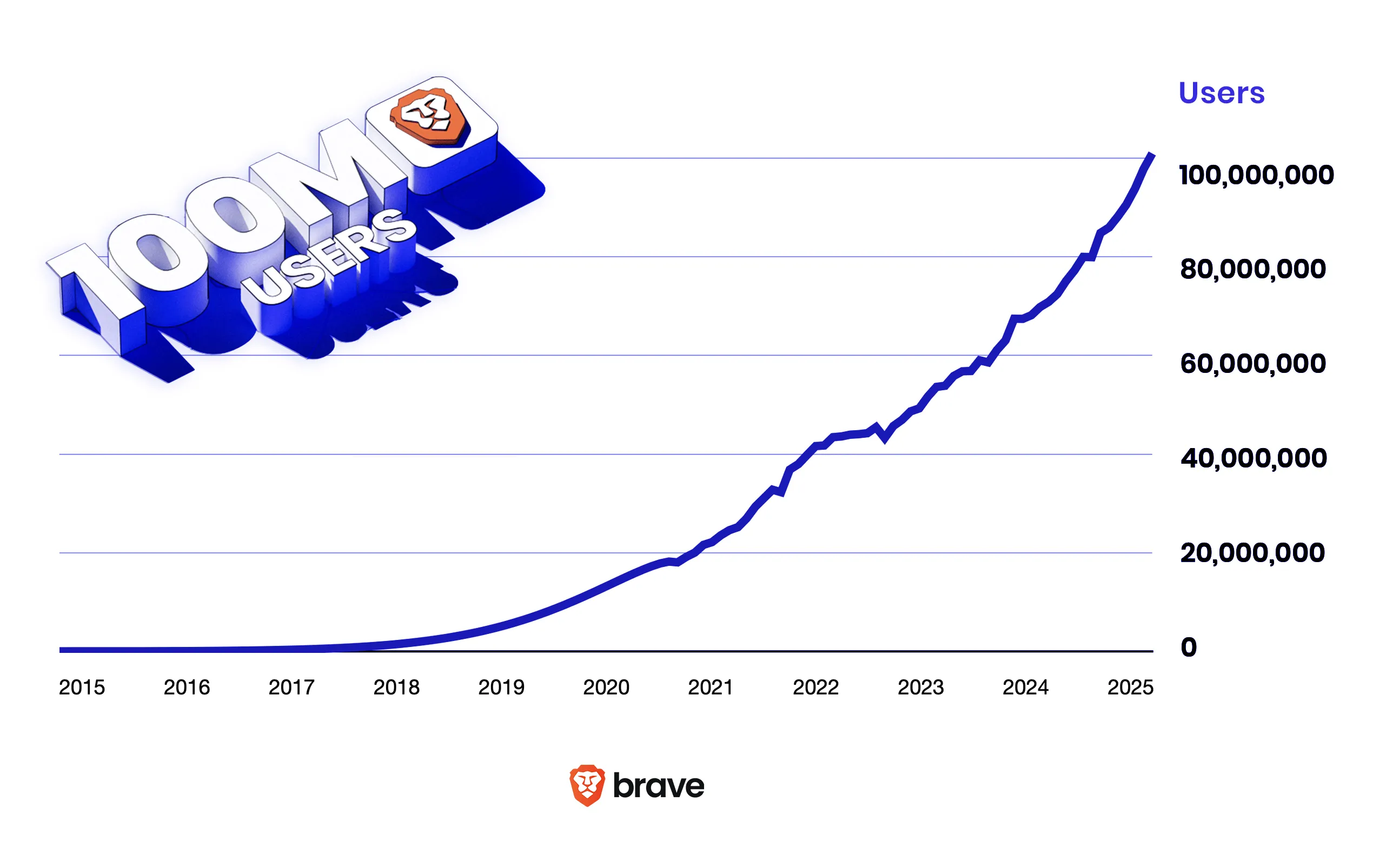
In a market dominated by trillion-dollar giants like Google and Microsoft, who would have thought that a privacy-first browser could quietly cross 100 million active users and $100 million in annualized revenue?
Yet, that’s exactly what Brave Software has done, marking one of the most remarkable growth stories in the search and browser industry in recent years.
According to Brave’s Chief Business Officer, the company surpassed the $100 million revenue milestone in Q1 2025.
And now boasts over 100 million monthly active users (MAUs) as of September, a sharp rise from 77 million at the end of 2024.
This isn’t just another headline about “tech growth.” It is a signal that even in markets as entrenched as web browsing and search, there’s still room for innovation, disruption, and user-driven trust.
How Did Brave Reach 100 Million Users?
The journey to 100 million users didn’t happen overnight or by accident.
According to the latest report of The Information, Brave positioned itself at the intersection of privacy, transparency and user control three values that increasingly define how modern users navigate the web.
Unlike Google Chrome or Microsoft Edge, which monetize heavily through data-driven advertising, Brave built its browser to do the opposite: block ads, prevent tracking and reward users instead of exploiting them.
Its pitch is simple but powerful: “Browse faster, safer, and without being tracked.”
And that message resonated. As data privacy scandals, ad fatigue, and AI-powered misinformation began eroding trust in big tech platforms, Brave quietly became the browser for people who wanted the internet on their terms.
By offering ad-blocking by default, private search, and its own cryptocurrency-based rewards system (BAT), Brave transformed what used to be a dull utility of the browser into a statement of digital independence.
Brave has 100M active users and owns its search index -> Search and browser startup Brave’s CBO says it passed $100M in annualized revenue in Q1, and had 100M MAUs as of September, up from 77M at the end of 2024
“Brave has also powered search capabilities for Meta Platforms and… pic.twitter.com/cw3osgACSU
— Glenn Gabe (@glenngabe) November 11, 2025
What Makes Brave Different in the Search Market?
Most important? Brave owns its own search index.
In a world where even AI search tools like Perplexity and Neeva have relied on data from Bing or Google, Brave stands out as one of the very few companies that have built an independent search index from the ground up.
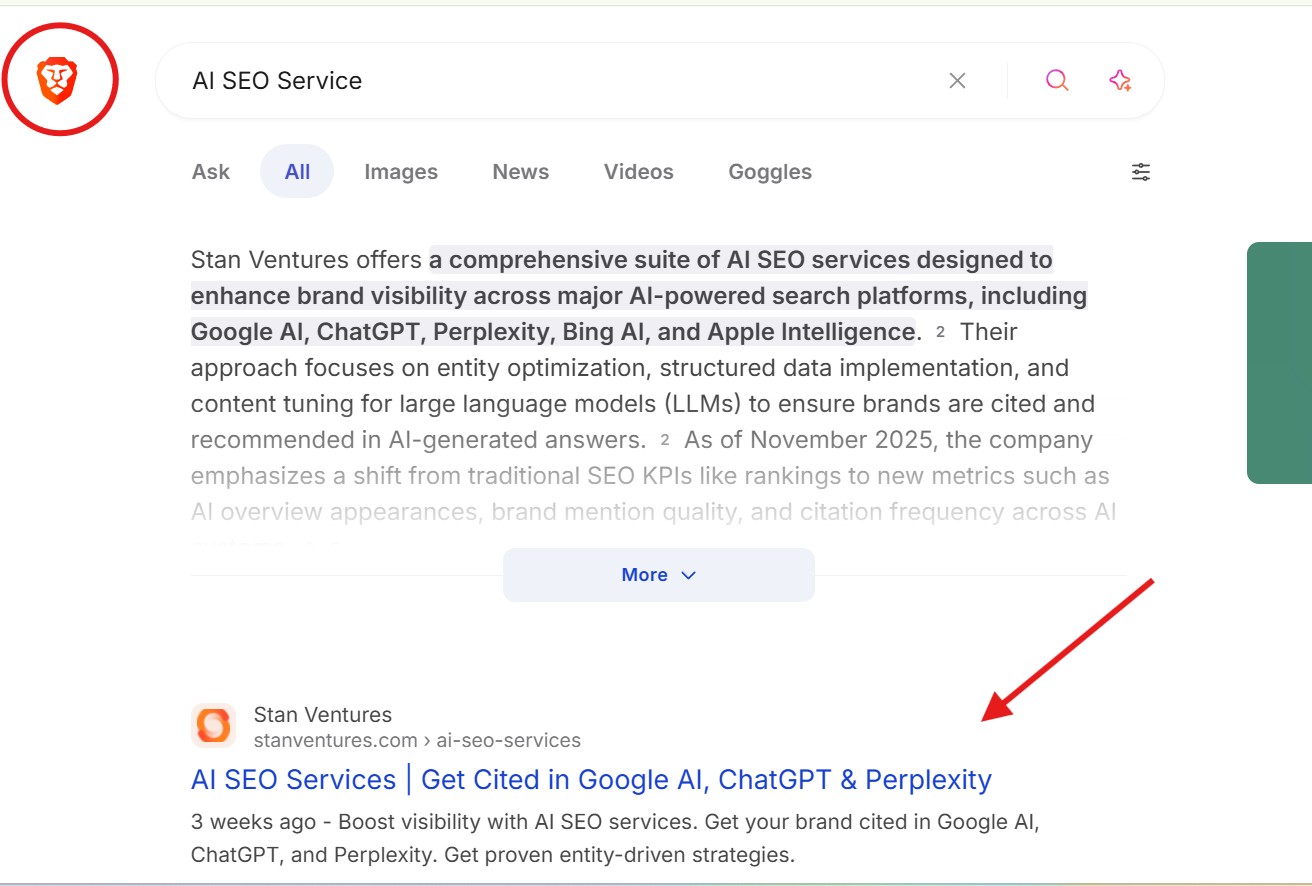
This independence gives Brave control over both user experience and monetization, something most competitors can’t claim.
“Brave has also powered search capabilities for Meta Platforms and Perplexity,” reports the company, signaling that its technology is being quietly embedded into some of the biggest names in tech.
That means Brave isn’t just another browser, it’s becoming a core search infrastructure provider for other companies.
By owning its search stack, Brave can tailor results, enhance privacy, and deliver relevant answers without sending data back to Google or Microsoft. And in the age of AI-driven search, that control is priceless.
How Does Brave Make Money?
Many people still assume that privacy-first products can’t make money. Brave’s success destroys that myth.
Its business model revolves around search partnerships, ad revenue, and Brave Rewards, a system that lets users earn tokens (BAT means Basic Attention Token) for viewing privacy-respecting ads.
But here’s the strategic masterstroke: Brave monetizes user attention, the same core value that drives Google’s empire but does it ethically.
- Default search traffic: Every Brave browser user who searches via Brave Search generates monetizable traffic.
- Ad revenue: Brave’s own ad ecosystem rewards both advertisers and users, creating a mutually beneficial loop.
- Search partnerships: Brave earns revenue when users engage with partner search results or affiliate content.
In short, Brave cracked a sustainable model for privacy-first monetization, one that doesn’t rely on surveillance capitalism.
Why Brave’s Growth Matters for the Tech Industry
Brave’s milestone doesn’t just mark business success, it challenges a long-standing assumption: that search and browser markets are closed ecosystems, forever dominated by Google and Microsoft.
Here’s what Brave’s rise tells us about the industry’s future:
- The browser layer still has room for disruption
People said the browser wars ended years ago. Brave’s growth proves otherwise. Users are hungry for browsers that offer differentiation such as privacy, speed, and trust.
- Owning a search index is strategic power
While most companies rely on Bing APIs or Google data, Brave’s independence makes it resilient and scalable especially as AI companies look for ethical, license-friendly data sources. - User trust is now a growth driver.
In an era of data leaks and AI misinformation, Brave turned “no tracking” into a selling point and users responded in millions. - Privacy can be profitable.
$100 million in annualized revenue proves that privacy-first doesn’t mean revenue-last. The model works, if executed with precision.
What Does Brave’s Success Mean for AI and Search?
AI search is redefining how people discover information. Platforms like Perplexity AI, ChatGPT and Google’s AI Overviews now summarize, answer and recommend instead of showing traditional search results.
But where does that information come from? Data-rich search indexes.
Brave’s search index gives it an enormous strategic edge. It’s not just a browser company anymore , it is a data infrastructure player.
Its index is already being used to power AI-driven search experiences for companies like Meta and Perplexity. This positions Brave as a B2B data partner in the AI economy, not just a consumer-facing brand.
That means every search query run through Brave’s system feeds a growing web of contextual data that AI companies can use to train and refine their models.
And because Brave is privacy-first, it offers a rare combination of clean data, without surveillance baggage.
The Bigger Picture: The Future of Search Isn’t Just Google vs. Bing
Brave’s story is a reminder that the search and browser market isn’t frozen.
Yes, Google commands over 90% of the market. Yes, Microsoft is pouring billions into AI search. But Brave shows that smaller, nimble players can still carve out meaningful niches by solving problems big tech won’t touch.
- Google optimizes for ad revenue.
- Bing optimizes for enterprise and AI integrations.
- Brave optimizes for users.
And that focus on real user needs is what’s driving its growth.
With AI changing how we discover, verify, and consume information, Brave’s privacy-driven, ad-light model feels less like a niche and more like a glimpse into the future of ethical search.
Why Investors Should Pay Attention
Brave’s $100M milestone is instructive.
It shows that even in “mature” markets, opportunities still exist for differentiated, user-centric products that monetize attention responsibly. For investors and tech builders, the implications are huge:
- Default placement is everything. Controlling the entry point to search equals long-term recurring revenue.
- Verticalized search opportunities are wide open. Niche, privacy-focused, or domain-specific engines could replicate Brave’s success at smaller scales.
- Partnerships over dependence. By powering Meta and Perplexity, Brave demonstrates that being the infrastructure layer can be more valuable than competing head-on.
The takeaway? Browsers and search aren’t dead markets, they’re reinventing themselves.
TL;DR – Key Takeaways
- Brave hit 100M monthly active users and $100M annualized revenue in 2025.
- It’s one of the few companies owning its own search index, giving it full control over data and monetization.
- Brave powers AI search capabilities for Meta and Perplexity.
- Its business model blends privacy-first advertising, user rewards, and search partnerships.
- The milestone proves there’s still room to disrupt search and browsing with ethics, innovation, and user trust leading the way.

Dipti Arora
AuthorDipti Arora is a Senior Content Writer with over seven years of experience creating impactful content across Digital Marketing, SEO, technology, and business domains. She has a strong background in managing news verticals and delivering editorial excellence. Dipti has contributed to leading publications such as The Times of India and CEO News, where her research-driven storytelling and ability to simplify complex subjects have consistently stood out. She is passionate about crafting content that informs, engages, and drives meaningful results.
