In a recent discussion on Blue Sky, Google’s John Mueller addressed a commonly misunderstood aspect of SEO: how and when Google processes link disavow files.
His response shed new light on a topic that is often surrounded by speculation and confusion.
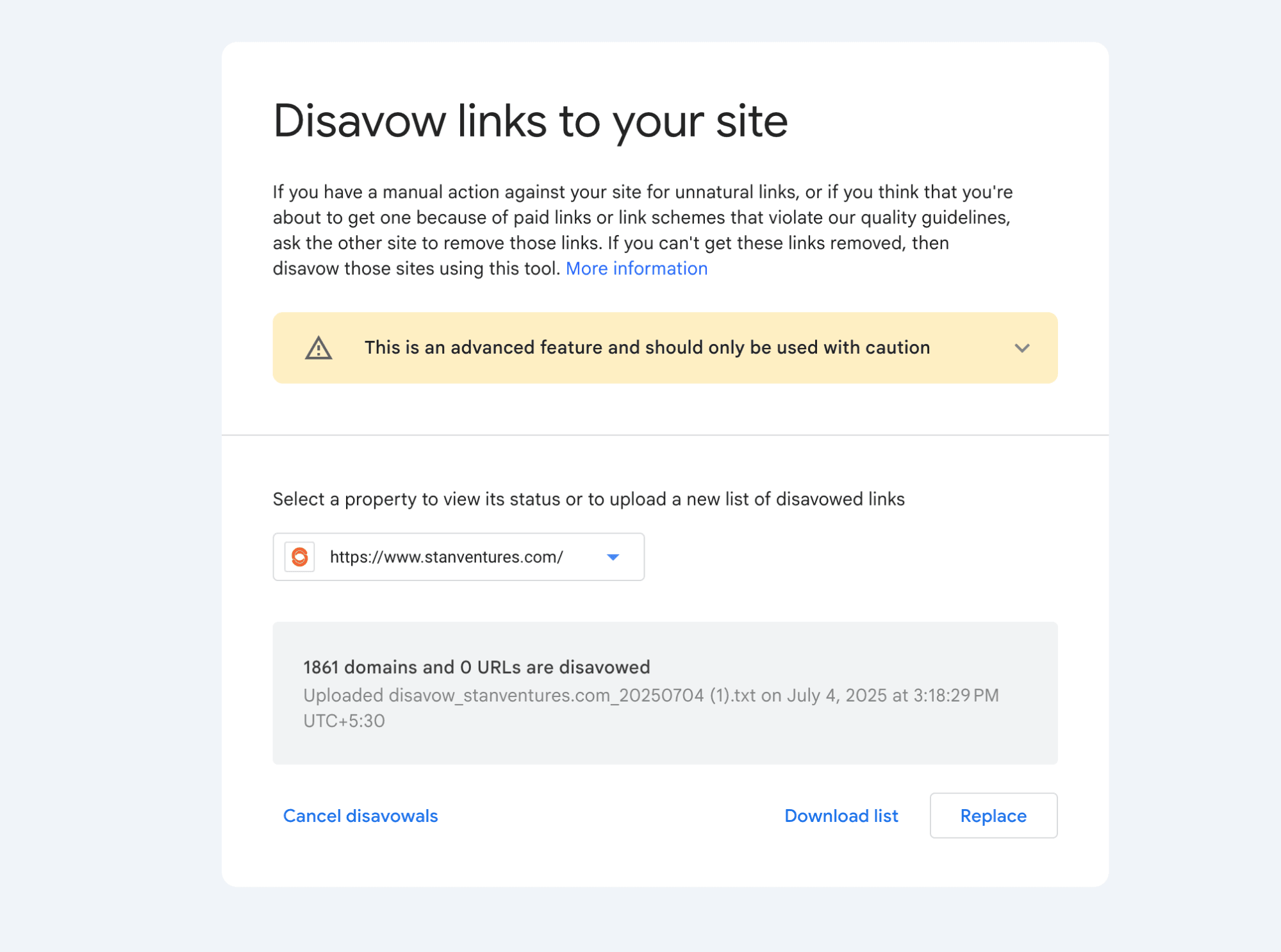
Spoiler? Disavow files are not instant appearing. In fact, Google does not “process” them immediately at all.
This might sound frustrating if you are a publisher or SEO working hard to clean up unnatural backlinks. You might be wondering: “If I upload a disavow file today, when will it actually take effect?” or “Does the order of links I include make a difference?”
What Exactly Is the Link Disavow Tool?
Let’s start with the basics for those newer to the SEO world.
Google’s Link Disavow Tool, accessible through Google Search Console, allows site owners to tell Google, “Hey, we don’t want these links to count against us.”
But it is not for just any backlink. It was created in response to a problem that exploded after Google’s Penguin update back in 2012 when many sites were penalized for unnatural or manipulative link-building tactics.
Webmasters needed a way to disown links they paid for or built unethically but could not get removed.
That is where the Disavow Tool came in. It lets you upload a text file listing specific URLs or entire domains you don’t want Google to associate with your site. Once uploaded, Google is supposed to “ignore” those backlinks when evaluating your site’s link profile.
However and this is the key Google has always said that most websites do not need to use this tool.
From Google’s own documentation:
“If you have a manual action for unnatural links to your site or think you are about to get one because of paid links or link schemes you created and you can’t remove those links manually, then you should disavow them.”
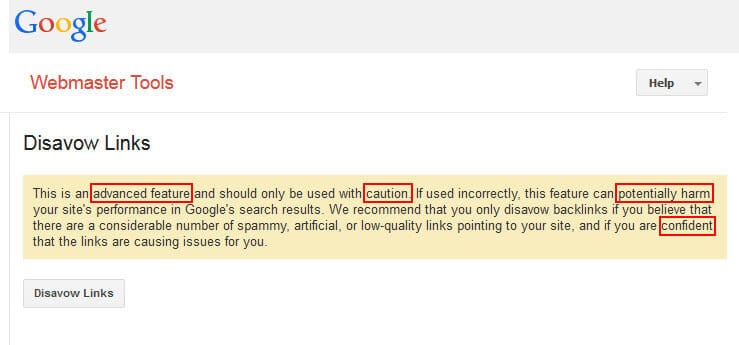
So unless you are cleaning up a mess you (or your SEO team) made in the past, the tool might be unnecessary.
The Question That Sparked a Clearer Answer
A user on Blue Sky asked a pretty technical but important question to John Mueller:
“When we add domains to the disavow, i.e., top up the list, can I assume the new domains are treated separately as new additions? You don’t reprocess the whole thing?”
To which Mueller replied:
“The order in the disavow file doesn’t matter. We don’t process the file per-se (it’s not an immediate filter of ‘the index’), we take it into account when we recrawl other sites naturally.”
What Does “We Don’t Process the File Per-Se” Mean?
Mueller’s answer suggests that Google doesn’t take immediate action on disavow file uploads. There is no background system that instantly scrubs those links from your site’s profile.
Instead, the data in your file sits and waits for Google to naturally recrawl the pages or domains you have disavowed.
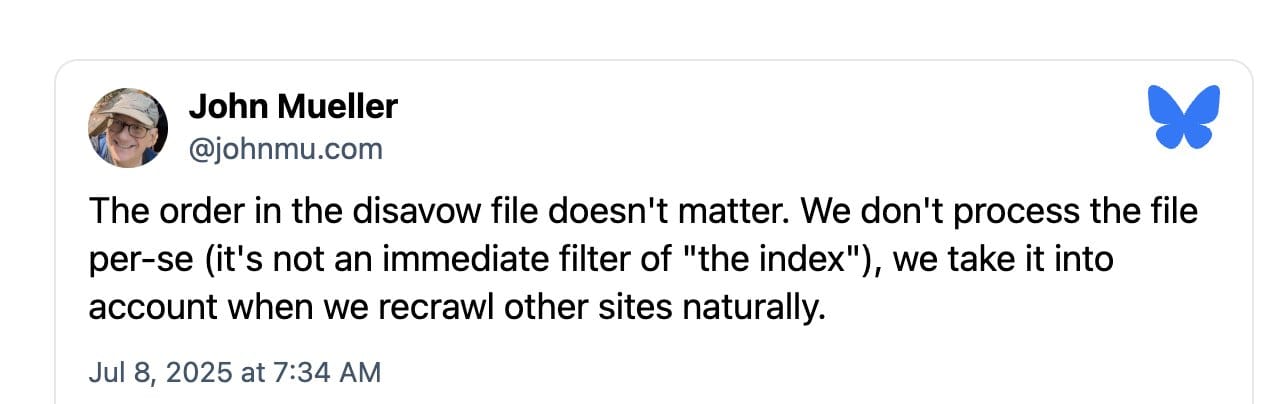
This means the effects of submitting a disavow file are not immediate. The links won’t be devalued or ignored right away. It could take weeks or even months depending on how often Googlebot recrawls the domains or pages you have listed.
Let us say you add “spammyblog.com” to your disavow list today. If Google only revisits that domain every few months, your disavow won’t take effect until the next crawl.
And if that link was pointing to your homepage? The change might not reflect until the homepage is reprocessed in the index.
Does the Order of URLs or Domains in the File Matter?
Another misconception that Mueller cleared up is that the order of links in your disavow file is irrelevant. Whether you list spammydomain.com at the top or bottom, it does not change how Google treats it.
Google treats the file as a collection of links to be excluded, not as a list with prioritization. So don’t worry about sorting alphabetically or by severity.
What Should SEOs and Site Owners Do With This Information?
This update does not mean you should stop using the disavow tool altogether. But it does change how we think about timing and urgency.
Here are some key takeaways:
Plan Ahead for Disavows
If you know you need to disavow harmful links (especially if you have received a manual action or are cleaning up old link schemes), then do not delay. The earlier you submit the file, the earlier Google can start ignoring those links once the next recrawl happens.
Manage Expectations
Do not expect traffic or ranking improvements the next day after disavowing links. There is a lag between submission and impact. Educate your stakeholders or clients that disavows are a slow burn, not a quick fix.
Clean Up What You Can Manually
If you are responsible for any unnatural links, always try to get them removed at the source first. Only disavow when you have tried and failed to remove them manually. Google prefers real link removals over disavows.
Only Use It When Necessary
As Google has repeatedly said and continues to focus on, most websites don’t need to use the disavow tool. Focus on building quality content and natural backlinks instead of obsessing over spammy links that likely don’t hurt you.
Disavow Files Are Tools, Not Triggers
John Mueller’s statement is a helpful reminder that disavow files are not triggers. Uploading a file does not spark a chain reaction or signal Google to act right away. Instead, it is a list that quietly waits to be referenced during future crawls.
So, if you are chasing down every spammy backlink and trying to disavow your way to better rankings then it is time to rethink your approach.
Focus on content, build real relationships, get natural links and save disavows for when they actually matter.

Dileep Thekkethil
AuthorDileep Thekkethil is the Director of Marketing at Stan Ventures, where he applies over 15 years of SEO and digital marketing expertise to drive growth and authority. A former journalist with six years of experience, he combines strategic storytelling with technical know-how to help brands navigate the shift toward AI-driven search and generative engines. Dileep is a strong advocate for Google’s EEAT standards, regularly sharing real-world use cases and scenarios to demystify complex marketing trends. He is an avid gardener of tropical fruits, a motor enthusiast, and a dedicated caretaker of his pair of cockatiels.
