
Google Search is sending dramatically less traffic to news publishers than it did just two years ago, dropping from 51% in 2023 to just 27% in 2025. Fresh data shared this week reveals that Google Discover has now become the dominant source of Google-driven traffic for news sites.
According to nearly 70% of referrals and fundamentally reshaping how publishers reach audiences.
The findings, highlight one of the most consequential changes in digital publishing in years.
It is a shift away from traditional web search toward algorithmic content discovery, with major implications for newsroom strategy, revenue stability, and audience development.
What Does the New Data Say About Google Traffic to News Publishers?
The analysis comes from NewzDash, which reviewed traffic patterns across more than 400 news publishers worldwide.
According to the data, Google Web Search now accounts for just 27.42% of Google-driven traffic to publishers, down from 51.10% in 2023.
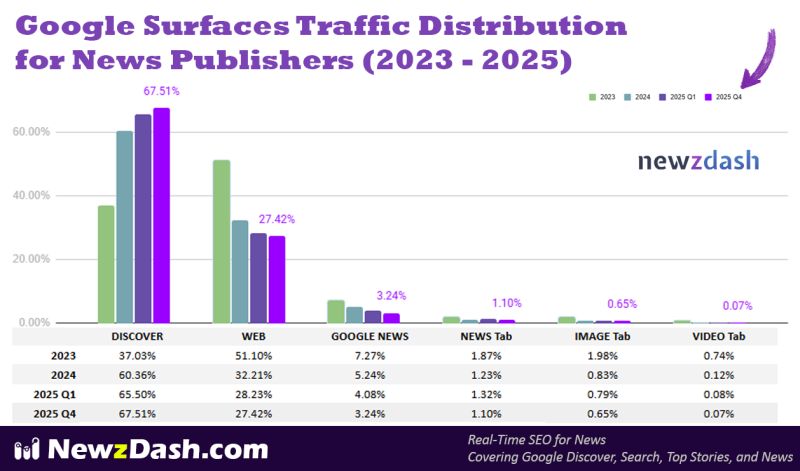
At the same time, Google Discover’s share has surged to 67.51%, nearly doubling over the same two-year period.
This represents a 25 percentage point drop in Search-driven traffic and an almost complete inversion of how publishers receive visibility from Google surfaces.
The data was shared publicly by John Shehata, who described the trend as “the Great Flip” in how news is distributed across Google.
Why Is Google Discover Now Dominating Publisher Traffic?
Google Discover has steadily evolved from a supplementary traffic source into the primary gateway between publishers and readers, particularly on mobile devices.
Unlike traditional Search, Discover does not rely on user queries. Instead, it proactively surfaces content based on user interests, browsing behavior, location, and engagement signals.
As mobile consumption has grown, this passive discovery model has become more prominent.
According to NewzDash’s analysis, Discover’s rise does not necessarily mean that Search is broken, but it does signal a redistribution of attention.
Users are increasingly consuming news without actively searching for it, relying instead on algorithmic feeds.
Shehata noted that Discover is now the “undisputed leader in traffic distribution,” a statement backed by consistent data across hundreds of publishers and multiple regions.

How Sharp Is the Decline in Traditional Google Search?
The decline in Google Web Search traffic is not subtle, it is steep and sustained.
Between 2023 and 2025:
- Search traffic fell from 51.10% to 27.42%
- Discover traffic rose from 37.03% to 67.51%
This change reflects a broader evolution in user behavior, where fewer people arrive at news sites by typing queries and more arrive through curated feeds.
Importantly, the figures represent percentage share of total Google mobile traffic, not absolute click volume, meaning some publishers may still be growing overall while seeing Search shrink as a proportion.
However, for publishers heavily dependent on Search, the drop represents a structural risk rather than a temporary fluctuation.
Why Is This Shift Risky for News Publishers?
While Google Discover can generate massive traffic spikes, it is also widely viewed as unpredictable and volatile.
Discover visibility can change overnight based on algorithm updates, shifting user interests, or engagement signals that publishers cannot fully control.
Unlike Search, where ranking factors are relatively well understood and keyword-driven, Discover offers limited transparency.
For many publishers, this creates several challenges:
- Traffic volatility with sharp peaks and sudden drops
- Limited ability to target intent-based audiences
- Difficulty forecasting revenue tied to pageviews
- Reduced control over content distribution
As Shehata and others in the industry have noted, Discover can be “super hit or miss,” making it a difficult foundation for consistent audience growth.
Does Strong Search Performance Still Matter?
Despite the decline in Search traffic share, NewzDash’s research highlights an important nuance: Search performance still plays a critical role in Discover visibility.
According to the analysis, publishers with a strong foundation in traditional Search tend to maintain more stable exposure in Discover. This creates what Shehata describes as the “Search–Discover Paradox.”
Even as Discover dominates traffic distribution, Search remains a key signal for authority, trust, and relevance, factors that influence whether content is surfaced in Discover feeds.
In other words, Search may no longer drive the majority of clicks, but it still underpins visibility across Google’s ecosystem.
How Does Google Discover Compare Across Devices?
The data shared by NewzDash focuses on mobile traffic, where Discover is most prominent.
Google has previously announced plans to bring Discover more fully to desktop surfaces, including the Google homepage, but a global rollout has yet to materialize.
As of December 2025:
- Discover remains primarily a mobile experience
- Limited desktop testing has been observed in regions such as Australia and New Zealand
- Google has not announced a firm timeline for global desktop expansion
If Discover does expand broadly to desktop, the balance between Search and Discover traffic could shift even further, amplifying the trends already visible on mobile.
What Exactly Do These Numbers Represent?
It is important to understand what the NewzDash data does and does not measure. The figures reflect:
- Percentage share of total Google mobile traffic
- Distribution across Google surfaces, not absolute growth or decline
- Web Search traffic excluding News, Images, and Video tabs
This means that while Search’s share has declined, some publishers may still be receiving similar or higher absolute traffic levels overall, depending on Discover performance and other referral sources.
However, the redistribution itself is significant because it changes how predictable and controllable that traffic is.
What Does This Mean for News Publisher Strategy?
The data underscores a need for publishers to rethink traffic strategies built primarily around keyword-driven Search.
While Discover optimization has become essential, it also need Search-focused and AI SEO. Publishers are increasingly being pushed toward a hybrid approach that balances:
- Search authority and technical SEO
- Discover-friendly storytelling and engagement
- Brand loyalty and direct traffic
- Diversification beyond Google entirely
Those relying too heavily on Discover risk exposure to sudden algorithmic shifts, while those ignoring Discover may miss the majority of Google-driven visibility.
Is This a Broader Signal About the Future of News Distribution?
The shift from Search to Discover reflects a deeper transformation in how information is consumed online. Discovery-based models favor immediacy, personalization, and passive consumption over deliberate research.
For Google, this aligns with broader trends across platforms, from social feeds to AI-curated content.
For publishers, it raises difficult questions about control, sustainability, and independence.
As Google Search sends less traffic by default, the power balance between platforms and publishers continues to evolve, often in ways that favor algorithms over editorial intent.
Key Takeaways:
- Search Traffic Halved: Google Search referrals to news publishers fell from 51% in 2023 to 27% in 2025.
- Discover Takes the Lead: Google Discover now drives ~68% of traffic, nearly doubling its share in two years.
- Shift in Consumption: Users increasingly consume news passively through feeds rather than actively searching.
- Volatility Risk: Discover traffic is unpredictable, creating spikes and sudden drops, making it less stable than Search.
- Search Still Matters: Strong SEO and authority remain crucial as they influence visibility in Discover feeds (“Search–Discover Paradox”).

Dipti Arora
AuthorDipti Arora is a Senior Content Writer with over seven years of experience creating impactful content across Digital Marketing, SEO, technology, and business domains. She has a strong background in managing news verticals and delivering editorial excellence. Dipti has contributed to leading publications such as The Times of India and CEO News, where her research-driven storytelling and ability to simplify complex subjects have consistently stood out. She is passionate about crafting content that informs, engages, and drives meaningful results.
