Google has officially clarified that website owners who block its AI-focused crawler, Google-Extended, will face no consequences in search rankings.
The update, released in newly revised documentation, draws a firm line between participation in AI model development and search visibility, answering months of industry speculation with a definitive no.
The change comes as Google continues to scale up its AI initiatives, particularly Gemini and Vertex AI, both of which rely on web content for training and improving factual accuracy through a process known as grounding.
However, even as the AI SEO race intensifies, Google is making one thing clear, that is, opting out won’t cost publishers their standing in search results.

A Clearer Policy Amid Growing AI Tensions
The debate over how AI models collect online content has intensified in recent months. Web publishers, media companies, and rights groups have increasingly pushed back against what they describe as unauthorized use of their work to train generative AI systems.
Until now, Google’s guidance on the matter left critical questions unanswered, particularly whether denying Google-Extended access would quietly impact a site’s SEO performance.
Now, Google’s updated documentation makes its position explicit:
“Google-Extended does not impact a site’s inclusion in Google Search nor is it used as a ranking signal in Google Search.”
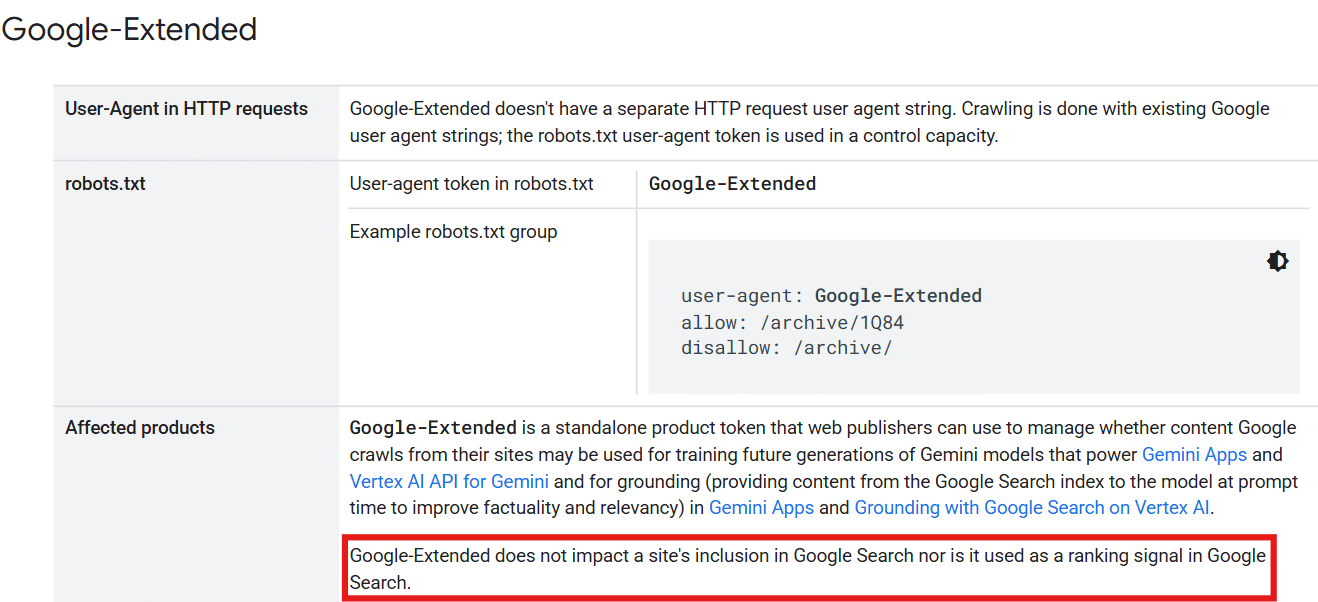
In short, publishers can opt out of allowing their content to be used for AI model training and grounding without risking their search engine presence.
Grounding, in this context, refers to feeding real-time, factual information from the web to AI models to improve the accuracy of their responses an increasingly important safeguard against misinformation and hallucinations in generative AI.
What the Updated Guidance Means for Publishers
The updated language not only clarifies technical misunderstandings but shifts the power dynamic.
Publishers no longer have to guess whether prioritizing their intellectual property might hurt their discoverability on the world’s largest search platform.
Critically, the changes emphasize:
- No Search Ranking Impact: Whether a site allows or blocks Google-Extended, its rankings in traditional Google Search will not be affected.
- Separation of Powers: Google is treating AI development and Search indexing as distinct functions, each governed by different policies.
- Transparency Across Platforms: The new language mirrors longstanding advice elsewhere on Google Search Central, aiming for consistency and minimizing confusion.
A Strategic Shift in the AI-Content Relationship
Google’s update lands in a digital environment increasingly fraught with questions about consent, ownership, and AI training data.
While companies like OpenAI and Meta have faced lawsuits and criticism for scraping vast amounts of public content to train their models, Google is taking a more cautious, policy-driven approach.
The implications are significant:
- Precedent for Consent-Based AI Development: Google’s formal separation of AI and Search could pressure other tech giants to adopt clearer, more transparent policies.
- Potential for Industry-Wide Change: As regulators worldwide move closer to legislating AI data usage, Google’s opt-out model could become a blueprint or a minimum standard for responsible AI practices.
- New Challenges for AI Training: Widespread publisher opt-outs could limit the diversity and breadth of data available to train future AI models, forcing developers to rethink how they source high-quality material.
What Site Owners Should Do Now
If you manage a website and are weighing your options, the path forward is straightforward:
Use Robots.txt to Block Google-Extended
Add the following line to your site’s robots.txt file if you want to prevent your content from being used in AI training and grounding:
makefile
CopyEdit
User-agent: Google-Extended
Disallow: /
Understand the Scope
Blocking Google-Extended only affects AI model usage. Your site’s indexing and ranking in traditional Google Search remain untouched.
Stay Updated
Google’s policies and broader AI-related standards are evolving. Keep an eye on Google Search Central and major tech policy updates.
Align Teams Internally
Inform your SEO, content, and legal teams about the clarification to ensure your site’s AI data usage policy reflects your broader strategic goals.
Evaluate Long-Term Impact
Consider how participating or opting out of AI grounding could affect your brand’s exposure in emerging AI-driven ecosystems.
Key Takeaways
- Blocking Google-Extended won’t affect your site’s search rankings or inclusion.
- AI data use and search indexing are now formally separated under Google’s policies.
- Publishers can make data decisions without fear of SEO consequences.
- Updated guidance matches longstanding Google Search Central advice.
- Transparency and opt-out mechanisms are becoming key pillars in AI development.

Dileep Thekkethil
AuthorDileep Thekkethil is the Director of Marketing at Stan Ventures, where he applies over 15 years of SEO and digital marketing expertise to drive growth and authority. A former journalist with six years of experience, he combines strategic storytelling with technical know-how to help brands navigate the shift toward AI-driven search and generative engines. Dileep is a strong advocate for Google’s EEAT standards, regularly sharing real-world use cases and scenarios to demystify complex marketing trends. He is an avid gardener of tropical fruits, a motor enthusiast, and a dedicated caretaker of his pair of cockatiels.
