
Search for anything and there it is, an answer, bold and immediate, at the very top of the screen. No click needed. No website visit. No delay. Just the response you were looking for, seemingly pulled from thin air.
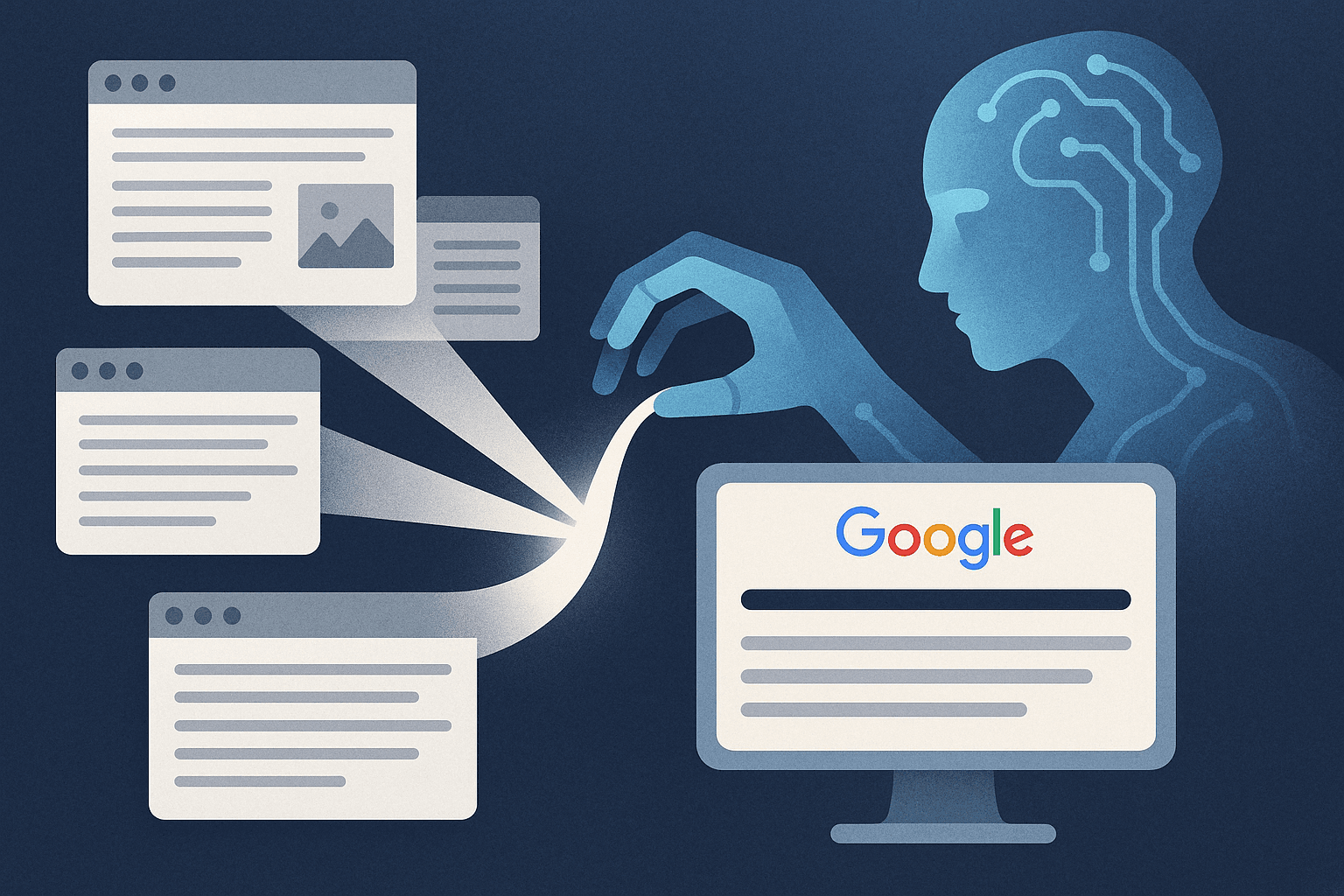
That brief moment of convenience comes at a steep cost. Google’s AI Overviews are stripping clicks away from publishers, rewriting the rules of how information flows online. Sites still provide the content. Google still scrapes it. But fewer and fewer readers ever make it to the source.
Answers Without a Click
Cyrus Shepard, the founder of Zyppy SEO, searched for something as specific as “Does Milwaukee offer a lifetime warranty?” What showed up first wasn’t a link to Milwaukee’s site or a direct answer from the company. Instead, Google’s AI Overview offered a short summary, dotted with a few clickable terms like “Hand Tools” and “Warranty Process.”
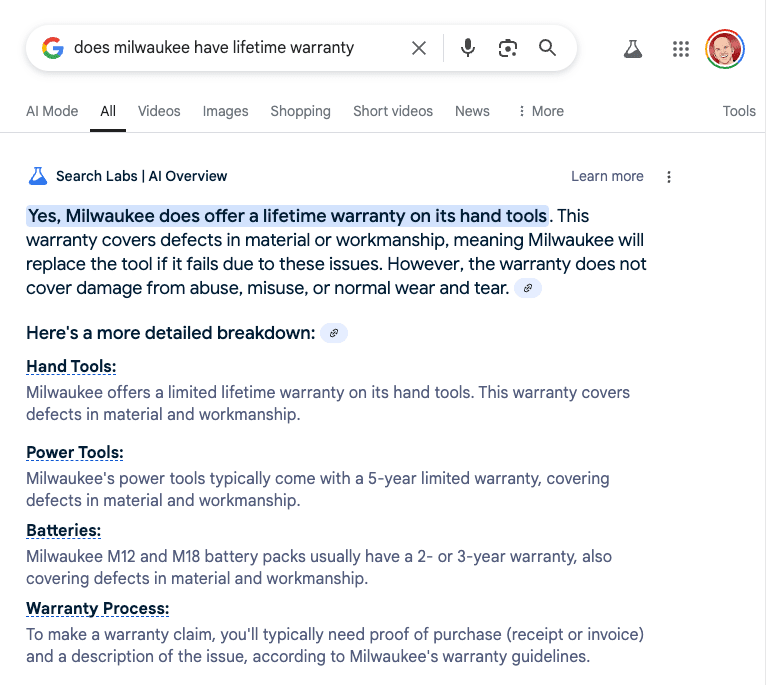
Well, that’s how AI Overviews are built to work.
Google keeps users from leaving the page by pulling information from across the web, rewording it, and displaying it in a self-contained summary. This strategy aims to reduce the number of clicks away and increase user engagement time.
Although the links may seem beneficial, many merely direct users further into Google’s ecosystem rather than toward the original information source.
Brands like Milwaukee may find that their content gets used to generate AI answers, without receiving any traffic in return. The only guaranteed method for them to appear is by paying for ads.
New: How AI Overviews Shift Traffic From Publishers to Google
It’s not enough that Google’s AI Overviews reduce clicks to publisher websites 📉
Google designed these so that what few clicks remain lead to walls of irrelevant ads and/or bad search results
Link in 🧵 pic.twitter.com/usrycPvTNS
— Cyrus (@CyrusShepard) May 8, 2025
The Disappearing Traffic Nobody Voted For
Google’s search success was built on a pretty simple understanding. Publishers put in the work to create content, Google helped people find it, and in return, those people were sent to the original sites. It was fair and it worked. AI Overviews break that model.
Now, Google still scrapes the same content, but instead of pointing users to it, it rewrites it into a one-stop summary. That makes Google the first and final destination. And for the people who made the content? They’re getting cut out.
And the numbers prove it:
- Amsive found a 15.5% drop in clicks for keywords with AIOs.
- Ahrefs reported a 34.5% decline in click-through rates.
- Seer Interactive tracked a staggering 54.6% drop over 12 months.
Research from Kevin Indig also shows that only 28% of Google searches lead to a website click; with AIOs, it shrinks to 24%.
The Shift Toward Ads
Google’s business is built on keeping people on its own. The longer users stay within Google’s walls, the more ads they see. That’s the game, and it’s working.
According to a study, visits to Google in the U.S. jumped 9% after AIOs launched. But those visits are shorter (session lengths dropped 1%). That means Google has to monetize them faster, and AI Overviews give them more ways to do that, right at the top of the results page.
Revenue reflects the change.
Google’s Q1 earnings for 2025 show an 8% year-over-year increase. It’s no coincidence.
AI Overviews are feeding the engine that keeps Google growing, even if it means draining traffic from the sites that fed it.
Small Publishers, Big Losses
Sites like Reddit have struck deals with Google and are seeing traffic surges. But smaller publishers are the ones being squeezed hardest.
Cloudflare CEO Matthew Prince put it this way “ ten years ago, for every two pages Google scraped, a publisher could expect one visit. Today, it takes six pages scraped to earn one visitor.”
That ratio is just unsustainable.
These sites are still being crawled. Their words are still training AI. But they’re getting fewer readers and less value for their work.
For many, that means thinner margins, lower ad revenue, and harder decisions about what kind of content is even worth making anymore.
And here’s where it starts to hurt everyone.
What Happens When Creators Stop Creating?
Every polished AI answer is built on content that someone else made. If that content stops coming, the quality of AI answers will eventually suffer.
Already, the web is being flooded with spam and auto-generated filler. Google itself is working to fight it. But without original content from real sources, even the best AI summaries start to fall apart.
This is a feedback loop. Fewer clicks mean less incentive to create, which leads to lower quality content, which leads to more reliance on AI, which sends even fewer clicks.
What Can Be Done?
Going up against Google’s massive influence might feel like shouting into the void. It’s huge, it’s everywhere, and it sets the rules. But that doesn’t mean publishers are stuck playing defense. There are still ways to push back, and regular users have a part to play too.
One of the most effective moves is bringing your focus to loyal audiences. Building direct relationships through email newsletters, memberships, or community platforms can help cut out the middleman entirely.
Publishers can also make their content more visible to search engines by using clear metadata and schema markup, which boosts their chances of being properly cited.
There’s strength in numbers as well. Media organizations can form coalitions to advocate for fair treatment, stronger attribution, and better oversight.
Exploring content licensing is another path. In a world where data drives everything, licensing gives publishers more control and leverage.
And finally, it’s worth encouraging readers to engage more directly. When people start bookmarking websites, using dedicated apps, or subscribing straight to the source, the industry becomes less dependent on search traffic. It won’t fix everything at once, but it’s a strong step in the right direction.
Key Takeaways
- AI Overviews are replacing clicks. Some publishers are losing over half their traffic on affected keywords.
- Most AIO links lead back to Google. They rarely take users to the original source of the information.
- Smaller publishers are being mined for content and receiving little in return.
- Google’s profits are climbing. Meanwhile, session time is down, meaning AI answers are being used to monetize faster.
- Without enough value coming back to creators, the flow of original content may start to dry up.

Zulekha
AuthorZulekha is an emerging leader in the content marketing industry from India. She began her career in 2019 as a freelancer and, with over five years of experience, has made a significant impact in content writing. Recognized for her innovative approaches, deep knowledge of SEO, and exceptional storytelling skills, she continues to set new standards in the field. Her keen interest in news and current events, which started during an internship with The New Indian Express, further enriches her content. As an author and continuous learner, she has transformed numerous websites and digital marketing companies with customized content writing and marketing strategies.
