Google’s URL Inspection Tool has been showing the wrong canonical URL — sometimes directing users to entirely different domains. This technical hiccup, or “Canonical Confusion” attack, can siphon traffic and visibility away from the original site, affecting both its reputation and search rankings.
Google’s Tool Mislabels Canonicals, Diverting Your Traffic
Content creators are reporting cases where Google’s tool designates a different site as the canonical URL — effectively treating a copied or spoofed version of the content as the original.
Traian Neacsu, a digital marketing professional, recently flagged this issue on social media. Despite the original content residing on his domain, Google’s tool incorrectly attributed it to a separate domain.
“I have never seen Google selecting a different domain name as canonical,” Neacsu tweeted, tagging Google’s Search Advocate John Mueller.
I have never seen Google selecting a different domain name as canonical, @JohnMu. Could this be some sort of spam? pic.twitter.com/012Ig1FQL0
— Traian Neacsu (@TraianNeacsu) November 6, 2024
The problem: Google’s system sometimes picks an entirely different domain as the primary source, ranking it above the original and sending it more traffic.
When content appears on multiple sites, Google aims to identify the primary source. However, a technical glitch or oversight can inadvertently prioritize a copied version.
Canonical Confusion Attacks: A New Kind of SEO Sabotage
Neacsu’s experience isn’t isolated. Experts point out that this issue can stem from “Canonical Confusion” attacks, where spammers copy content onto separate domains and then manipulate Google’s algorithm into misassigning the canonical tag.
If successful, the duplicate content, sometimes hosted on spammy sites, gets ranked above the original. For businesses, this means lost traffic and a drop in search visibility.
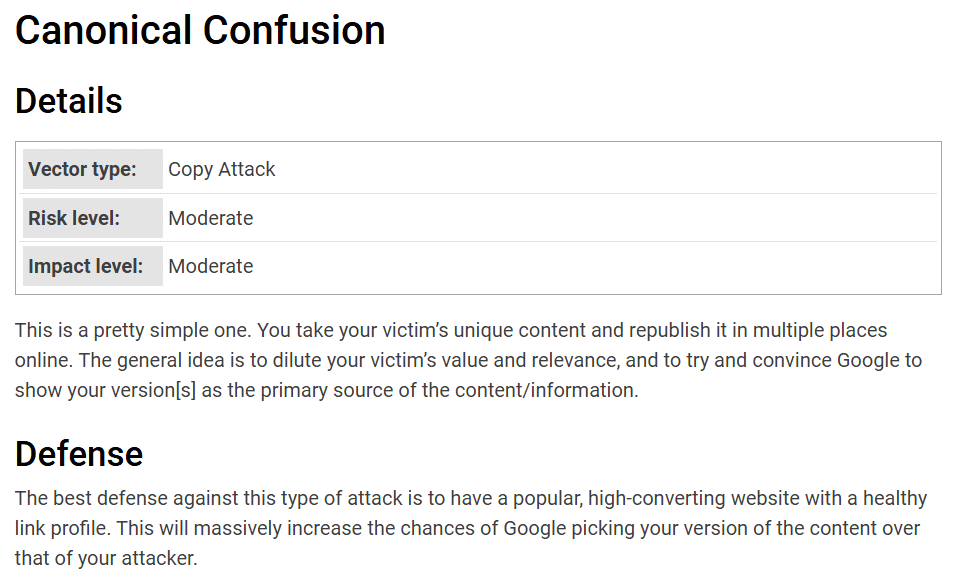
Darth Autocrat, another SEO expert, describes this tactic as a form of “negative SEO,” in which spammers attempt to outrank the legitimate site with their own content.
But, it should be noted – it can also be “self inflicted”,
or caused by Google,
due to shoddy syndication practices,
and/or G’s preference for “authority sites” (popular sites with tons of links)https://t.co/rSoFYFlCF5— Darth Autocrat (Lyndon NA) (@darth_na) November 6, 2024
As Google consolidates content to the sites it considers “legit,” errors in determining the canonical can damage the actual content creator’s search rankings.
What Causes Google to Pick the Wrong Canonical?
Several factors contribute to this error:
- Algorithm Confusion: Google’s algorithms attempt to determine the most relevant source for users but can mistakenly prioritize the wrong URL, particularly when similar or identical content exists on multiple domains.
- Malicious SEO Tactics: Bad actors sometimes intentionally duplicate content across various domains, hoping Google will misattribute the canonical to their own site.
Google’s ranking system may even favor a different site if it considers the other domain to have higher quality or authority metrics, regardless of the original content’s source.
Why This Matters: The Real Cost of Canonical Confusion
This technical mishap has real-world consequences for businesses and brands. Firstly, there’s the immediate loss of traffic.
If searchers are directed to another domain, original content creators can lose potential customers, leads, or ad revenue. Furthermore, canonical misattribution affects credibility.
If Google ranks a different domain as the main content source, users might associate it with that third-party site, undermining the original creator’s reputation and trustworthiness.
The impact doesn’t stop there. For websites dependent on SEO, such misattributions can hurt rankings and bring down site traffic, even resulting in penalties if Google’s system misidentifies the original site as duplicative.
What Site Owners Can Do to Address Canonical Confusion
If Google’s misattribution strikes your site, here are practical steps you can take to regain control:
Enhance Content Quality: Google often assigns canonical URLs based on quality signals. Ensure your content is unique, authoritative, and regularly updated to reinforce its relevance.
Check the URL Inspection Tool Regularly: Regular monitoring through Google’s URL Inspection Tool can help catch these errors early, allowing you to intervene before significant traffic loss occurs.
Boost Site Reputation with Link Building: A well-established, highly reputable domain is less likely to be misattributed by Google’s system. Consider strategic link-building to reinforce your site’s authority.
Ensure Accurate Canonical Tagging: Although Google may override these, correct canonical tags on your site give the algorithm more context. Regularly verify that these tags are accurately set across your pages.
Report Issues to Google: If Google’s tool shows an incorrect canonical, contact Google Search Console to report the discrepancy. While responses aren’t guaranteed, Google uses this feedback to improve its algorithms over time.
Will Google Fix This? Canonical Confusion’s Future
Google is constantly evolving its algorithm to better handle content duplication and attribution. However, addressing niche issues like “canonical confusion” may not be an immediate priority, especially when cases remain relatively rare.
While updates may eventually remedy these misattributions, the persistence of malicious actors looking to manipulate search results will likely mean that content creators and site owners need to stay vigilant.
Key Takeaways
- Google’s system can mistakenly select a different website as the primary source for your content, diverting traffic away from your site.
- Some use “Canonical Confusion” attacks to duplicate your content on their domains, tricking Google into ranking their copy above the original.
- When your content is misattributed, your site can lose search visibility and traffic and even face credibility issues if users associate it with another site.
- Frequent checks on the URL Inspection Tool help catch misattributions early.
- Reporting canonical issues through Google Search Console provides feedback that could help resolve misattribution and improve your site’s standing.

Dileep Thekkethil
AuthorDileep Thekkethil is the Director of Marketing at Stan Ventures, where he applies over 15 years of SEO and digital marketing expertise to drive growth and authority. A former journalist with six years of experience, he combines strategic storytelling with technical know-how to help brands navigate the shift toward AI-driven search and generative engines. Dileep is a strong advocate for Google’s EEAT standards, regularly sharing real-world use cases and scenarios to demystify complex marketing trends. He is an avid gardener of tropical fruits, a motor enthusiast, and a dedicated caretaker of his pair of cockatiels.
