The SEO community thrives on clarity, yet Google recently muddied the waters. At a Creator Summit, Pandu Nayak, Google’s VP of Search, claimed that rankings are evaluated at the page level rather than the site level.
This assertion stunned industry experts, given years of Google’s documentation suggesting otherwise.

SEO expert Glenn Gabe summed up the reaction perfectly: “My head almost exploded after reading those comments.” His response wasn’t just frustration but a rallying cry to revisit Google’s history with site-level algorithms and their undeniable impact on search rankings.
.
If you were surprised by Pandu Nayak’s comments about page-level versus site-level impact, you weren’t alone. I’ve been working on this post since that came out. I hope you enjoy it 🙂 -> Documenting Google’s site-level evaluation and impact on search rankings using the ‘Gabeback… pic.twitter.com/VTcNPhBWpl
— Glenn Gabe (@glenngabe) November 18, 2024
Update (November 20, 2024): In response to debates after the Creator Summit, Google updated its guide on search ranking systems to clarify that it uses both page-level and site-wide signals.
The guide now states:

Page vs. Site-Level Evaluations
Nayak’s remarks contradicted a well-documented reality: Google has long utilized site-level signals to assess quality. Glenn Gabe and others have detailed numerous algorithm updates—Panda, Penguin, and the Helpful Content Update (HCU)—that clearly show site-wide evaluations affecting rankings.
As Gabe explains, “Google has not been shy about explaining it has site-level quality algorithms that can have a big impact on rankings, especially during major algorithm updates like broad core updates.”
John Mueller, Google’s Senior Webmaster Trends Analyst, also reinforces this: “We do index things page by page, we rank things page by page, but there are some signals that we can’t reliably collect on a per-page basis where we do need to have a better understanding of the overall site. Quality kind of falls into that category.”
Site-level: Have one url that’s high quality, but the site overall isn’t? Via @johnmu There are some signals we can’t reliably collect on a page-per-page basis. We need to have a better understanding of the *site overall*. Quality falls into that category: https://t.co/tkTRxmFupG pic.twitter.com/YnNG3ip5jl
— Glenn Gabe (@glenngabe) June 12, 2021
The idea isn’t that every page is judged the same way but that overarching site quality influences individual rankings—a concept echoed by Paul Haahr, a Google ranking engineer, who stated, “When all things are equal with two different pages, sitewide signals can help individual pages.”
One of my favorite quotes btw is from Google’s Paul Haahr (one of the most experienced and smartest Googlers working on G’s algos and systems). Yep, site-level impacting page-level scoring:
“When all things are equal with two different pages, sitewide signals can help individual… pic.twitter.com/sFyy3cnZnq— Glenn Gabe (@glenngabe) November 18, 2024
He even noted that Google propagates information from the domain to the page level: “Given absolutely no other information… the Wall Street Journal article looks better [than one from an unknown domain].”
Rich Snippets and Trust Signals
One practical example of site-level evaluations is the presence—or absence—of rich snippets in search results. If a site loses its rich snippets, it’s rarely because of isolated page-level issues. Instead, it often signals a broader trust issue with the site’s overall quality.
Glenn Gabe highlights this phenomenon: “If rich results aren’t shown in the SERPs, and it’s set up correctly from a technical POV, then that’s usually a sign that Google’s quality algorithms are not 100% happy with the website.”
Google’s recent clarification highlights that while site-wide signals contribute to rankings, their influence is nuanced. Even high-quality pages can be impacted by low trust or poor quality signals stemming from other areas of a site.
Low-quality content, even in isolated areas of the site, can undermine trust and drag down the performance of even high-quality pages.
Similarly, Gabe has pointed out that user-generated content (UGC) on some parts of a site can negatively impact the entire domain. He advises site owners to address these issues proactively, warning that neglecting one section of a site can harm its overall standing in search rankings.
Site-Level Impact: The Evidence Speaks
Gabe has spent years documenting Google’s approach to site-level algorithms in what he calls the “Gabeback Machine.” This archive includes Google’s own statements, announcements, and patents that detail how site-wide evaluations can drag down—or elevate—a site’s rankings.
For example, Glenn highlights the HCU, which he was briefed on by Google in 2022. “Google explained it was a site-level classifier which could impact rankings across the entire site,” he recalled. The algorithm targeted sites with content crafted for search engines rather than humans, resulting in dramatic ranking drops for affected domains.
Google’s updated guide directly acknowledges the role of these classifiers, emphasizing that site-wide signals remain a critical factor in ranking evaluations.
It’s not just HCU. Gabe points to Panda and Penguin as clear examples of site-level penalties. Panda, introduced in 2011, penalized sites with thin or low-quality content, while Penguin (2012) targeted domains riddled with spammy backlinks. These updates didn’t just affect a few pages—they pulled entire sites into the depths of search result obscurity.
Why This Matters: Holistic Quality Over Page-Specific Fixes
Gabe aptly says, “It’s not like every URL on a site suddenly became low quality… It’s just that the classifier had been applied, and boom, rankings tanked across the entire site.” This observation underscores the importance of maintaining consistent quality across all pages, not just focusing on individual fixes.
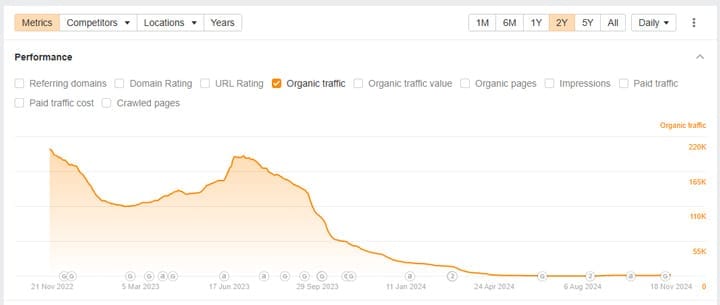
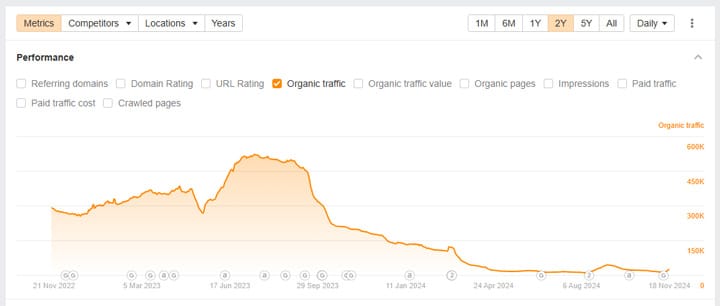
The implications for website owners are clear: addressing only the most visible problems won’t cut it. A comprehensive strategy that targets site-wide issues is essential. Whether it’s removing outdated content, cleaning up spam, or improving technical SEO, holistic efforts are needed to avoid algorithmic penalties.
The Path to Recovery: Insights and Practical Steps
For sites hit by these algorithms, recovery can feel like an uphill battle. Glenn Gabe often advises site owners to take a methodical approach: “Significantly improving the quality of a website has effects across the board. It can take months (6+ months) for Google to reevaluate a site after improving quality overall.”
After removing low-quality content, how does a quality evaluation work? -> Via @johnmu It can take months (6+ months) for G to reevaluate a site after improving quality overall. It’s partially due to reindexing & partially due to collecting quality signals https://t.co/LAxheTmPRU pic.twitter.com/ZId8b5YuCC
— Glenn Gabe (@glenngabe) August 15, 2021
This process involves more than technical tweaks. It’s about rethinking your site’s overall value proposition. Here are some practical steps inspired by Gabe’s insights:
Audit Content Thoroughly: Identify and either improve or remove thin, outdated, or irrelevant content.
Enhance User Experience: Optimize page load speeds, improve navigation, and ensure mobile usability.
Strengthen Trust Signals: Build a portfolio of high-quality backlinks and demonstrate authority in your niche.
Monitor Metrics: Use tools like Google Search Console to detect traffic changes and pinpoint areas for improvement.
Be Patient: Quality recoveries are slow but possible. Consistency and persistence are key.
What’s Next? Predictions for Google’s Algorithms
The debate sparked by Nayak’s comments won’t end soon. Glenn Gabe suggests that Google may be leveraging a mix of site-level and page-level evaluations, even if it’s not explicitly stated.
“Maybe Google’s page-level ranking takes site-level scoring into account,” he speculates, emphasizing the interconnected nature of these assessments.
For now, site owners should remain vigilant, adapting to algorithm changes with an eye on long-term quality.
As Google continues to refine its ranking systems, staying informed and proactive will remain the best defense.
Key Takeaways
- Both page-level and site-wide signals contribute to Google’s ranking systems.
- Updates like Panda, Penguin, and HCU have historically penalized entire sites for specific issues.
- Recovery requires a holistic approach, focusing on overall site quality rather than isolated fixes.
- Communication from Google about its algorithms has often been inconsistent, causing confusion among site owners.
- Staying proactive with regular audits, quality improvements, and adherence to best practices is essential for maintaining rankings.

Dileep Thekkethil
AuthorDileep Thekkethil is the Director of Marketing at Stan Ventures, where he applies over 15 years of SEO and digital marketing expertise to drive growth and authority. A former journalist with six years of experience, he combines strategic storytelling with technical know-how to help brands navigate the shift toward AI-driven search and generative engines. Dileep is a strong advocate for Google’s EEAT standards, regularly sharing real-world use cases and scenarios to demystify complex marketing trends. He is an avid gardener of tropical fruits, a motor enthusiast, and a dedicated caretaker of his pair of cockatiels.
