A new Unbounce study finds that while 83% of landing page traffic comes from mobile devices, desktop pages convert 8% better — a costly imbalance marketers can’t afford to ignore.
Mobile devices may rule the web, but they’re failing to win the conversions that matter most.
A sweeping new report from Unbounce, analyzing more than 57 million conversions across 41,000 landing pages, reveals that desktop users still outconvert mobile visitors by eight percentage points, despite the latter driving a commanding 83% of traffic.
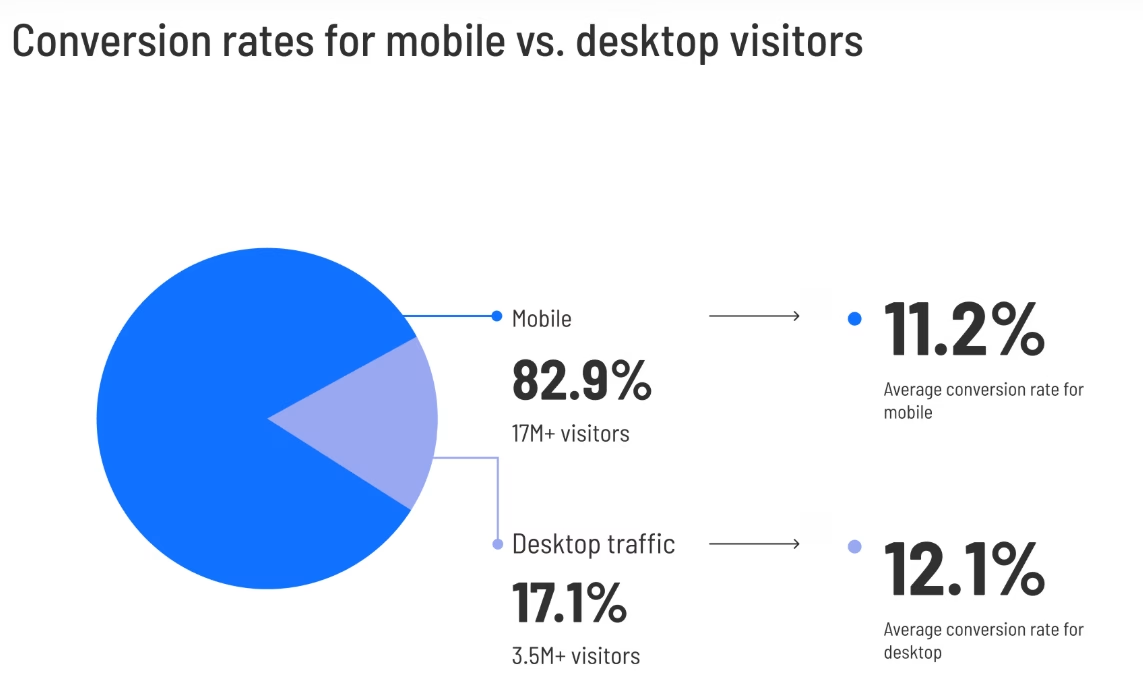
That gap represents more than just a missed opportunity for marketers. If mobile users are the majority audience but continue to convert less effectively, the industry’s design priorities may be fundamentally misplaced.
Unbounce’s findings suggest that mobile landing pages are costing brands real money. The report says, “If you’re still building your landing pages for desktop first… you’re missing out big time.”
The Numbers Behind the 8% Divide
The dataset, which spans dozens of industries, shows a median conversion rate of 6.6%, but the gap between the best and worst performers is wide. Some verticals hit 12.3%, while others hover near 3.8%.
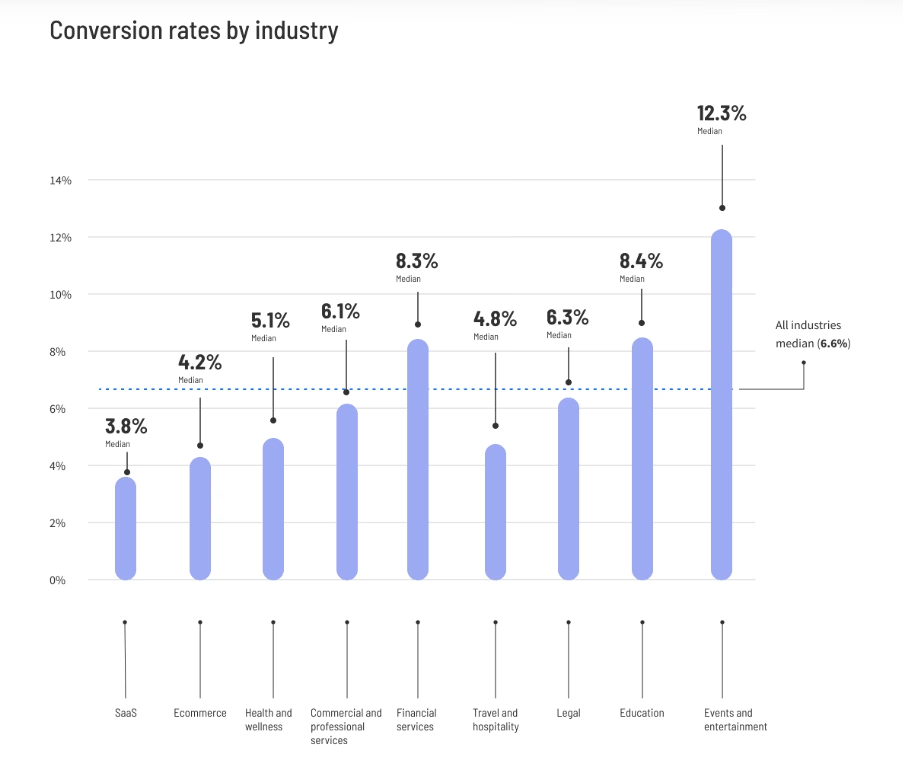
The report estimates that if all mobile pages matched desktop conversion rates, over 1.3 million additional conversions could have been achieved.
In other words, this isn’t a niche concern. It’s an industry-wide leak.
Why Mobile Still Falls Short
If mobile drives the majority of visits, why are conversions lagging?
Part of the problem lies in design inertia. Many landing pages are still crafted with desktop in mind and then compressed to fit smaller screens.
This “shrink it and ship it” approach often leads to cramped visuals, clumsy navigation, and slower load times — all proven conversion killers. Add in the distractions of mobile use (notifications, smaller text, on-the-go browsing), and even a minor friction point can derail a potential sale or signup.
The irony is that mobile visitors are often closer to action. They might be researching on the move, scanning offers, or deciding quickly. Yet, instead of harnessing that immediacy, most mobile pages make them work harder.
As attention spans tighten, every unnecessary tap, scroll, or long paragraph is a lost conversion waiting to happen.
The Reading-Level Revelation
One of the report’s more surprising insights has nothing to do with pixels or design, it’s about language.
Landing pages written at a 5th to 7th-grade reading level convert dramatically better than those with more complex writing.
Specifically, simpler copy achieved an 11% conversion rate, which is 56% higher than pages written at an 8th–9th-grade level and more than double that of “professional-level” text.
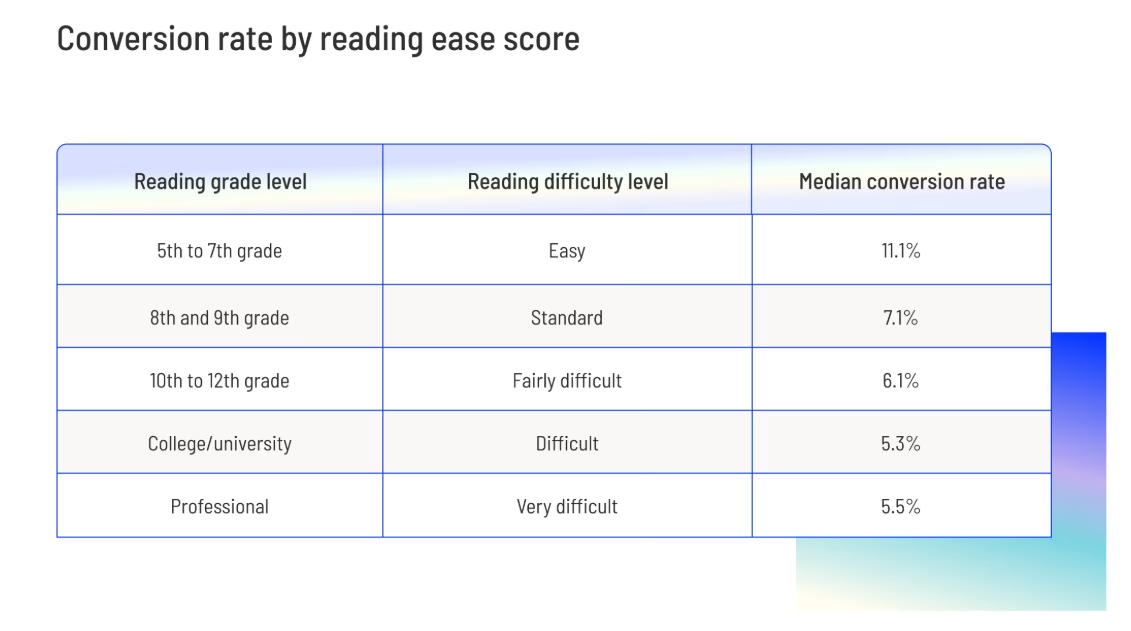
As language difficulty increased, conversion rates dropped. Pages filled with long words (three or more syllables) saw conversion rates fall by 24.3%.
It’s a finding that challenges a long-held assumption in marketing — that sophistication signals credibility. The data suggests the opposite. People respond better to clarity than to cleverness.
Even in B2B marketing, where technical audiences might expect jargon, clarity still drives more action. Shorter sentences, familiar words, and conversational tone outperform ornate prose.
The Channel Champions
The report also ranks how different traffic sources stack up for conversions — and the results may surprise some marketers.
Email dominates, with an average conversion rate of 19.3%, far ahead of any other channel. That may seem counterintuitive in an era where social platforms dominate attention, but email remains the channel of intent. People who open an email are already halfway down the funnel.
Following closely are paid social channels, with Instagram (17.9%) and Facebook (13%) emerging as top performers. Their visual formats and precise audience targeting appear to give them an edge over paid search, including Google Ads, which trails behind.
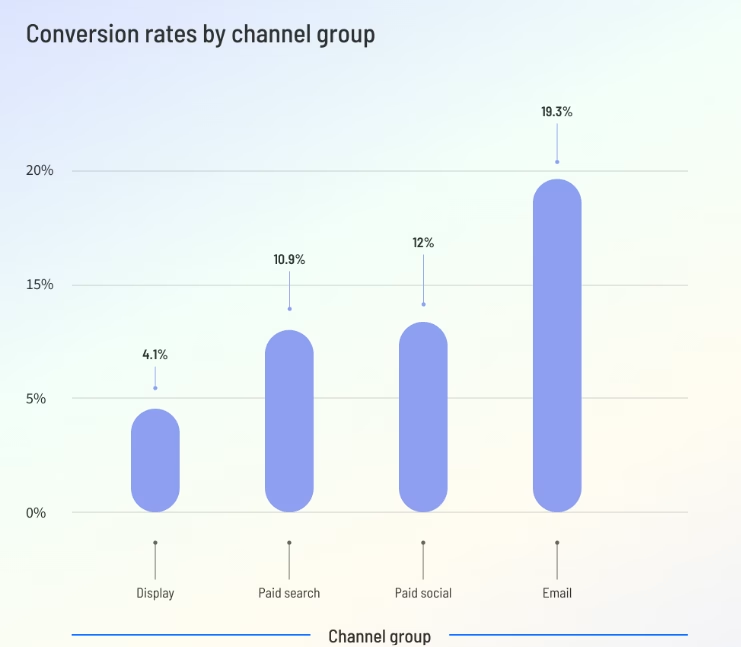
For many advertisers, this underscores the growing need to integrate campaigns more intelligently. Social media builds awareness, email seals the deal, and both rely on landing pages that make the transition seamless.
What’s Driving the Conversion Imbalance
Beyond poor optimization, the conversion gap may also reflect a shift in user behavior. Mobile browsing is inherently fragmented. People scroll between apps, multitask, and rarely stay on one page for long.
Desktop users, in contrast, engage in more deliberate sessions. They might be at work or at home, dedicating a few minutes to complete a purchase or form. That mindset difference could explain part of the disparity.
Still, technology can close that gap. Faster-loading mobile pages, one-click checkout, simplified forms, and smarter adaptive layouts all make it easier for mobile visitors to finish what they start.
Lessons From the Data
Taken together, the findings offer a clear mandate for digital marketers: mobile-first thinking must go beyond design aesthetics. It’s about reimagining the entire user journey for smaller screens and shorter attention spans.
The evidence shows that most mobile users want immediacy, clarity, and ease — and the brands that deliver those will convert better, faster, and more often.
Key insights from Unbounce’s benchmark data include:
- Mobile optimization remains insufficient, even as mobile traffic surges.
- Clear, simple writing outperforms complexity by a wide margin.
- Email continues to outperform every other channel for conversion rates.
- Benchmarks are useful, but context matters — not all conversions are equal.
- A/B testing remains critical to uncover what works across devices and audiences.
Why This Research Matters Now
The study arrives at a time when marketing budgets are being scrutinized more than ever. Every click is expensive, and every conversion is precious. If 8% of potential conversions are being lost to preventable mobile friction, that’s a serious revenue leak.
Moreover, Google’s shift toward mobile-first indexing makes this data even more relevant. Mobile performance affects not just conversions but also visibility. Pages that load slowly or render poorly on phones risk ranking lower in search results, which is a double penalty indeed.
This is where the report’s insights intersect with larger marketing trends. The industry’s pivot toward user experience as a ranking signal, combined with rising ad costs, means optimization can’t be optional.
For brands competing in crowded markets, small percentage gains can translate into substantial profit differences.
From Benchmarks to Action
So, how can marketers bridge the conversion divide? Here are some practical tips:
- Prioritize mobile-first design. Build for the phone screen first, then adapt to desktop. Test form layouts, CTA placement, and loading times.
- Simplify the copy. Write as if you’re speaking to a friend. Avoid long sentences, heavy jargon, and abstract phrasing.
- Reconsider your channels. Don’t overlook email. Revisit paid social strategies where visual storytelling and short-form CTAs excel.
- Track more than conversion rate. Measure lead quality, lifetime value, and return on ad spend to understand the full picture.
- Commit to A/B testing. Even minor changes — a rewritten headline, a shorter form, or faster load time — can close part of the gap.
Redefining “Mobile-Ready”
The term “mobile-optimized” has become marketing shorthand, but the Unbounce report challenges teams to rethink what it really means.
A page that looks fine on a phone screen isn’t necessarily performing well. True optimization involves understanding how people read, tap, and decide on mobile — and designing around that behavior.
As mobile continues to command the majority of web visits, the distinction between “mobile” and “desktop” design will likely fade.
Marketers who internalize these lessons early could find themselves ahead of the curve, capturing conversions their competitors continue to lose.
Key Takeaways
- Mobile traffic dominates, but converts 8% worse than desktop.
- Simple copy performs best — aim for a 5th–7th grade reading level.
- Email tops all channels with nearly 20% average conversion.
- Benchmarks are useful, but real success depends on context and value.
- Continuous optimization is the only sustainable strategy.

Zulekha
AuthorZulekha is an emerging leader in the content marketing industry from India. She began her career in 2019 as a freelancer and, with over five years of experience, has made a significant impact in content writing. Recognized for her innovative approaches, deep knowledge of SEO, and exceptional storytelling skills, she continues to set new standards in the field. Her keen interest in news and current events, which started during an internship with The New Indian Express, further enriches her content. As an author and continuous learner, she has transformed numerous websites and digital marketing companies with customized content writing and marketing strategies.
