At Search Central Live Asia Pacific 2025 Google has officially answered a question many SEO professionals have been asking lately:
Do we really need new frameworks for Generative Engine Optimization (GEO) and Answer Engine Optimization (AEO)?
Their response is simple — probably not.
Speaking at the Search Central Live Deep Dive Asia Pacific, Google’s Cherry Prommawin and Gary Illyes explained that features like AI Mode, AI Overviews, Circle to Search and Google Lens are not running on any new system.
Instead, they work just like other familiar features in Search such as featured snippets or knowledge panels and use the same Google Search infrastructure we have known for years.
But what does this mean and how does it affect the way we optimize for search in 2025 and beyond?
Are AI Features in Google Search Operating as a New Engine?
During the Search Central Live Deep Dive Asia Pacific 2025, Cherry Prommawin clarified that AI features behave more like featured snippets or knowledge panels — not something wholly new.
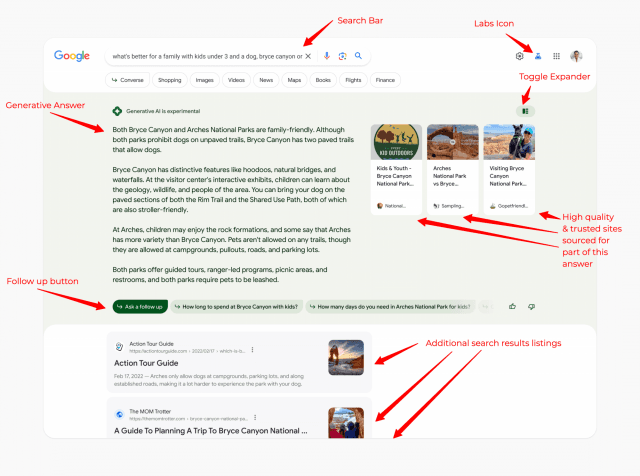
“They all draw on the same ranking signals and data sources as traditional Search,” she explained.
This is not just a semantic difference. It is a structural one. AI Mode and AI Overviews are not standalone products. They are built directly into the existing core indexing and ranking engine.
So then… Why the confusion?
Maybe it is due to various factors which can be the naming, the speed of innovation. Maybe it is our collective assumption that something labeled “AI” must be an entirely new frontier.
But in truth Google’s message is this: AI in Search is an augmentation, not a replacement.
How Is AI Search Built on Traditional Google Search Infrastructure?

Illyes backed this up by emphasizing that both classic and AI-driven results are served using a unified infrastructure. That means:
- Indexing is the same.
- Ranking is the same.
- Serving results is the same — just with new interpretation layers added to power AI functionality.
So, if you are optimizing content for SEO today, you are already optimizing for AI Search in many ways.
Let us reflect on that. How often do we, as marketers, panic and reinvent the wheel?
In this case, it turns out the wheel still works just fine — we just might want to add a new set of tires for better traction.
Is Googlebot Still Relevant in the Age of AI Search?
A particularly interesting nugget from the session: AI Overviews and AI Mode rely on the same crawler that powers Googlebot.
Yes, that Googlebot — the one we have been optimizing for over the last two decades.
It is still visiting pages, following links, collecting fresh content. So, for those worrying about the need for a new crawling strategy for GEO/AEO? You can stand down.
However, the only noteworthy exception mentioned was Gemini, which is treated as a separate system within Google’s ecosystem and uses its own bots to feed its models. Still, for the majority of AI-driven search features, Googlebot is your guy.
What’s the Role of Indexing, BERT, and Statistical Models in AI Search?
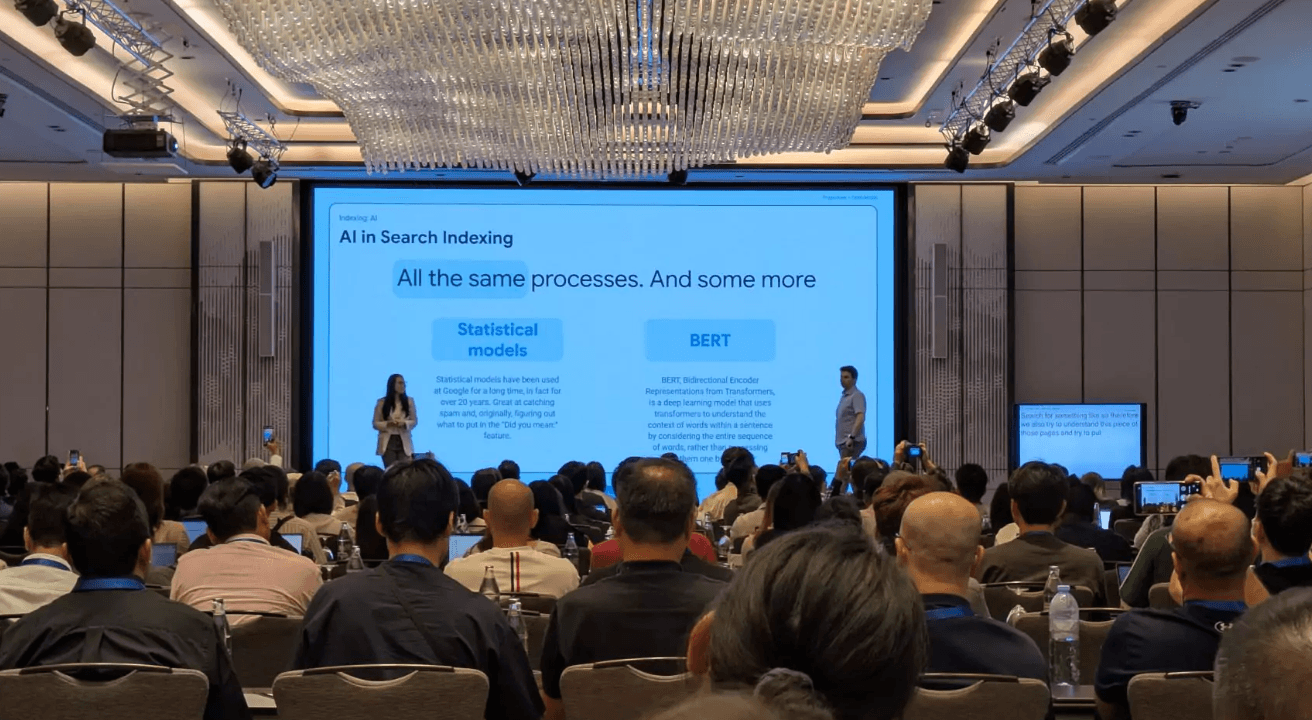
Cherry and Gary took a deep dive into indexing as well. They explained that pages processed by AI Search go through the same indexing pipeline as traditional search:
- Statistical models that have been in play for over 20 years — originally developed to power features like “Did you mean?”
- BERT is layered in for deep natural language understanding.
- These models have evolved to support spam filtering, query expansion and now, AI interpretation.
And here is what this really means: You do not need to reinvent your content strategy to “make it AI-friendly.” If your content is well-structured, human-readable and optimized for helpfulness and authority then you are already on the right track.
How Do RankBrain and MUM Power Query Understanding in AI Search?
At the query-serving stage, Google continues to deploy complex systems like RankBrain and MUM:
RankBrain applies machine learning to adjust ranking signals dynamically based on behavior patterns.
MUM (Multitask Unified Model) brings multimodal and multilingual understanding into the mix which means decoding queries that involve not just words but images, videos, context and more.
This stage is where AI Mode shines, interpreting and delivering answers that are not only relevant but context-aware — similar to what we’ve seen with featured snippets but powered by deeper models.
Should You Create New SEO Strategies for GEO or AEO?
This brings us back to the main question: Should marketers develop entirely new frameworks for GEO (Generative Engine Optimization) or AEO (Answer Engine Optimization)?
Gary Illyes’ stance was unequivocal: “AI Mode and AI Overviews are just features of Search.”
Cherry Prommawin agreed: “You can continue to use the same principles that guide traditional SEO.”
This was the key takeaway of the session and arguably of the entire conference.
Developing standalone strategies for GEO or AEO may not just be redundant and it could actually distract from higher-impact SEO tasks. Instead, marketers are encouraged to:
- Double down on helpful content.
- Optimize for intent, not just keywords.
- Structure content for better crawlability and understanding.
- Use multimedia where relevant.
- And finally, focus on the user — not the bot.
Because whether it is Googlebot or Gemini’s crawler, the objective is still the same: delivering the most relevant, helpful response to a user’s query.
What’s the Best Way to Optimize for AI-Enhanced Google Search?
If you have been stressing about rewriting your SEO playbook from scratch — don’t.
Instead, look at AI enhancements as extensions of existing capabilities. The better your foundation in SEO, the more future-proof your strategy becomes.
We do not need to tear down the house. We just need to upgrade the plumbing. “AI is another feature in the Search product,” Cherry concluded.
So rather than chasing after a new acronym or building GEO/AEO as separate verticals, maybe it is time we simply… evolve our existing SEO processes with AI in mind.

Dileep Thekkethil
AuthorDileep Thekkethil is the Director of Marketing at Stan Ventures, where he applies over 15 years of SEO and digital marketing expertise to drive growth and authority. A former journalist with six years of experience, he combines strategic storytelling with technical know-how to help brands navigate the shift toward AI-driven search and generative engines. Dileep is a strong advocate for Google’s EEAT standards, regularly sharing real-world use cases and scenarios to demystify complex marketing trends. He is an avid gardener of tropical fruits, a motor enthusiast, and a dedicated caretaker of his pair of cockatiels.
