
News publishers expect search referrals to drop by more than 40% by 2029 as search engines increasingly deliver answers directly, leaving fewer reasons for users to click through to original reporting.
Media executives are bracing for a sharp decline in search traffic as AI-powered search tools reshape how people find information.
According to a new report from the Reuters Institute, publishers anticipate search engine referrals will fall by 43% within the next three years.
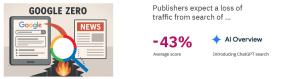
The expectation reflects a growing belief that search engines are no longer acting primarily as gateways to publisher websites.
Instead, they are becoming destinations in their own right, offering summaries, explanations, and task-based responses that often satisfy users without a visit to the source.
This concern is backed by recent performance data.
The report cites Chartbeat figures showing global organic Google search traffic dropped by 33% between November 2024 and November 2025. In the United States, the decline reached 38% over the same period.
AI Overviews Are Changing User Behavior
Google’s AI Overviews now play a central role in how many searches are answered. These summaries appear at the top of roughly 10% of U.S. search results, according to the report. When they appear, users are far more likely to find what they need without clicking through to another site.
This changes how visibility works in search. Success was once measured through rankings, impressions, and visits. AI Overviews shorten that path by presenting key information upfront, which reduces how often individual articles receive direct traffic.
The impact differs by content category.
Lifestyle and utility topics such as weather forecasts, TV schedules, and horoscopes are among the most exposed because they are easy for AI systems to summarize quickly and accurately.
Hard news has held up better so far, especially breaking stories and original reporting, although publishers do not expect that protection to last forever.
A Move Away From Classic SEO
As expectations reset, many publishers are reconsidering how much effort they put into traditional search optimization.
The Reuters Institute report points to growing interest in answer engine optimization and generative engine optimization as alternatives to conventional SEO.
These approaches focus less on ranking pages and more on how content appears inside AI-generated responses, chat interfaces, and overview panels.
Several publishers surveyed said they plan to reduce investment in classic Google SEO and experiment more with visibility inside AI platforms such as ChatGPT, Gemini, and Perplexity.
While referral traffic from these platforms is growing, the report describes it as small relative to Google, at least for now.
Distribution Without Ownership
Beyond traffic loss, publishers are increasingly worried about control.
When content is summarized or referenced inside AI systems, media companies have limited influence over how their work is framed, credited, or monetized.
Attribution is becoming harder to define.
If an AI assistant summarizes an article or uses it to answer a question, it is unclear whether that interaction should count as a visit or how its value should be measured. Existing analytics systems were not built for this kind of consumption.
In response, licensing is gaining traction as a parallel strategy.
Publishers are pursuing AI licensing agreements, revenue-sharing deals, and negotiated terms around citation and visibility. These arrangements are not replacing audience traffic, but they offer another way to capture value as referrals become less reliable.
New Metrics Are Replacing Clicks
The report suggests that a different set of performance indicators is beginning to matter.
Metrics such as citation frequency, share of AI answers, and brand recognition inside generated responses are emerging alongside traditional traffic measures.
It also anticipates growing demand for tools that can distinguish human visits from automated or agent-based usage.
As AI systems increasingly act on behalf of users, understanding how content is consumed will matter as much as how often it is clicked.
What Publishers Can Do Now
Publishers can start by identifying which parts of their content portfolios are most vulnerable to AI summarization.
Utility-driven pages may require new monetization approaches, while distinctive reporting remains a key differentiator.
Improving clarity, structure, and source transparency can help content perform better inside AI answers.
At the same time, teams should begin tracking metrics that reflect visibility and influence rather than relying solely on referral volume.
Early exploration of licensing and platform partnerships may also reduce long-term dependence on search traffic alone.
A Future Where Search Still Matters, but Differently
Search is not disappearing, but its role is changing fast.
The Reuters Institute report describes a future where being visible remains important, even as direct visits decline.
Publishers now face the challenge of adapting to AI-led discovery without losing the value of original journalism. Many are beginning to rely on clearer performance signals and, in some cases, AI SEO services to understand how their content is surfaced, summarized, and cited across AI-driven search experiences.
How well publishers balance distribution, attribution, and monetization over the next few years may determine who remains sustainable in an environment where answers increasingly arrive without a click.
Key Takeaways
- News publishers expect search traffic to drop by more than 40 percent by 2029 as AI-driven search tools reduce the need for clicks.
- Google’s AI Overviews are changing how people use search by answering questions directly, which increases zero-click behavior.
- Lifestyle and utility content face the greatest risk, while hard news has been more resilient so far.
- Many publishers are moving away from traditional SEO and experimenting with answer-focused and generative visibility strategies.
- As referral traffic weakens, publishers are exploring new measures of value, including licensing deals, citation visibility, and brand recognition inside AI responses.

Zulekha
AuthorZulekha is an emerging leader in the content marketing industry from India. She began her career in 2019 as a freelancer and, with over five years of experience, has made a significant impact in content writing. Recognized for her innovative approaches, deep knowledge of SEO, and exceptional storytelling skills, she continues to set new standards in the field. Her keen interest in news and current events, which started during an internship with The New Indian Express, further enriches her content. As an author and continuous learner, she has transformed numerous websites and digital marketing companies with customized content writing and marketing strategies.
