
According to a new industry study by Ann Smarty, a staggering 90% of businesses say they are worried about the future of SEO and organic findability due to the rise of AI and large language models (LLMs).
This is not just another algorithm update scare, it is a deep structural shift in how people find, trust and engage with content online.
We have all seen it coming. Search engines are slowly turning into answer engines. AI summaries stealing clicks. Buying journeys shrinking from weeks to seconds.
But few expected it to move this fast. Over the past two years, brands have seen measurable drops in organic traffic, changing patterns in click attribution and an unprecedented rise in AI-driven visibility.
So, what does this mean for marketers and businesses that have relied on SEO for decades?
Is traditional SEO dead, or is it simply being reborn as something else, like GEO (Generative Engine Optimization) or SEO for AI?
Are Businesses Really Losing Faith in SEO Because of AI?
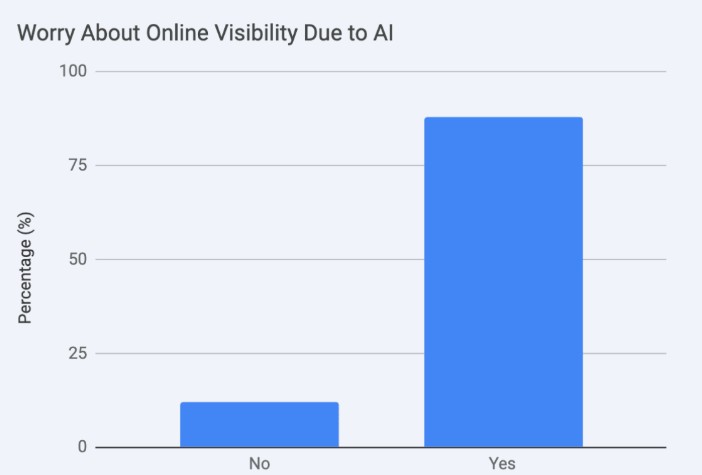
Yes and the anxiety is widespread. The study found that 87.76% of businesses admit they are worried about how AI will impact their ability to be found online.
The decline in traffic is not hypothetical; it is being felt across multiple industries. What is changing is not just how people search but where they search and how they consume answers.
With the introduction of ChatGPT, Google Gemini, Perplexity, and Claude, consumers now expect quick, conversational answers rather than scrolling through 10 search results.
For businesses, this means visibility is no longer just about ranking and it is about being recognized by AI systems that may or may not credit the original source.
Many survey participants expressed concern that even when AI systems use their data, the visibility does not always translate into traffic.
It is as if their content is being read but not remembered. This is the new “zero-click” problem, except it is not just a feature of Google anymore; it’s becoming the foundation of AI-driven discovery.
As one marketing executive put it, “Our content shows up in AI summaries, but the user never reaches our site. It’s like we are feeding the system that’s taking our visitors away.”
What Are Businesses Most Concerned About When It Comes to AI?
When asked what specifically worries them, most businesses pointed to one thing above all: not being found online at all.
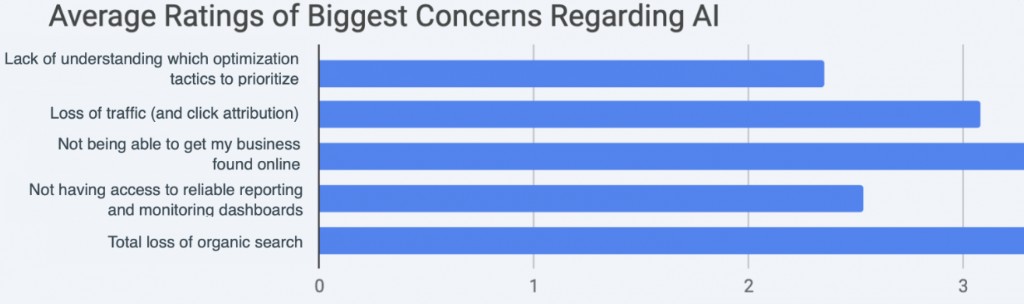
The top concern in the survey, with an average rating of 3.69 out of 5 was “not being able to get my business found online.” This was followed closely by the “total loss of organic search visibility” and the “loss of traffic and click attribution.”
In other words, businesses are not just afraid of ranking lower, instead they are afraid of disappearing altogether.
The shift toward AI-driven search results has made it harder for companies to measure impact.
Without clear click attribution, it is becoming nearly impossible to know which queries drive engagement or which AI systems mention your brand at all.
One of the more subtle fears mentioned in the report was the loss of control. Traditional SEO allowed marketers to track impressions, clicks, and rankings with precision.
Now, AI models generate answers on the fly, using aggregated information that’s often opaque and impossible to audit.
And while AI-generated results are designed to help users, they may inadvertently silence smaller brands that don’t have enough authority, trust signals, or branded mentions for AI systems to prioritize.
Is Traditional SEO Dead in the Age of AI?
Despite the fears, not one respondent in the study said that SEO will die. In fact, 100% of surveyed businesses believe SEO will continue to exist — it just won’t look the same.
The consensus is clear: SEO will evolve into something more complex, multi-layered, and AI-aware.
Chris Nichols of Fast Frigate explained that even as AI transforms search behavior, technical SEO still plays an irreplaceable role.
“If search engines or AIs can’t crawl or discover the information your site has to offer, then you are excluded,” he said.
“For large enterprise sites, monitoring crawl logs is still vital, I have seen instances where crawl rates from meta bots have increased server costs by four times over.”
His point highlights an important truth: technical accessibility remains the foundation. If your data is not structured, discoverable, or optimized for AI parsing, it may not even make it into the generative ecosystem.
So, no, SEO isn’t dying. But it is transforming from a game of keyword ranking into a strategic discipline focused on semantic discoverability, brand authority, and answer-level visibility.
Are Businesses Increasing or Cutting Their SEO Budgets Because of AI?
Here is where the conversation takes an unexpected turn: despite rising fears, most businesses are actually increasing their SEO spending.
The study revealed that 61.2% of companies plan to increase their SEO budgets because of AI, while only 4.1% intend to cut back. About a third, 34.7%, will maintain current spending levels.
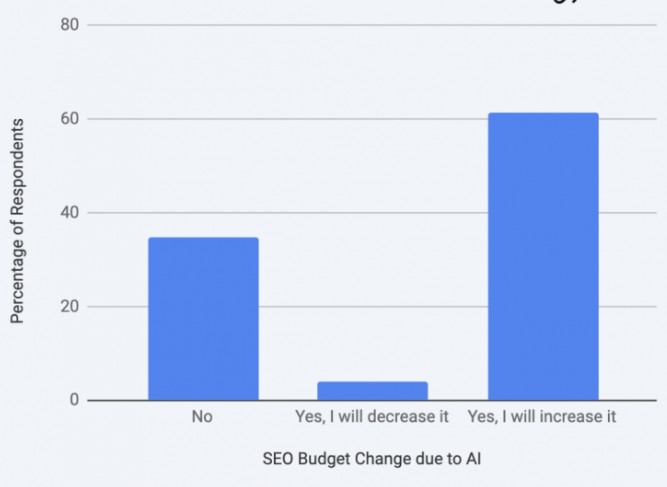
This suggests that businesses are not retreating, they are preparing for an SEO reinvention. They understand that staying visible in the AI era requires investment, not withdrawal.
The logic is simple: if AI systems are now deciding what’s “useful,” “trustworthy,” or “authoritative,” then brands must ensure they’re producing content that meets those evolving standards.
That means higher-quality writing, better structured data, improved brand recognition, and long-term authority building.
Many respondents described this as a “visibility insurance policy” and investing in SEO not to chase rankings but to remain relevant as AI engines reshape how people discover information.
What Do Businesses Call This New Era of Optimization?
Interestingly, there is still no universal name for this next phase of SEO. But a few front-runners are emerging.
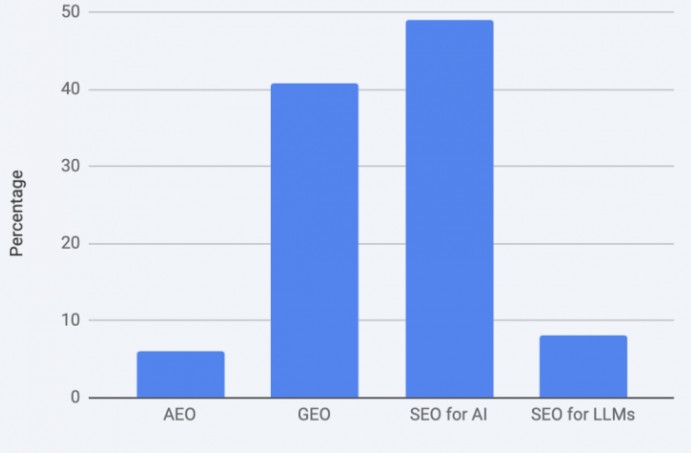
When asked what term best describes optimization for AI visibility, “SEO for AI” took the lead with 48.98%, followed closely by “GEO” (Generative Engine Optimization) at 40.82%. Smaller groups opted for “SEO for LLMs” or “AEO” (Answer Engine Optimization).
The takeaway? Most marketers want to preserve the familiar language of SEO while adapting its purpose for a new ecosystem.
“SEO for AI” feels approachable, logical, and evolutionary.
It suggests continuity, the idea that we’re still optimizing for discovery, just through a different lens. “GEO,” on the other hand, represents a more technical and forward-facing term, signaling the integration of AI visibility as its own measurable discipline.
Either way, what’s clear is that the term “SEO” is not being abandoned. It’s being expanded.
What Kind of AI Visibility Are Businesses Focusing On?
Visibility itself is being redefined. In the past, marketers wanted clicks and now, they want mentions.
The survey found that 75.5% of businesses prioritize their brand being included in AI-generated answers, even if it does not produce a direct link.
Only 14.3% said they prefer being cited as a resource with a clickable URL.
This reflects a dramatic philosophical shift in how visibility is valued. It’s not just about traffic anymore, it is about presence and association.
Being mentioned as the recommended brand in a ChatGPT answer or Google’s AI Overview could shape perception far more than a single organic link ever could.
This is especially true for brands operating in crowded industries where visibility equals credibility.
As one respondent noted, “Even if users don’t click, the fact that our brand appears in the AI’s answer gives us authority. That’s the new SERP real estate.”
However, this change also introduces new challenges. Without click data or referral tracking, it becomes harder to prove ROI. Marketers must now look at brand recall, sentiment, and engagement rather than just traffic metrics.
What’s the Right Approach to SEO for AI?
If there’s one message echoed across the survey responses, it is this: don’t chase short-term hacks, build long-term credibility.
Dave Anderson, one of the marketing leaders surveyed, explained it best:
“Avoid the marginal tactics people are preaching. The actual business impact of SEO for AI is still minimal right now, but it’s growing.
Focus on brand mentions, social engagement, backlinks, and rich content. Don’t obsess over vanity metrics. AI SEO is still in its infancy, but its foundation is the same, find the best way to answer user intent.”
That is the core truth here. AI systems, just like search engines, reward relevance, authority, and trust. The difference is that they do it more contextually and conversationally.
So, the strategy moving forward isn’t about overhauling SEO. It’s about teaching AI models who you are, what your brand stands for, and why your information deserves to be surfaced.
It’s brand optimization, content structure, and digital PR, all fused into one.
Key Takeaways / TL;DR
- 90% of businesses are worried about the future of SEO and organic visibility due to AI and LLMs.
- 61.2% plan to increase their SEO budgets, signaling adaptation, not abandonment.
- “SEO for AI” (49%) and “GEO” (41%) are the top emerging terms for AI-driven visibility.
- 75.5% of businesses prioritize brand mentions in AI answers over click-throughs.
- 100% of respondents believe SEO will evolve, not die and shifting focus from rankings to recognition.
- Experts advise doubling down on brand authority, experience, and content quality to remain visible in the age of AI.

Dileep Thekkethil
AuthorDileep Thekkethil is the Director of Marketing at Stan Ventures, where he applies over 15 years of SEO and digital marketing expertise to drive growth and authority. A former journalist with six years of experience, he combines strategic storytelling with technical know-how to help brands navigate the shift toward AI-driven search and generative engines. Dileep is a strong advocate for Google’s EEAT standards, regularly sharing real-world use cases and scenarios to demystify complex marketing trends. He is an avid gardener of tropical fruits, a motor enthusiast, and a dedicated caretaker of his pair of cockatiels.
