
If you’ve spent any time reading about SEO, you’ve probably come across the term link juice.
It sounds informal — because it is.
But the idea behind it is one of the most important concepts in how Google decides which pages deserve to rank.
Here’s what it means, how it works, and what you should actually do about it.
The Simple Definition
Link juice is the SEO value that passes from one page to another through a hyperlink.
When a page links to yours, it shares some of its authority with you.
The stronger that page is, the more value it passes along.
Think of it like a recommendation.
If a well-respected expert in your industry vouches for you, that carries more weight than a recommendation from a random stranger.
Google treats links the same way.
Where the Idea Comes From
Link juice is built on Google’s original ranking algorithm — PageRank.
PageRank treated every link on the web as a vote.
The more votes a page received — and the stronger those votes were — the higher it ranked.
Google’s algorithm has evolved a lot since then.
But the core logic hasn’t changed.
In fact, Google’s own Search Central documentation confirms that links remain one of the most important signals Google uses to discover and evaluate pages.
Links remain one of the top three ranking signals in Google’s algorithm today.
How Link Juice Flows
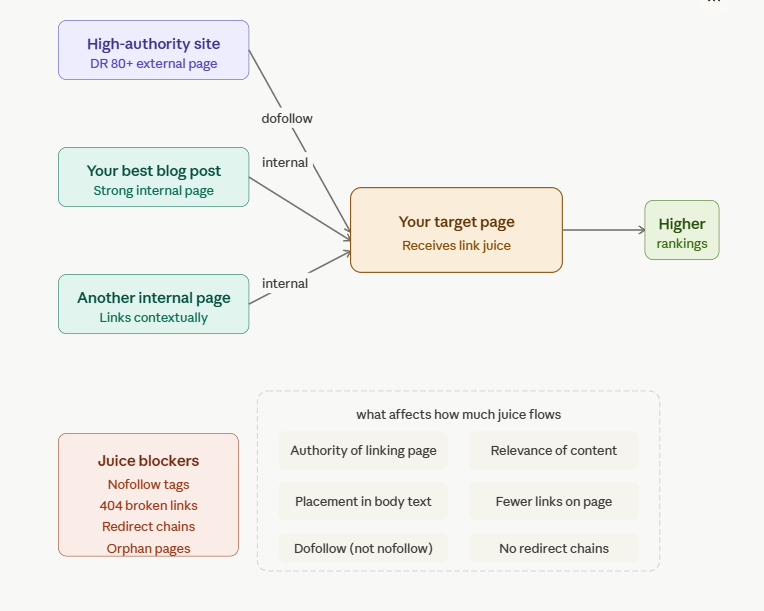
There are two ways it moves.
Through external backlinks. When another website links to yours, their page authority flows into your site.
A backlink from a high-authority news site passes far more value than one from a brand-new blog with no traffic.
If you’re looking to build those kinds of authoritative links at scale, white label link building service is built exactly for that.
Through internal links. When you link from one page on your own site to another, you’re distributing your existing authority internally.
This is something a lot of site owners overlook — but it’s completely within your control.
What Makes a Link Pass More (or Less) Juice?
Not all links are equal. Here’s what decides how much value actually flows:
Authority of the linking page. A link from a page that itself has strong backlinks passes more value. A link from a page nobody links to passes very little.
Relevance. A link from an SEO blog pointing to your SEO guide carries more weight than a random link from a cooking site.
Placement on the page. Links inside the main body of an article pass more juice than links buried in footers or sidebars. Position signals importance to Google.
How many other links are on that page. Link juice gets divided among all outgoing links. A page linking to 50 sites shares far less per link than one linking to just 3.
Dofollow vs. nofollow. Only dofollow links pass link juice. A nofollow tag tells Google not to transfer any authority to the destination page.
According to Ahrefs’ guide on link equity, the quality and relevance of the linking domain matters far more than the sheer number of links pointing to a page.
What Stops Link Juice from Flowing?
A few things block it entirely:
Nofollow tags — the link exists but no value transfers.
Broken links — a 404 page stops the juice dead. It goes nowhere.
Redirect chains — every extra hop in a redirect loses some of the original value before it reaches its destination.
Orphan pages — pages with no internal links pointing to them never receive any juice, no matter how good the content is.
Why This Matters for Your SEO Strategy
Understanding link juice changes how you think about both link building and your own site structure.
On the link building side, one strong relevant backlink will always outperform ten weak ones.
Chasing volume without quality is how most link building budgets get wasted.
On the internal side, your most-linked pages are sitting on pools of authority.
If those pages don’t link to your important service pages or newer content, you’re leaving ranking power on the table.
A simple internal link from a high-traffic post can move a struggling page more than a new backlink can.
A Quick Example
Say you publish a blog post that earns backlinks from several industry sites.
That post now has strong link juice.
If you then add an internal link from that post pointing to your services page, some of that authority flows directly to the page you want to rank.
That’s link juice working in your favor — without building a single new backlink.
For agencies managing multiple client sites, white label link building makes it easy to deliver this kind of authority-driven strategy under your own brand.
The Takeaway
Link juice isn’t a magic metric you can measure directly.
Google stopped publishing PageRank scores publicly in 2016.
But the underlying principle — that links pass authority and authority influences rankings — is as relevant as ever.
Focus on earning links from strong, relevant pages.
Build internal links from your best-performing content to the pages that matter most.
And regularly audit for broken links and redirect chains that might be quietly leaking your site’s authority.
That’s how you put link juice to work.

Deepan Paul
AuthorDeepan Paul is a Team Lead of the Internal Marketing Department at Stan Ventures, with four years of experience helping brands recover, grow, and hold on to organic traffic across global B2B, B2C, and D2C markets. He's known as a ranking revival expert. When traffic drops, pages fall out of the index, or visibility disappears after an update, he finds the cause and fixes it. Today he runs Stan Ventures' own organic presence, and that goes well past Google. He tracks and grows how the brand shows up in AI Overviews and across AI tools like ChatGPT, Perplexity, and Gemini, where citations decide who gets mentioned and who doesn't. His work covers technical SEO, content strategy, indexing, and building growth systems that hold up when algorithms shift. He has managed international clients and led cross-functional teams, keeping every SEO decision tied to what the business actually needs. Outside of client work, Deepan trains SEO professionals, speaks at industry events, and contributes insights to digital marketing publications. His approach is simple: build systems that keep working, instead of chasing quick wins.
