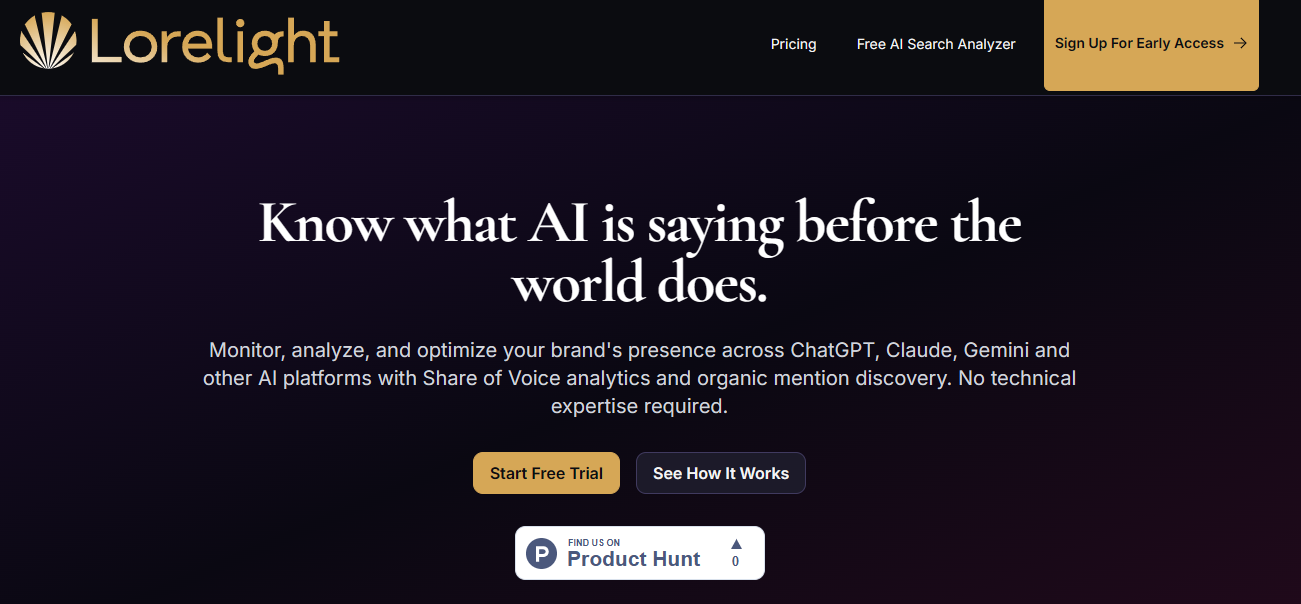
Benjamin Houy, the founder of the Generative Engine Optimization (GEO) platform Lorelight, has announced he is shutting down the startup.
It is not due to failure or funding issues, but because of what he calls a realization about the true nature of AI search visibility.
How often does a founder admit that the problem they set out to solve might not need solving at all?
Houy’s explanation of why he’s walking away from a functioning product offers a rare look inside the fast-evolving and sometimes misunderstood world of AI search optimization.
What Was Lorelight and Why Was It Built?
Launched just a few months ago, Lorelight was built on a timely premise: as AI tools like ChatGPT, Claude and Perplexity become the default way people find information, brands need to understand and influence how they appear in AI-generated responses.

Lorelight’s vision was to act as the “SEO for AI search engines.” It could:
- Track brand mentions in ChatGPT and other generative platforms
- Monitor visibility trends across AI-generated answers
- Identify the context and content that drove citations or references
The goal? To give marketers and businesses the data they need to increase their brand visibility inside AI-driven answers, Houy called “GEO” (Generative Engine Optimization).
And by all accounts, it worked. Customers signed up, the platform provided detailed insights, and the technology functioned as intended.
But success on paper does not always equal impact in practice.
The Turning Point: When Data Didn’t Drive Action
Houy’s decision to shut down Lorelight didn’t come from product failure, it came from watching how users interacted with it.
He noticed a pattern: people were interested and impressed but they didn’t change their marketing behavior based on what the tool told them.
“Customers would sign up, explore the data, get excited and then churn,” Houy wrote. “Not because the insights were wrong, but because they did not change what users actually needed to do.”
That’s when Houy began to question the core assumption of GEO: if brands already know what to do, does tracking AI mentions actually help them do it better?
So, he started researching.
He manually analyzed hundreds of AI-generated answers across ChatGPT, Claude, and Perplexity to see which brands got cited most often and why. The findings? Eye-opening, but not in the way he expected.
What Actually Drives AI Search Visibility?
In GEO was supposed to uncover a new frontier of search optimization. But Houy’s research led him somewhere much more familiar.
After reviewing hundreds of responses, he found that brands consistently mentioned in AI-generated content shared four traits:
- They produced high-quality, genuinely helpful content.
- They were referenced in authoritative publications.
- They had established reputations in their respective industries.
- They demonstrated genuine thought leadership and expertise.
Sound familiar? That’s because it’s the exact formula that drives traditional SEO, PR, and brand credibility.
In Houy’s words:
“There was no secret GEO strategy. The same principles that build authority on Google such as trust, expertise, helpfulness are the ones AI models use to determine what and who to reference.”
AI models like GPT-5 are trained on web content that already reflects these signals. They don’t “invent” credibility; they mirror it.
In short, the best GEO strategy is just good marketing.
Why GEO Doesn’t Work as a Standalone Product
This realization left Houy with a difficult truth: Lorelight’s insights were accurate, but not actionable.
What users needed to do, build better content, strengthen authority, get cited by trusted sources did not depend on data dashboards. It depended on fundamentals.
Houy put it bluntly: “I was building a tool for something that didn’t need a tool.”
The second challenge was technical. GEO is, by nature, unstable. AI models constantly evolve. Their training data shifts. Their behavior changes with every update.
That means a standalone GEO tool would need constant recalibration, not just to measure performance but to understand how different AIs interpret brand authority over time.
“It’s an incredibly complex, moving target,” Houy noted. “For GEO to provide real value, it needs to exist as part of a comprehensive SEO platform, not as an isolated product.”
Where GEO Actually Fits: As Part of SEO, Not Apart from It
If there is one takeaway from Lorelight’s closure, it’s this: GEO isn’t dead, it’s just not standalone.
Generative Engine Optimization makes sense as a feature within larger, established SEO ecosystems.
Platforms like Ahrefs, Semrush, or Moz already have the data infrastructure, customer base, and analytic depth to integrate GEO insights alongside backlink tracking, keyword analytics, and site audits.
Houy pointed to a real example: when Ahrefs acquired Detailed.com, founded by SEO strategist Glen Allsopp, it wasn’t about creating new categories — it was about strengthening what already worked.
“Adding GEO visibility to comprehensive SEO tools makes perfect sense,” Houy said. “They already have the context and the audience for it. For a standalone startup, it’s an uphill battle.”
The Lesson Behind Lorelight’s Shutdown
For Houy, closing Lorelight is not a failure. It’s a strategic realization.
He isn’t walking away from tech; he’s walking back toward fundamentals.
Houy is now refocusing his energy on French Together, his long-running language-learning business that generates over $10K in monthly recurring revenue.
It’s not a hypergrowth startup, but a steady, purpose-driven company built on real user value.
His next steps?
- Expanding beyond French to other languages
- Launching a mobile app
- Rebranding for broader reach
- Doubling down on what’s already working
Because, as he put it, “sometimes the smartest business decision isn’t to build more, it’s to stop building what doesn’t need to exist.”
A Broader Reflection on AI, SEO, and the Illusion of Novelty
Lorelight’s story underscores something many in marketing and tech are quietly realizing: the fundamentals of visibility haven’t changed, only the interfaces have.
AI hasn’t reinvented how trust is earned online. It’s simply compressed it.
What used to take months of search indexing now happens instantly inside large language models but the input that earns recognition remains the same: authoritative, well-researched, human-centered content.
Interestingly, this also points toward how AI SEO services are evolving.
For instance, at Stan Ventures, we are helping brands adapt to this shift by integrating AI search optimization into broader digital strategies.
Rather than chasing short-lived GEO tools, Stan Ventures focuses on aligning brand visibility with how AI SEO interprets and surface information, a practical blend of human expertise and algorithmic insight.
TL;DR – Key Takeaways
- Benjamin Houy shuts down Lorelight, a GEO (Generative Engine Optimization) tool for AI search visibility.
- The platform worked technically but failed to change customer behavior.
- Houy found that AI search visibility mirrors traditional SEO principles such as quality content, authority, reputation, and trust.
- GEO makes sense only as part of broader SEO suites, not as a standalone category.
- Houy will refocus on his language-learning venture, French Together.
- The broader lesson: Good marketing outlasts every algorithmic shift.

Dipti Arora
AuthorDipti Arora is a Senior Content Writer with over seven years of experience creating impactful content across Digital Marketing, SEO, technology, and business domains. She has a strong background in managing news verticals and delivering editorial excellence. Dipti has contributed to leading publications such as The Times of India and CEO News, where her research-driven storytelling and ability to simplify complex subjects have consistently stood out. She is passionate about crafting content that informs, engages, and drives meaningful results.
