The newest funding data in the AI search ecosystem has revealed a sharp divide between where investors placed their bets and where the long-term value of the market truly resides. More than $227 million flowed into AI visibility and LLM monitoring tools, yet Adobe’s $1.9 billion acquisition of Semrush proves that dashboards were never the real alpha.
Instead, the durable upside sits inside agentic SEO platforms, the tools that actually ship work, automate execution, and embed themselves into daily operations.
This is not just another hype-cycle correction. It is a structural turning point, and the reasons behind it are becoming impossible to ignore.
Why Did AI Visibility Monitoring Look Like the Future?
In 2024, every CMO, growth leader, and brand strategist began asking a new question: “How does my brand show up in ChatGPT?”
With no standard prompts, no consistency in AI responses, and a market desperate for visibility metrics, LLM monitoring tools felt inevitable.
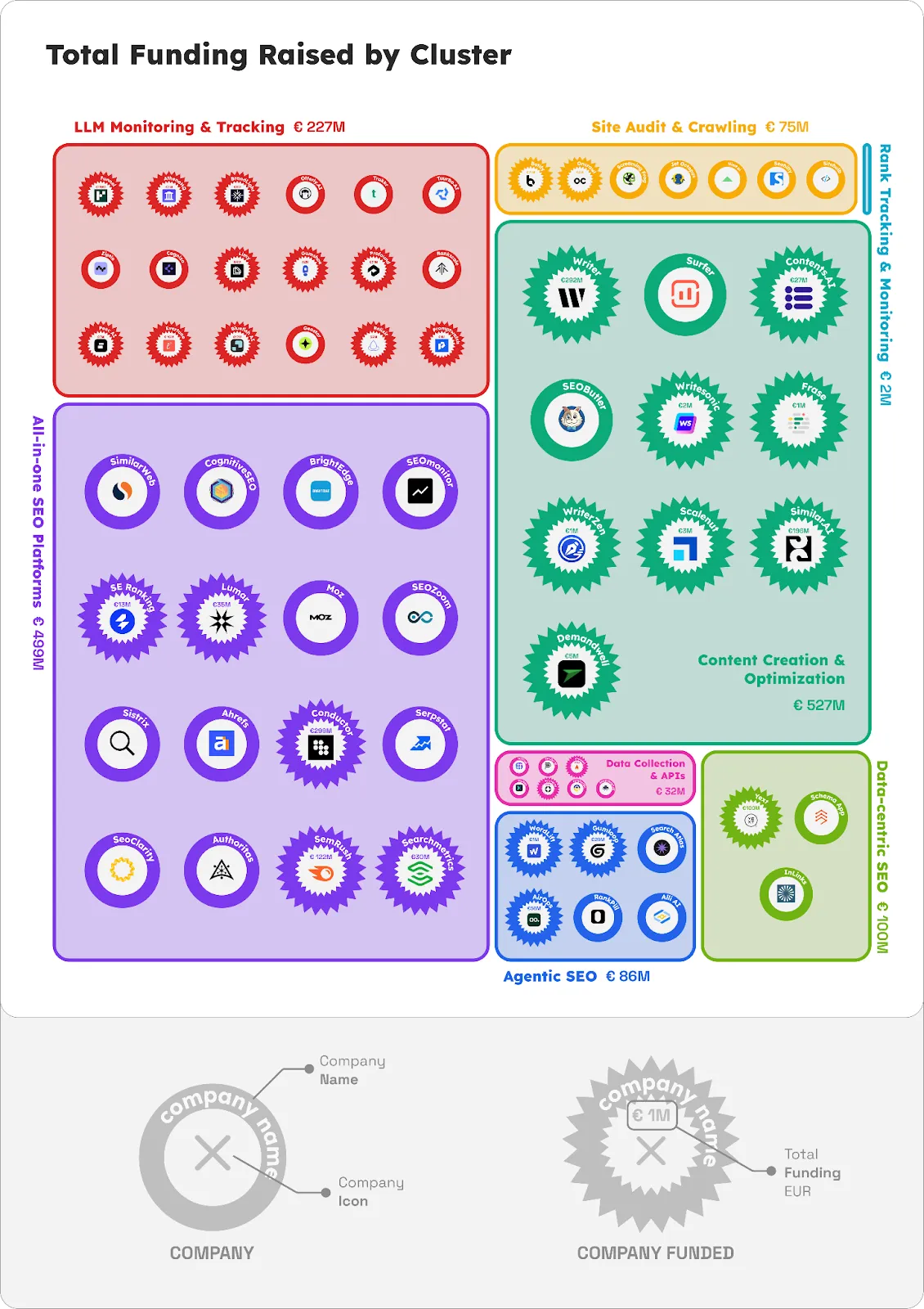
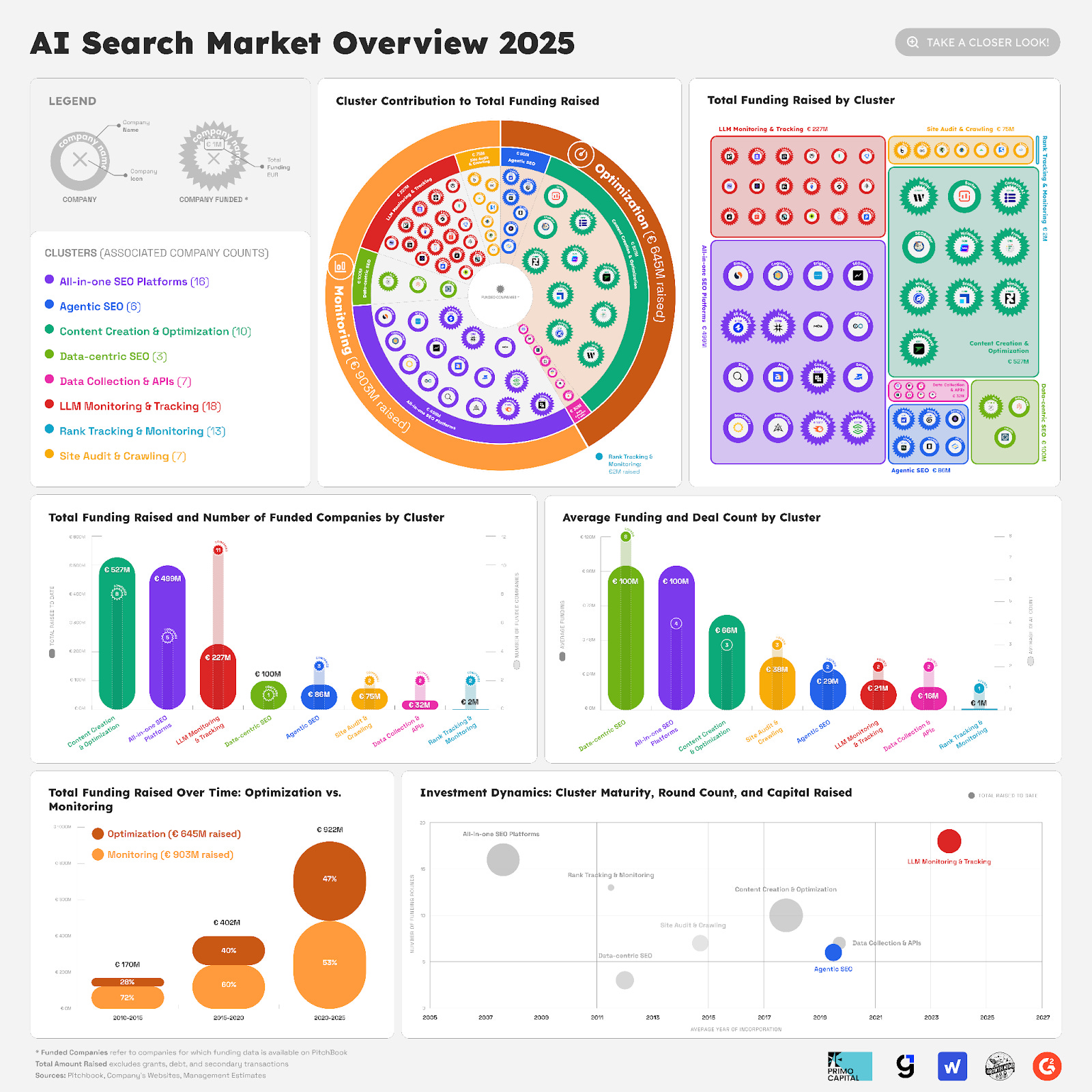
A combined dataset of 80 companies with $1.5 billion in funding paints the picture sharply:
- Established SEO platforms: $550 million
- LLM monitoring startups: $227 million
- Agentic AI SEO companies: $86 million
Visibility tracking became the “obvious” category because it aligned with the SaaS model investors adore. It looked clean, high-margin and instantly adoptable.
That appearance was deceptive. Monitoring tools have negative switching costs, which means customers can stop using them without operational risk. The loss is merely historical charts.
Agentic platforms, by contrast, deliver the one thing marketing teams cannot live without, continuous output. If a company turns them off, their content production engine stalls entirely.
This single difference explains why the market is now recalibrating.
What Made Monitoring a Weak Moat From the Start?
Visibility dashboards seemed innovative, but they were ultimately fragile. A few reasons explain why:
- Monitoring Became “Infrastructure” too Quickly.
Amplitude made AI monitoring free. Semrush added it as another checkbox in its product suite. When a category becomes a free feature, the standalone startups inside it collapse.
- The Market Lacked Genuine Differentiation.
Dozens of companies built nearly identical dashboards tracking LLM results. With no proprietary prompts, no user-level data visibility, and no defensible model, the category commoditized overnight.
- The Value They Provided Was Insight, Not Action.
In 2025, AI’s value is no longer in telling you what is happening. It is in executing what needs to happen next.
This is why the investors who chased monitoring tools now face a painful correction.
Why Is the Alpha in Execution, Not Insights?
Agentic SEO companies, those that can create, edit, distribute, and optimize content autonomously have been building for far longer.
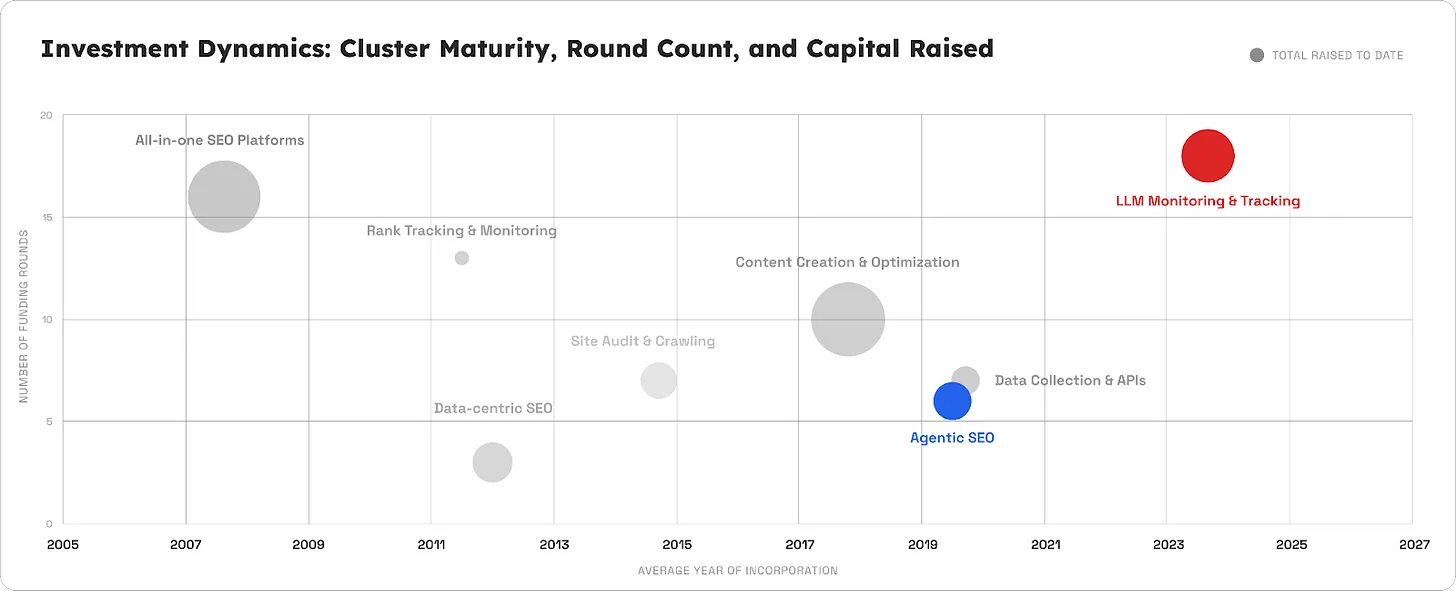
Their average age is 5.5 years, compared to 1.3 years for monitoring startups. They survived long enough to understand real customer pain.
More importantly, they built operational infrastructure, not dashboards. That creates three deep competitive moats:
1. Execution Velocity
Brands today need synchronized output across:
- Google and Bing
- TikTok and YouTube
- Reddit and Quora
- AI search platforms
Agentic tools automate this pipeline end-to-end. Monitoring tools cannot.
2. Business Context Grounding
Generic optimization is dead.
Brands need tools that understand:
- Product taxonomy
- Brand voice
- Customer segments
- Existing content assets
This creates real switching friction because the tool becomes part of the company’s internal knowledge graph.
3. Operational Scale
Businesses don’t need one-off content; they need governance, workflows, scheduling, review layers, and channel-specific formatting. Agentic tools embed themselves deep into operations, making them extremely hard to displace.
This is why investors misread the landscape. The “messy” parts, workflows, approvals, integrations were actually the moat.
Will the Next 18 Months Become an AI Extinction Window?
Based on funding timing and runway math, the AI visibility sector is heading toward a consolidation wave in Q3/Q4 2026.
Many monitoring startups raised inflated 2024 seed valuations without corresponding revenue growth.
Here’s the underlying math:
- Average funding date: March 2025
- Average capital raised: €21 million
- Average runway: 18 months
- Extinction window: Q3 2026
To raise again, they must show 3x–5x ARR growth, which is nearly impossible for a product that has already been commoditized by free add-ons from major platforms.
If they fail, three outcomes await:
- Down rounds
- Acqui-hires
- Shutdowns
The category simply cannot sustain dozens of standalone monitoring tools at venture scale.
How Is the Industry Shifting Because of Google, ChatGPT, and Perplexity?
According to investor and analyst Niccolo Sanarico, search behavior is undergoing a fundamental transformation:
- Google is integrating more AI-generated results.
- ChatGPT and Perplexity are becoming direct search entry points.
- SEO is shifting from manual consulting to automated, AI-driven execution layers.
The data supports this. Recent research values the SEO market at $166 billion, evenly split between tools and services. Yet the services layer, dominated by agencies and consulting is ripe for disruption because its processes are manual and expensive.
Workforce data signals what’s coming next:
- Content-level SEO roles fell 28% in 2024.
- Strategic roles increased 50%–58%.
- Enterprise AI tool budgets grew from 5% to 15% of SEO spend.
The industry is transitioning from human production to AI-powered operational orchestration.
What Should Tool Buyers Do Now?
A new procurement mindset is emerging. Instead of asking whether a tool is “AI-powered,” buyers must evaluate whether it solves an operational bottleneck.
You should ask:
- Does this eliminate manual work or just visualize data?
- Can my existing platform (Semrush, Ahrefs) eventually bundle this feature?
- Will my operations stop if I turn this tool off?
If the answer to the last question is “no,” the tool has weak stickiness.
What Should Investors Take Away From This?
The gap between narrative (monitoring) and value (execution) is closing quickly. The next category winners will be companies that:
- Provide workflow automation
- Integrate deeply into operations
- Cannot be easily replaced by platform bundles
The key venture question becomes:
“Would Semrush or Ahrefs need to rebuild core infrastructure to copy this?” If not, it isn’t defensible.
What Does This Mean for Builders in the AI Stack?
If you are building monitoring tools, you have 18 months to evolve or be acquired.
If you are building agentic platforms, your defensibility depends on:
- Workflow depth
- Brand-specific logic
- Multi-channel orchestration
- Governance and consistency
The more operational complexity you manage, the stronger your moat becomes.
The Market Finally Understands What Actually Creates Value
The past two years were filled with dashboards, charts, and monitoring tools that looked like the future. But Adobe’s acquisition of Semrush reminds us that true value lies in platforms, distribution, and operational embedding.
The alpha is not LLM monitoring. The alpha is execution. Agentic SEO tools are not flashy, they are essential.
And as the industry heads toward its 2026 correction, only the companies that ship real work, integrate deeply, and operate at scale will survive the next wave.
Key Takeaways
- LLM monitoring raised $227M but proved low-moat and easily commoditized.
- Adobe buying Semrush for $1.9B shows platforms and distribution hold real value.
- Agentic SEO tools raised far less but offer stronger defensibility through execution.
- Monitoring tools have zero switching costs; agentic systems become operational infrastructure.
- Most AI visibility startups launched in 2024 with inflated valuations and short runways.
- Category faces a potential extinction event by Q3/Q4 2026 due to weak revenue growth.

Dipti Arora
AuthorDipti Arora is a Senior Content Writer with over seven years of experience creating impactful content across Digital Marketing, SEO, technology, and business domains. She has a strong background in managing news verticals and delivering editorial excellence. Dipti has contributed to leading publications such as The Times of India and CEO News, where her research-driven storytelling and ability to simplify complex subjects have consistently stood out. She is passionate about crafting content that informs, engages, and drives meaningful results.
