Key Takeaways
- Guest posting remains the most widely used link-building tactic, favored by 64.9% of marketers, but its strategic value has shifted from raw backlinks to brand authority, audience reach, and entity-level mentions that feed AI Overview citations.
- Quality has displaced volume as the dominant signal: 85.3% of guest posting sites are classified as low-quality, and ten placements on tightly relevant publications consistently outperform fifty on generic blogs.
- SEO impact depends on three variables: the referring site’s domain authority, in-content link placement versus author bio placement, and natural anchor text variation, not on placement count alone.
- Editorial review has tightened sharply in the AI era. Publishers now reject formulaic or recycled pitches on sight, and only about 8.5% of cold outreach emails generate any response, making personalization, content gap targeting, and first-hand experience non-negotiable.
- Track outcomes, not outputs: referral traffic quality, conversions, branded search lift, keyword position movement on linked pages, AI Overview citations, and backlink indexation status are the metrics that indicate whether a campaign is actually compounding.
- AI Overviews have raised the stakes for brand mentions. Brands with zero AI Overview mentions receive 38% fewer clicks than peers, making the unlinked byline as strategically valuable as the dofollow backlink itself.
- The most resilient programs treat guest posting as one channel in a portfolio combined with digital PR for top-tier placements, niche edits for tactical lifts, and tiered link building to amplify the authority transfer from primary placements.
Guest posting is one of the most enduring authority-building plays in SEO, and it remains the most widely used link-building tactic, favored by 64.9% of marketers.
What has changed over the last one decade is the bar:
- Publishers now reject templated pitches on sight
- Google’s Search Quality Rater Guidelines reward demonstrable experience over generic expertise
- AI Overviews increasingly cite a handful of trusted brands rather than sites that produce commodified content that fails to add additional value.
This guide unpacks how guest posting works in 2026, from finding publishers that pass editorial scrutiny, to writing pieces that earn placements and drive qualified referral traffic, to tracking the metrics that actually move SEO outcomes.
What Is Guest Posting?
Guest posting or guest blogging is the practice of writing an article for another website in your industry, typically in exchange for an author bio, a contextual backlink, or both.
It is one of the oldest but effective off-page SEO tactics, and it remains relevant even in 2026 because editorial placements still signal trust to search engines (and of course AI engines) in ways that paid or fabricated links cannot.
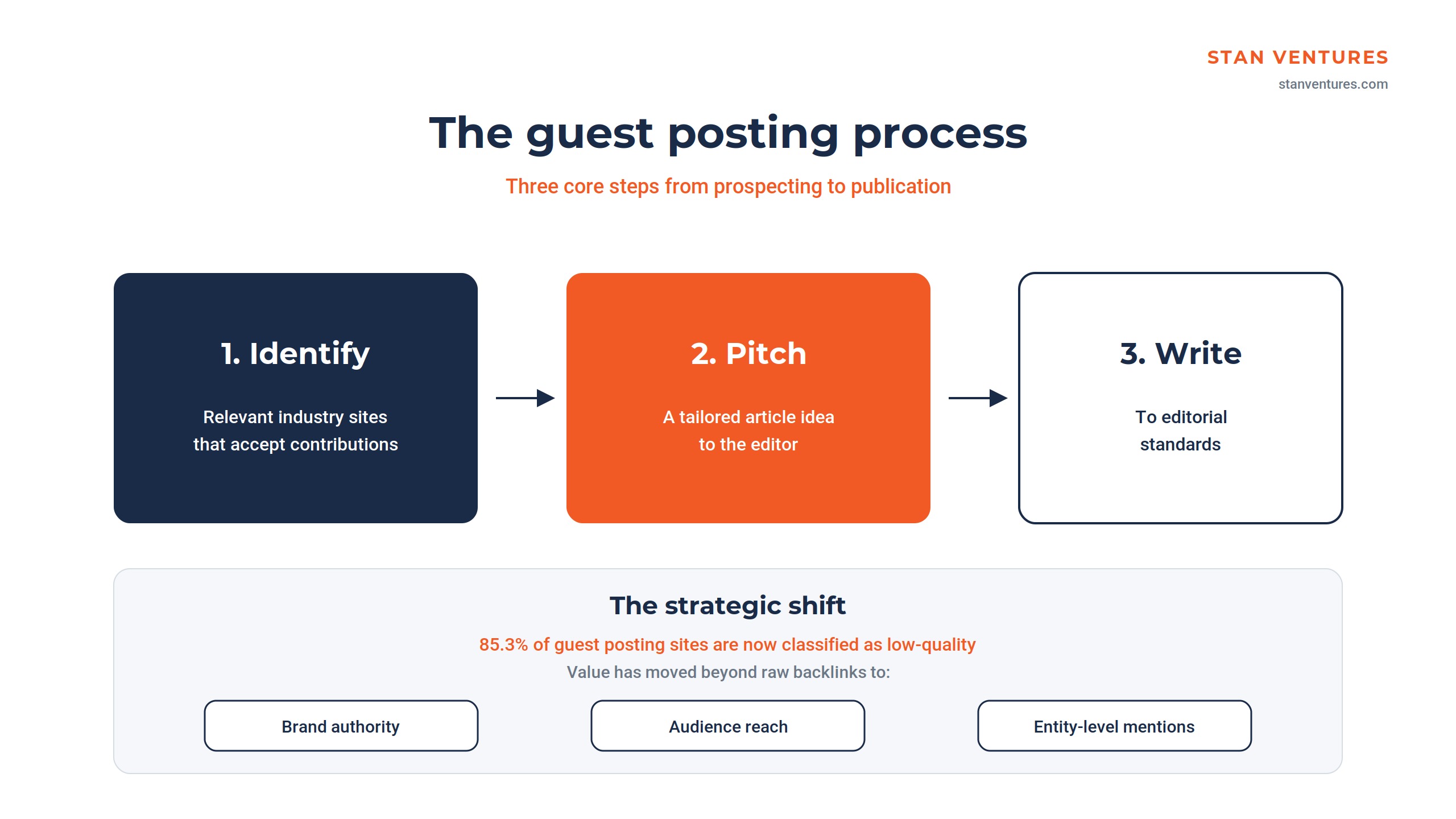
The process involves three core steps:
- Identifying relevant websites that accept external contributions.
- Pitching a tailored article idea to the editor or content lead.
- Writing content that meets the publisher’s editorial standards.
Guest posting once functioned primarily as a backlink play. Today, with 85.3% of guest posting sites classified as low-quality, the strategic value has shifted toward brand authority, audience reach, and entity-level mentions that feed both Google rankings and large language model citations.
Why Guest Posting Still Works in 2026
Guest posting earns its keep in three measurable ways, and understanding each one is what separates a campaign that compounds from one that stalls.
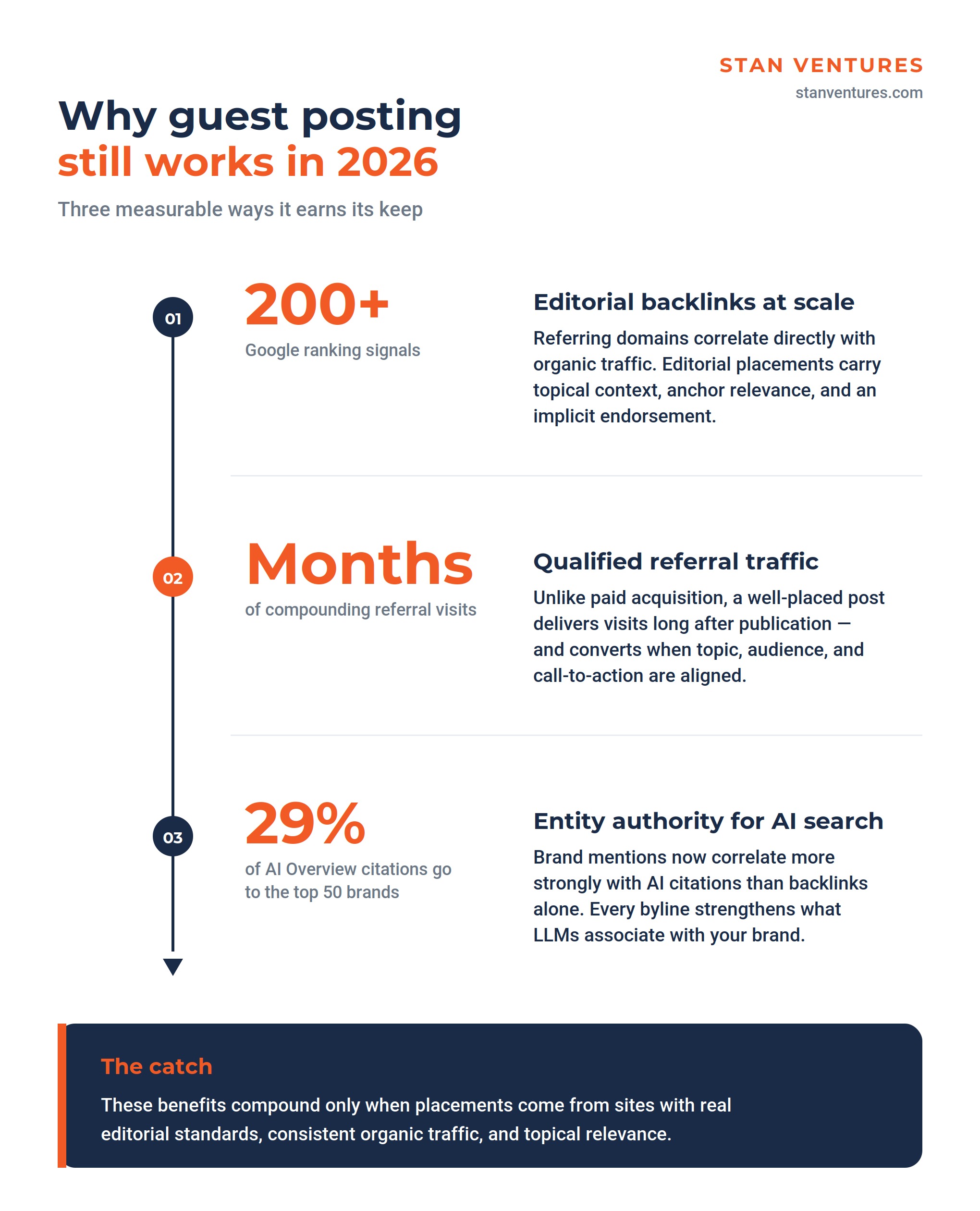
It earns editorial backlinks at scale:
Backlinks remain one of the strongest Google ranking signals, and studies have consistently found a direct correlation between the number of referring domains and organic traffic.
Editorial placements from real publications are categorically different from paid directory submissions; they carry topical context, anchor relevance, and an implicit endorsement.
It drives qualified referral traffic:
Unlike paid acquisition, a well-placed guest post can deliver compounding referral visits for months or years after publication.
Editorial placements convert when the topic, audience, and call-to-action are aligned.
It builds entity-level authority for AI search:
Ahrefs’ study shows that brand mentions, which guest posts can create, now correlate more strongly with AI Overview citations than backlink volume alone, and that the top 50 brands in AI Overviews capture nearly 29% of all citations.
Every guest byline, linked or unlinked, strengthens the brand-to-topic association that LLMs like ChatGPT, Perplexity, and Google’s AI Overviews use to decide who gets quoted.
The catch: These benefits compound only when placements come from sites with real editorial standards, consistent organic traffic, and topical relevance to the brand being promoted.
How Guest Posting Affects SEO Rankings
Search engines treat guest post backlinks as votes of confidence, but the weight of these votes depend on three variables.
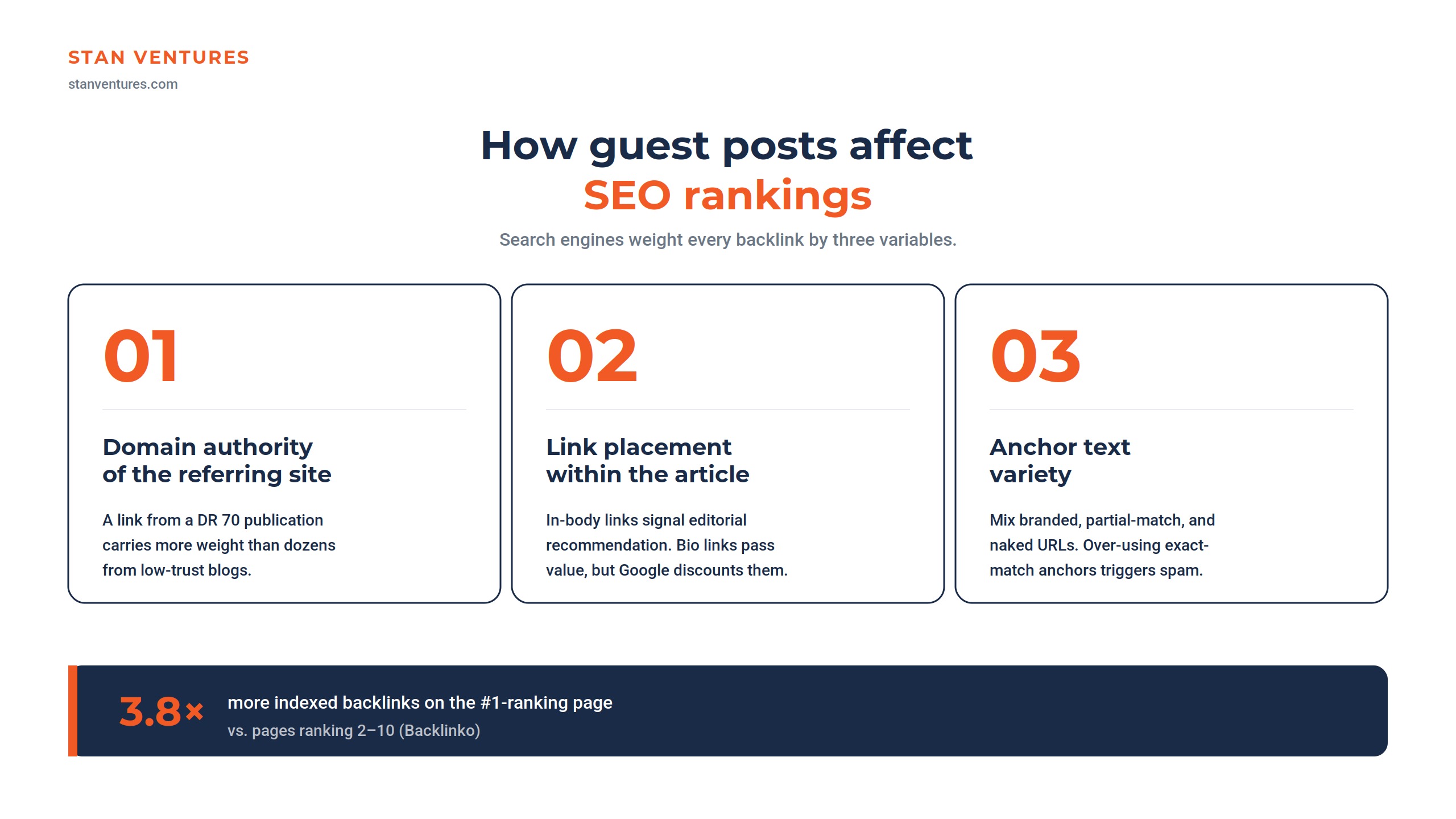
The first is domain authority of the referring site, expressed through metrics like Ahrefs’ Domain Rating or Moz’s Domain Authority. A contextual link from a DR 70 publication generally carries more SEO value than dozens from low-trust blogs.
Of course, these are third party metrics that Google algorithms ignore but these third part metrics are created based on hundreds of quality metrics that is commonly believed to be used by Google for ranking purposes.
Once you shortlist a website based on the third party metrics, try to ensure these sites have real organic traffic. This adds an extra layer of signal that can assert the website is truly worth getting a backlink.
The second is link placement. A link embedded in the body of the article, surrounded by relevant context, signals natural editorial recommendation. A link buried in an author bio still passes some value but is widely understood to carry less weight.
The third is anchor text. Anchor text gives search engines context about the destination page, but over-optimization triggers spam signals. The pragmatic approach is to vary anchor types, such as branded, partial-match, and naked URLs alongside the occasional exact-match, to keep the link profile natural. Our anchor text optimization guide breaks down the seven anchor types in detail.
A useful benchmark: The top-ranking page on Google has roughly 3.8X more indexed backlinks than pages in positions 2 through 10. The implication is not that more links is always better, but that consistent, quality-aligned guest posting compounds in measurable ways over time.
How to Find Guest Posting Opportunities
Finding the right publications is where most campaigns succeed or fail. The goal is not a long list; it is a short list of sites whose audiences actually overlap with the target customer profile and whose editorial standards signal real authority.
Google search operators
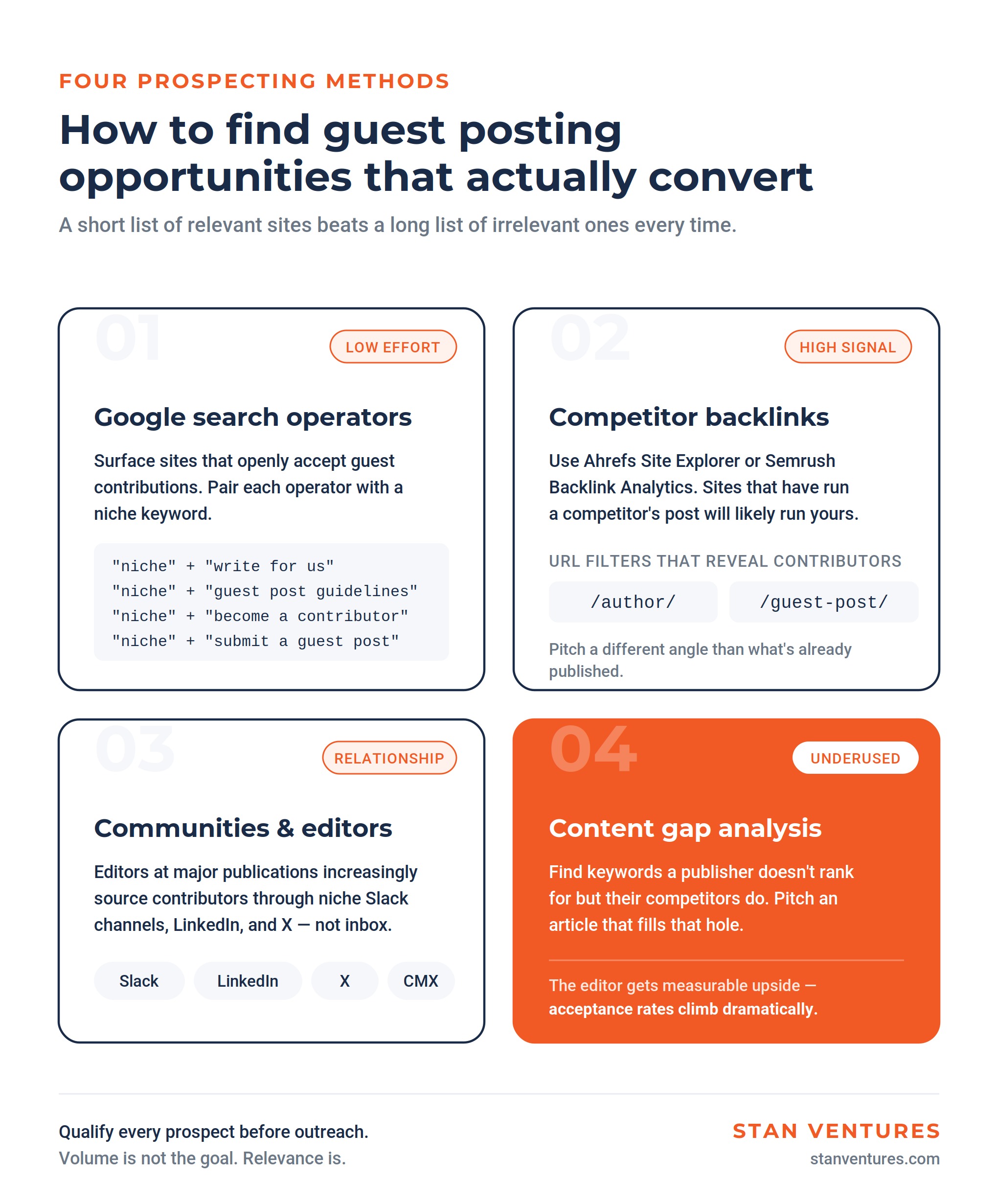
Advanced search operators surface sites that openly accept guest contributions. The following queries, combined with a niche keyword, return a workable starting list:
- “[niche keyword]” + “write for us”
- “[niche keyword]” + “guest post guidelines”
- “[niche keyword]” + “become a contributor”
- “[niche keyword]” + “submit a guest post”
- “[niche keyword]” + “now accepting guest posts”
These queries produce uneven results, so each prospect still needs to be qualified before outreach.
Competitor backlink analysis
Tools like Ahrefs Site Explorer and Semrush’s Backlink Analytics surface the guest posts a competitor has already secured. A practical filter is searching for URLs with /author/ or /guest-post/ in the slug, which often reveals dedicated contributor pages.
Sites that have published a competitor’s content are statistically more likely to accept a similar pitch, especially if the angle proposed differs from what they already have.
Industry communities and editor relationships
Editors at major publications increasingly source contributors through professional communities, including niche Slack channels, LinkedIn, Twitter/X, and dedicated content marketing groups, rather than inbox pitches.
Following editors directly, replying to their public requests for sources, and engaging substantively before pitching consistently outperforms cold email outreach.
Content gap analysis
This is the most underused tactic. Tools like Semrush’s Keyword Gap or Ahrefs’ Content Gap report identify keywords a prospective publisher does not rank for but their competitors do. Pitching an article targeting one of those gaps offers the editor measurable upside (the article fills a content hole and has a built-in case for organic traffic) and dramatically improves acceptance rates.
How to Qualify a Guest Posting Site
Not every site that accepts guest posts is worth the time. The following framework cuts the prospect list down to placements that actually move the needle.
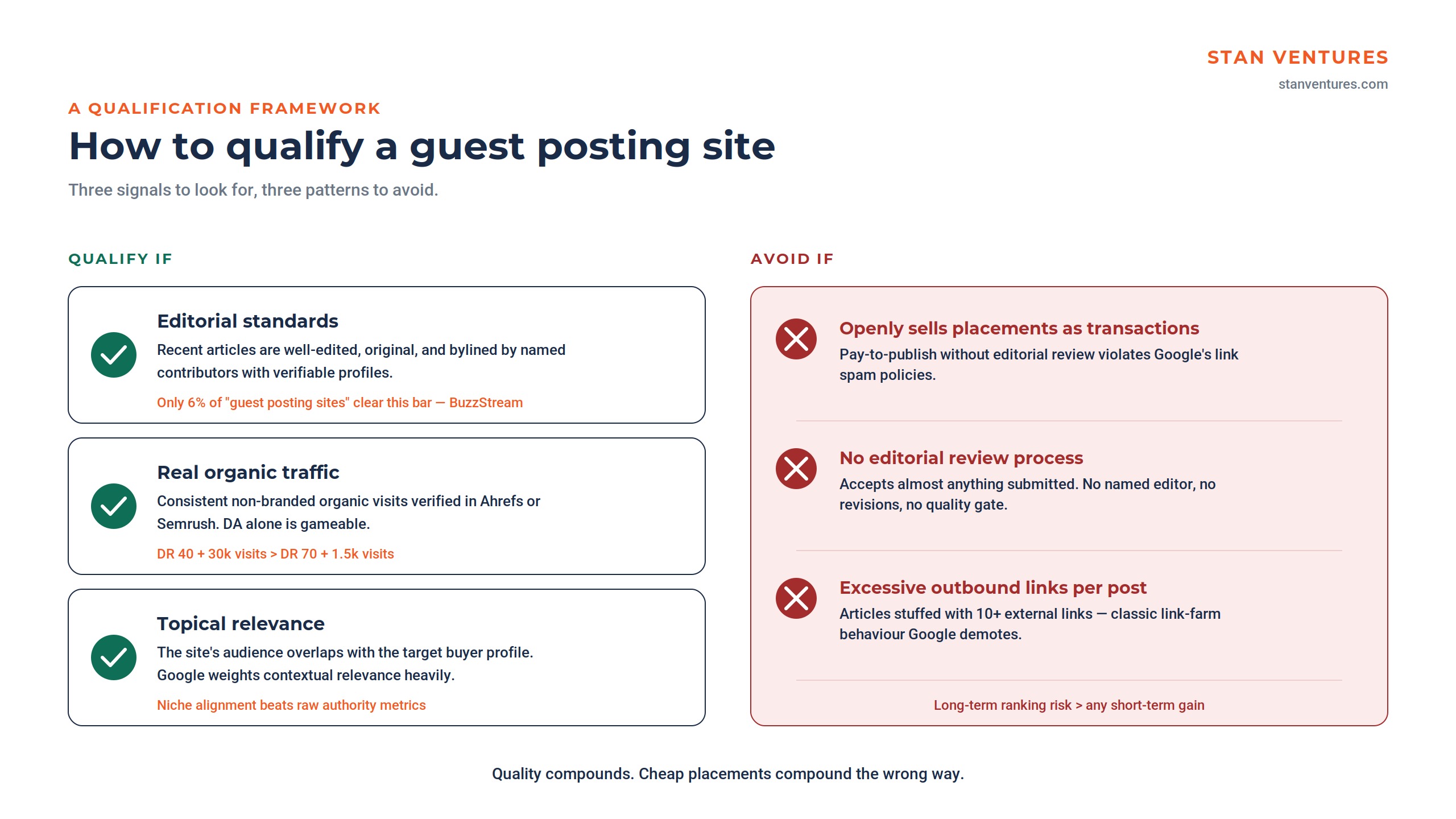
Editorial standards
Recent articles should be well-edited, original, and bylined by named contributors with verifiable profiles. Sites that publish multiple thin posts daily, accept any submission for a fee, or carry no author attribution are red flags.
BuzzStream’s research suggests only about 6% of so-called “guest posting sites” meet a reasonable quality bar: a useful reminder to be selective.
Real organic traffic
Domain authority alone is gameable. The cleaner signal is consistent organic traffic from non-branded keywords, verified through tools like Ahrefs and Semrush.
A site with DR 40 and 30,000 monthly organic visitors is a stronger placement than a DR 70 site with 1,500 visits and a suspicious backlink profile.
Topical relevance
A backlink from a site whose audience overlaps with the target buyer is worth more than one from a higher-authority but irrelevant publication. Google’s algorithms increasingly weight contextual relevance, and the contextual link building guide explains why niche alignment outperforms raw metrics.
Indicators to avoid
Sites that openly sell guest post placements as a transaction (rather than through editorial review) violate Google’s link spam policies.
Sites with no editorial review process, excessive outbound links per post, or networks of inter-linked properties should be excluded. The long-term ranking risk outweighs any short-term gain. The link farms breakdown details the patterns search engines flag.
How to Pitch a Guest Post That Gets Accepted
Editors at top publications receive dozens of cold pitches per week. According to a recent study, only about 8.5% of cold link-building emails generate any response. The pitches that break through share five characteristics.
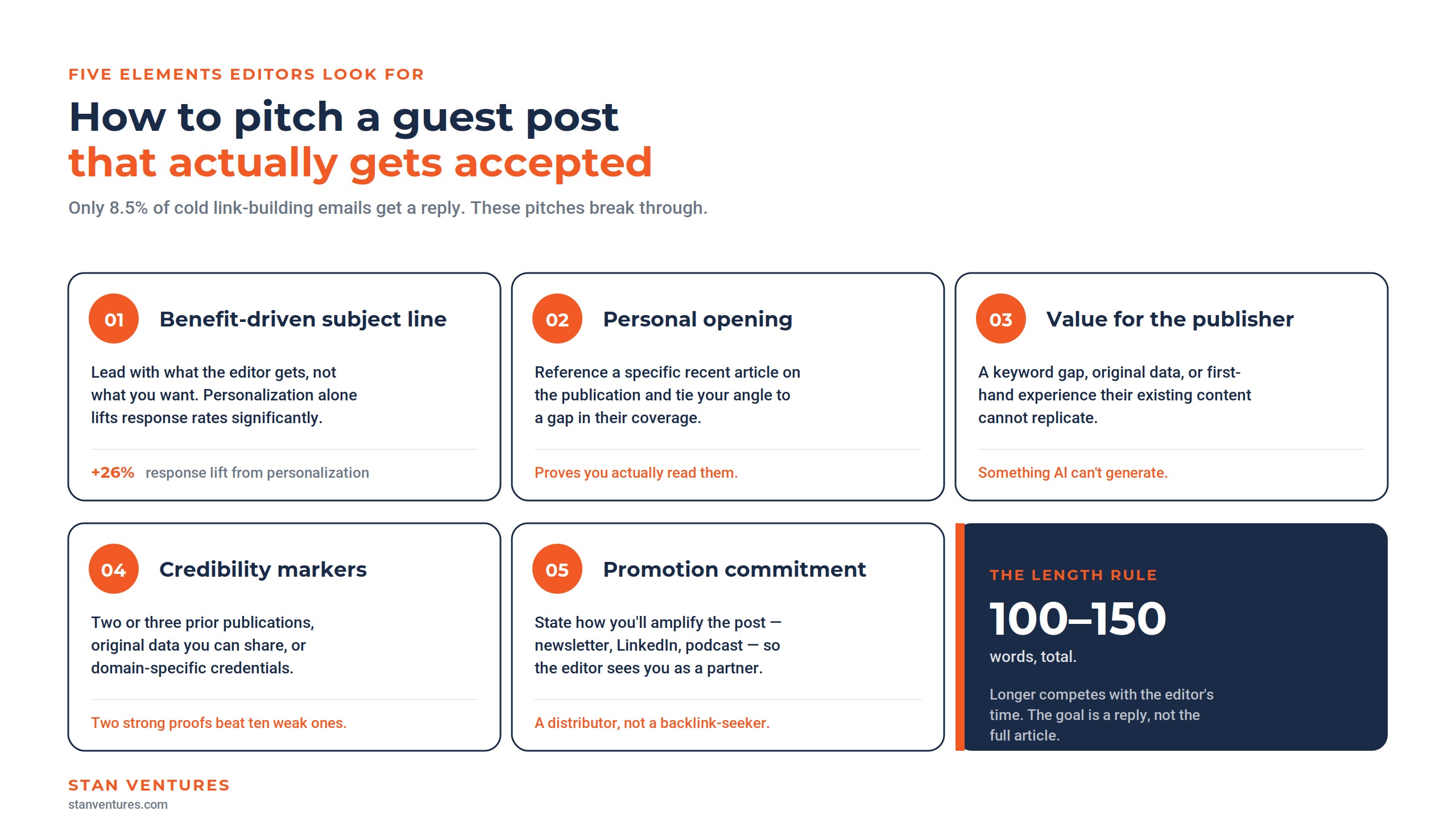
A benefit-driven subject line
Editors scan inboxes; subject lines that lead with a clear value proposition (“Article idea to fill your AI search coverage gap”) outperform generic ones (“Guest post submission”).
Personalizing the subject line alone has been shown to lift response rates by 26%.
An opening that proves the pitch is personal
Reference a specific recent article on the publication, explain what resonated, and tie the proposed angle to a gap in their coverage. This single signal that the writer has actually read the publication is often the difference between a reply and silence.
A value proposition tied to outcomes for the publisher
What will their readers learn that they cannot find elsewhere on the site? Is the proposed topic a keyword their competitors rank for but they do not? Will the post include original data or first-hand experience that AI-generated content cannot replicate?
Credibility markers
Two or three relevant previous publications, original data the contributor can share, or domain-specific credentials. Senior contributors who have published hundreds of guest posts report that they will accept a less-credentialed writer with a clear promotion plan over a high-profile name with no plan to share the published article.
A promotion commitment
Briefly stating how the post will be amplified to a newsletter, on LinkedIn, in a podcast signals to the editor that the contributor is a partner in distribution, not just a backlink-seeker.
The right length is roughly 100 to 150 words. Anything longer competes with the editor’s time, and the goal of the pitch is a reply expressing interest, not a full article submission.
How to Write a Guest Post That Gets Published
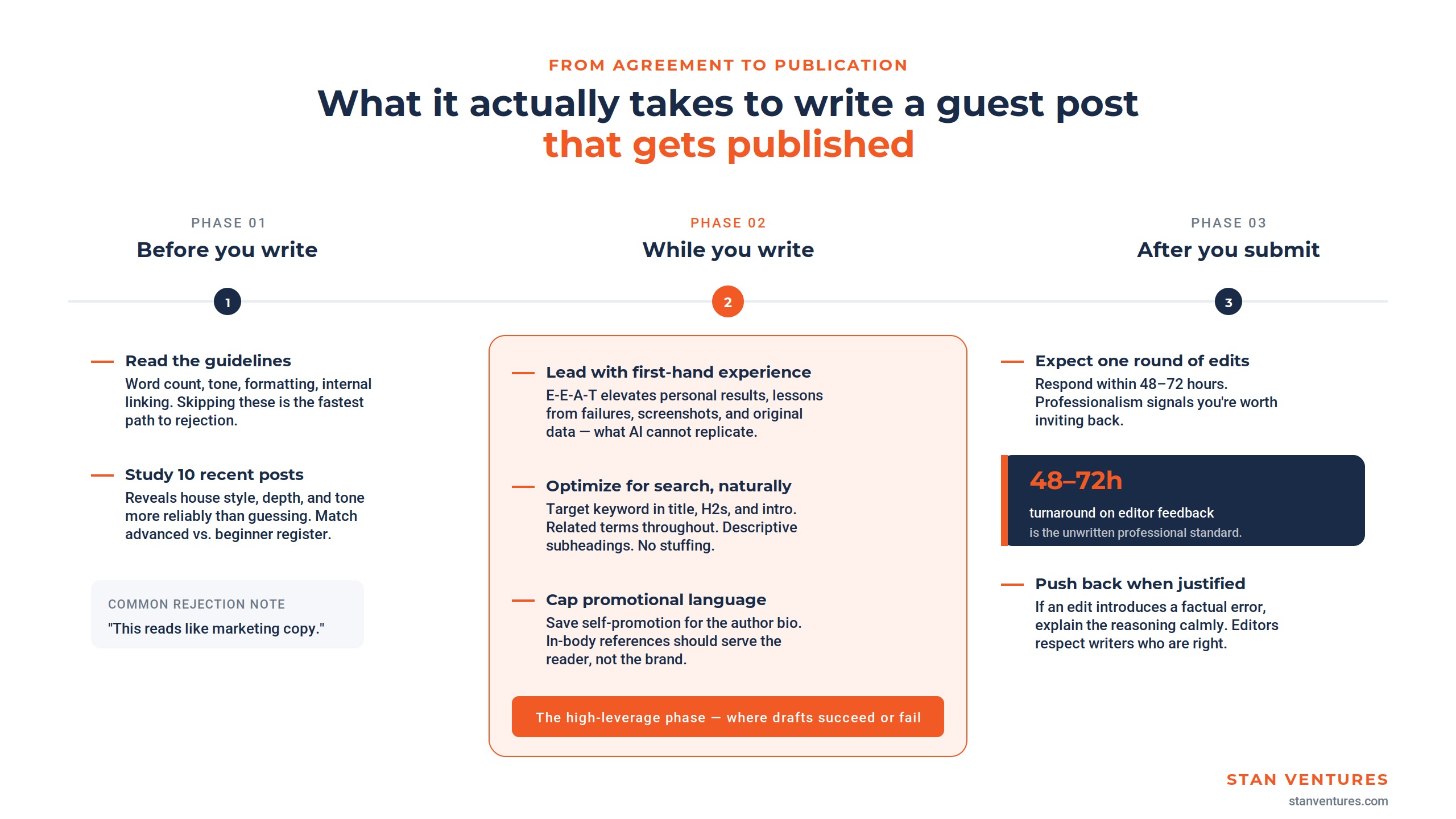
Once an editor agrees in principle, the article itself has to clear their editorial standards. The following practices separate accepted drafts from rejected ones.
Read the guidelines before writing
Most publications publish detailed contributor guidelines covering word count, formatting, tone, internal linking expectations, and image requirements. Failing to follow these signals disrespect for the editor’s time and is one of the fastest paths to rejection.
If guidelines are not public, asking the editor for them upfront is standard practice, and reviewing roughly 10 recent posts on the site is a reasonable substitute when no formal guide exists.
Match the publication’s depth and tone
A common rejection note is “this reads like a marketing copy.”
House-style alignment matters: a publication aimed at advanced practitioners needs technical depth and specifics, while a beginner-focused publication wants step-by-step structure and accessible analogies. Studying ten recent posts on the target site reveals the right register more reliably than guessing.
Lead with first-hand experience
Google’s E-E-A-T framework (Experience, Expertise, Authoritativeness, and Trustworthiness) explicitly elevates content that demonstrates first-hand involvement with the topic.
Personal results, lessons learned from failures, screenshots from actual work, and original data are precisely the signals AI-generated content cannot replicate. Including a case study, a small original dataset, or a screenshot of real workflow output measurably increases the chance of acceptance.
Optimize for search without forcing it
Guest posts that rank in search engines deliver more value to both the contributor and the publisher.
Practical optimization includes using the target keyword naturally in the title, H2s, and opening paragraph; adding related terms throughout the body; and using descriptive subheadings that mirror common search queries.
Aggressive keyword stuffing is now a rejection trigger at most respectable publications.
Cap promotional language
Reputable editors strip overt brand mentions from guest posts. Save self-promotion for the author bio. Within the article body, references to a product or service should serve the reader’s understanding, not function as advertisement.
Expect and accept revisions
Roughly one round of edits is standard. Responding to feedback within 48 to 72 hours signals professionalism and increases the odds of being invited back.
When pushback on an edit is justified, for example, when an edit introduces a factual error, explaining the reasoning calmly almost always works. Editors respect writers who are right; they avoid writers who are difficult.
How to Track Guest Post Performance
A guest post that is never measured cannot be repeated. The following metrics indicate whether a placement is contributing to broader SEO and brand goals.
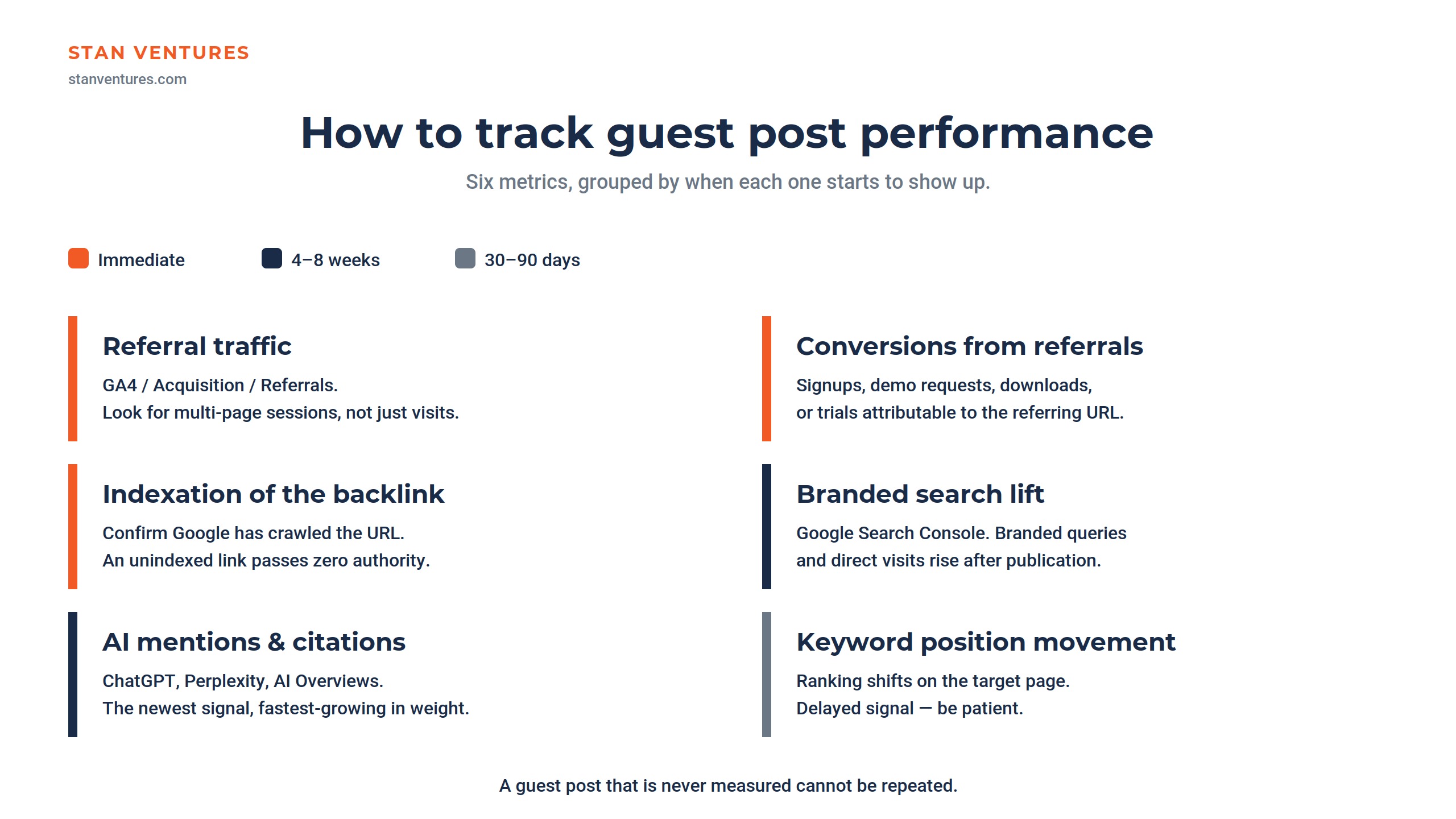
Referral traffic: Visible in Google Analytics under Acquisition → All Traffic → Referrals. Quality referral traffic shows reasonable session duration and pages per session, not a spike followed by immediate bounce.
Conversions from referral traffic: Newsletter signups, demo requests, content downloads, or product trials attributable to the referring URL. This is the metric that justifies continued investment.
Branded search lift: A pattern often visible in Google Search Console four to eight weeks after publication. As more readers encounter the brand on third-party publications, branded queries (and direct visits) rise.
Keyword position movement: For target pages linked from the guest post, position improvements on the relevant keywords. This is a delayed signal — typically 30 to 90 days post-publication.
AI Overview citations and brand mentions: A newer but increasingly important metric. Brand monitoring tools and direct queries in ChatGPT, Perplexity, and Google AI Overviews indicate whether guest posting is feeding the entity associations LLMs draw on.
Indexation status of the backlink: A backlink that Google does not index passes no authority. The backlink indexing guide covers practical ways to accelerate indexation if a placement has not been crawled within a few weeks.
What are the Common Guest Posting Mistakes to Avoid?
The following pitfalls account for the majority of failed guest posting campaigns.
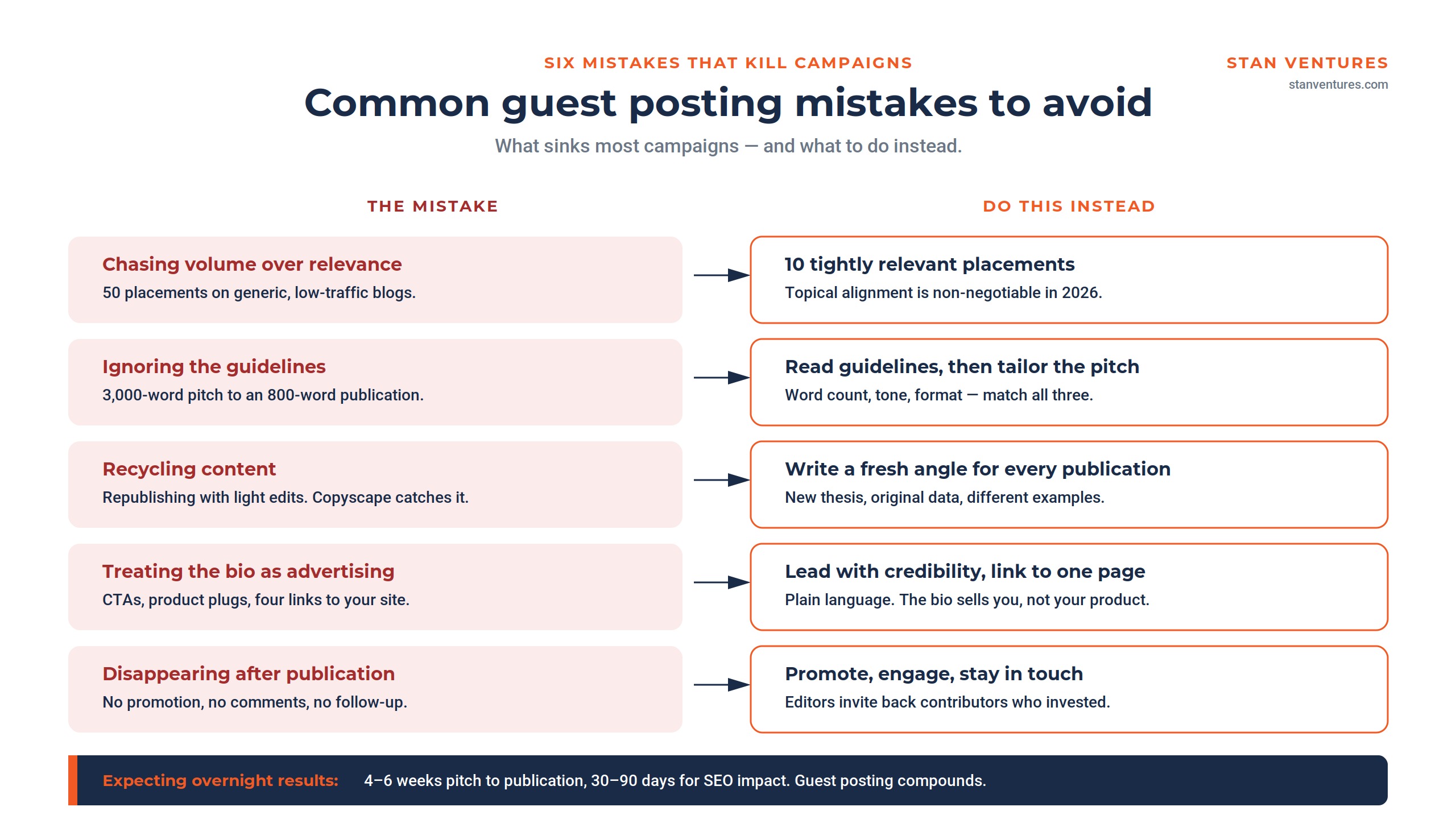
Chasing volume over relevance: Ten placements on tightly relevant sites deliver more SEO value than fifty on generic, low-traffic blogs. Topical alignment is non-negotiable in 2026.
Ignoring guidelines: Pitching a 3,000-word post to a publication that publishes 800-word articles, or recycling a template across dozens of editors, signals that the contributor has not read the publication. Both are instant rejection triggers.
Recycling content: Submitting a piece already published elsewhere,even with minor edits, violates almost every guest post guideline and creates duplicate-content risk for the publisher. Plagiarism detection tools like Copyscape catch this routinely.
Treating the bio as advertising: A bio crammed with calls-to-action and product mentions reads like a brochure. The bios that drive the most click-throughs lead with credibility, link to one relevant page, and use plain language.
Disappearing after publication: Failing to promote the article, respond to comments, or maintain the publisher relationship caps the long-term value of a single placement. Editors are far more likely to accept follow-up pitches from contributors who invested in the published piece.
Expecting overnight results: Guest posting is a compounding strategy. Most placements take four to six weeks from pitch to publication, and SEO outcomes typically materialize over 30 to 90 days. Campaigns abandoned after a few weeks rarely produce the data needed to evaluate them.
Guest Posting vs. Other Link Building Tactics
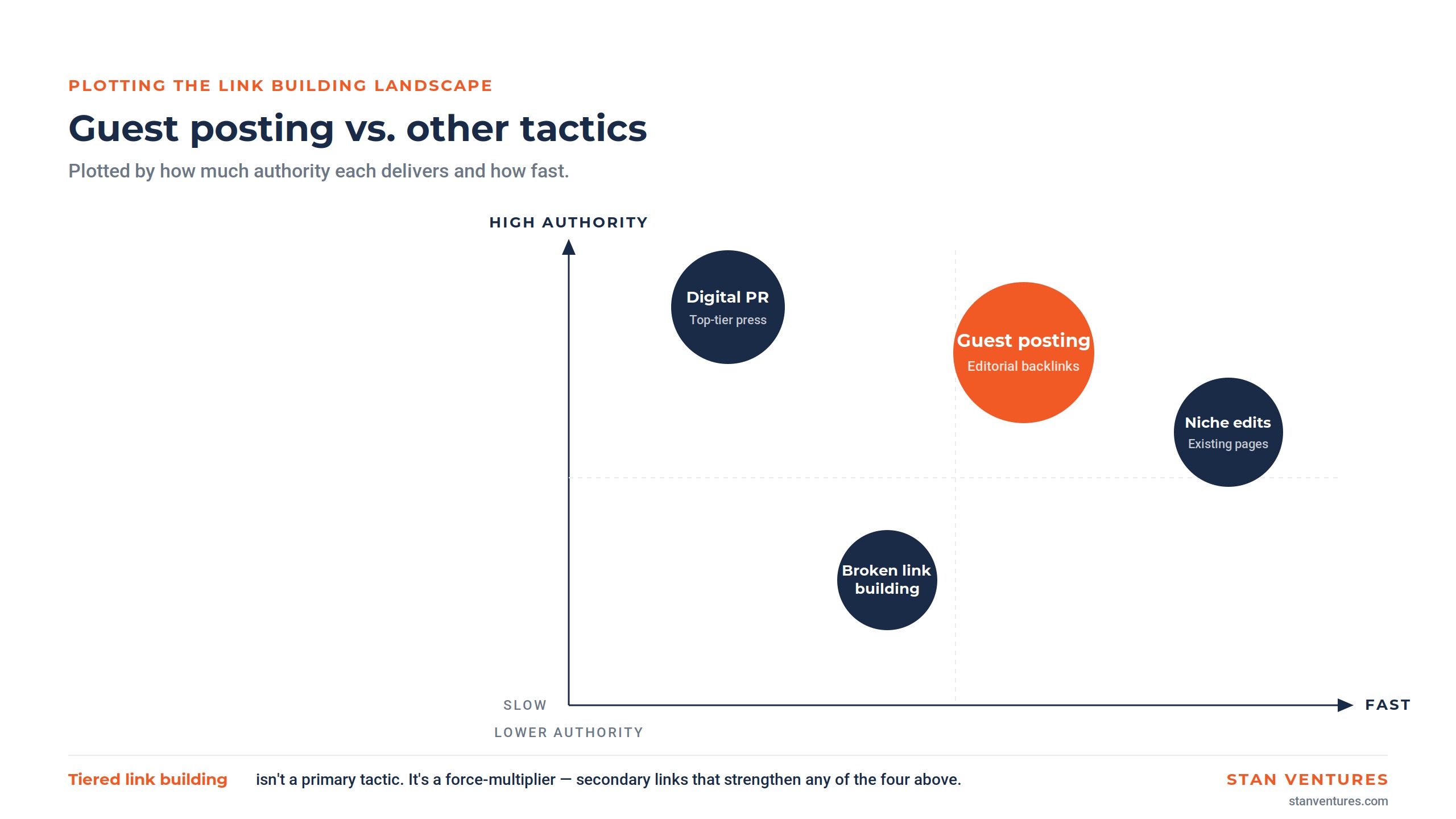
Guest posting sits alongside several other tactics in a modern off-page mix, and the right strategy usually combines them rather than relying on one.
Niche edits
Niche edits, also called link insertions, involve adding a contextual backlink to an existing, already-indexed article on a third-party site.
They deliver faster authority transfer because the host page already ranks, but they offer less control over surrounding context than a freshly written guest post. The guest posting vs. niche edits comparison details when each is more appropriate.
Digital PR
Digital has overtaken guest posting in effectiveness rankings according to recent industry studies reporting that 48.6% of SEO professionals now consider it the most effective link-building tactic.
Digital PR campaigns built around original data routinely earn placements on top-tier publications that no longer accept conventional guest pitches.
Broken link building
Broken link building identifies dead outbound links on relevant pages and offers a replacement piece of content. Conversion rates are lower than guest posting, but the links earned are typically high-value because the host site has already chosen to link out on that topic.
Tiered link building
Tired link building is the practice of pointing secondary backlinks at primary guest post placements. This can accelerate the authority transfer from a strong guest post that has not yet moved rankings on its own.
The most resilient programs treat guest posting as one channel in a portfolio: editorial backlinks from guest posts for foundational authority, digital PR for top-tier placements and brand visibility, niche edits for tactical lifts on specific pages, and tiered support to maximize the value of each placement.
How AI Search Is Changing Guest Posting
Two shifts in the search landscape directly affect how guest posting should be approached today.
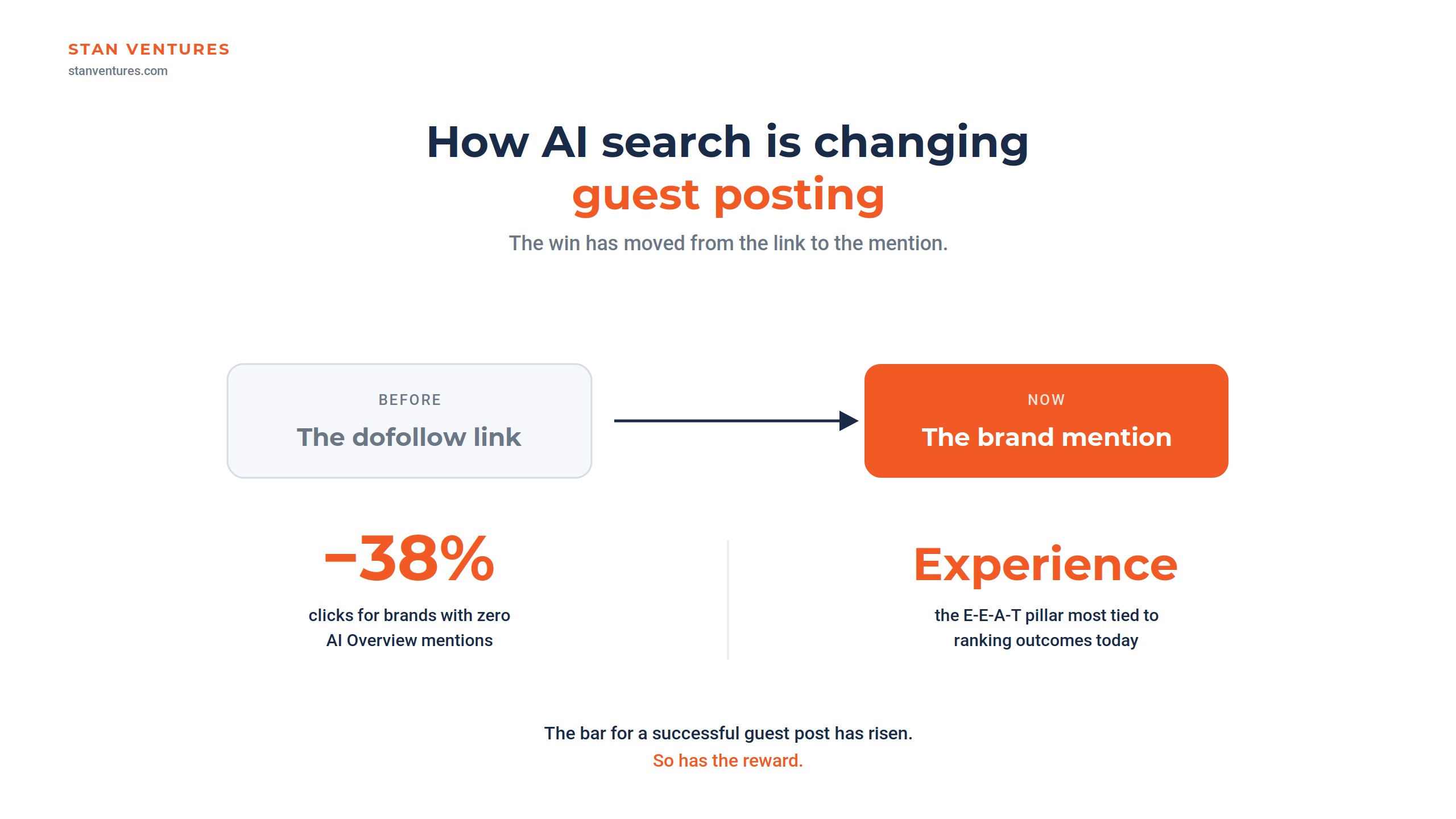
First, AI Overviews are reshaping click-through behavior.
Research finds that brands with zero AI Overview mentions receive 38% fewer clicks than peers, and that brand mentions on authoritative sites are now a primary signal AI systems use to decide who to cite. This makes the byline and the unlinked brand mention as strategically valuable as the dofollow backlink itself.
Second, publishers are tightening editorial review.
With AI-generated content flooding the open web, top publications now reject pitches that read formulaic or recycled almost on sight. The contributors winning placements in 2026 are the ones who lead with first-hand experience, original data, and a perspective that AI tools cannot synthesize from existing content.
Google’s own guidance on creating helpful, people-first content reinforces this: demonstrable Experience is the E-E-A-T pillar most directly tied to ranking outcomes.
The practical implication is that the bar for a successful guest post has risen. The reward, for contributors who clear it, is higher: fewer competitors, more visibility per placement, and a brand-to-topic association that pays off in both traditional and AI-driven search.
So, guest posting in 2026 is a discipline, not a tactic. Done with patience and rigor, selective targeting, real expertise, and content that earns its placement, it remains one of the cleanest paths to compounding SEO authority and brand visibility.
Done as a volume play, it produces low-value links, missed editorial standards, and outcomes that vanish with the next algorithm update.
The contributors who treat each placement as a partnership, with the editor, with the readers, with the algorithm, are the ones whose names start showing up in AI Overviews, whose branded searches climb, and whose target pages move into the positions that actually drive traffic. That is the version of guest posting worth investing in.

Dileep Thekkethil
AuthorDileep Thekkethil is the Director of Marketing at Stan Ventures, where he applies over 15 years of SEO and digital marketing expertise to drive growth and authority. A former journalist with six years of experience, he combines strategic storytelling with technical know-how to help brands navigate the shift toward AI-driven search and generative engines. Dileep is a strong advocate for Google’s EEAT standards, regularly sharing real-world use cases and scenarios to demystify complex marketing trends. He is an avid gardener of tropical fruits, a motor enthusiast, and a dedicated caretaker of his pair of cockatiels.