Google’s quiet removal of the num=100 parameter from search earlier this year shook the SEO industry. For years, professionals, researchers and data companies relied on that parameter to fetch 100 search results in one go.
Suddenly, without it, workflows became clunky: competitor tracking slowed, keyword research required more paginated calls and large-scale data collection turned costly and inefficient.
And then came the solution. SerpApi has announced the Google Fast Light API, a tool specifically designed to scrape 100 organic results in a single request.
For SEOs left scrambling after Google’s change, this might just be the relief they were waiting for.
But what exactly changed, how does the API work and will it really fix the problems caused by Google’s decision?
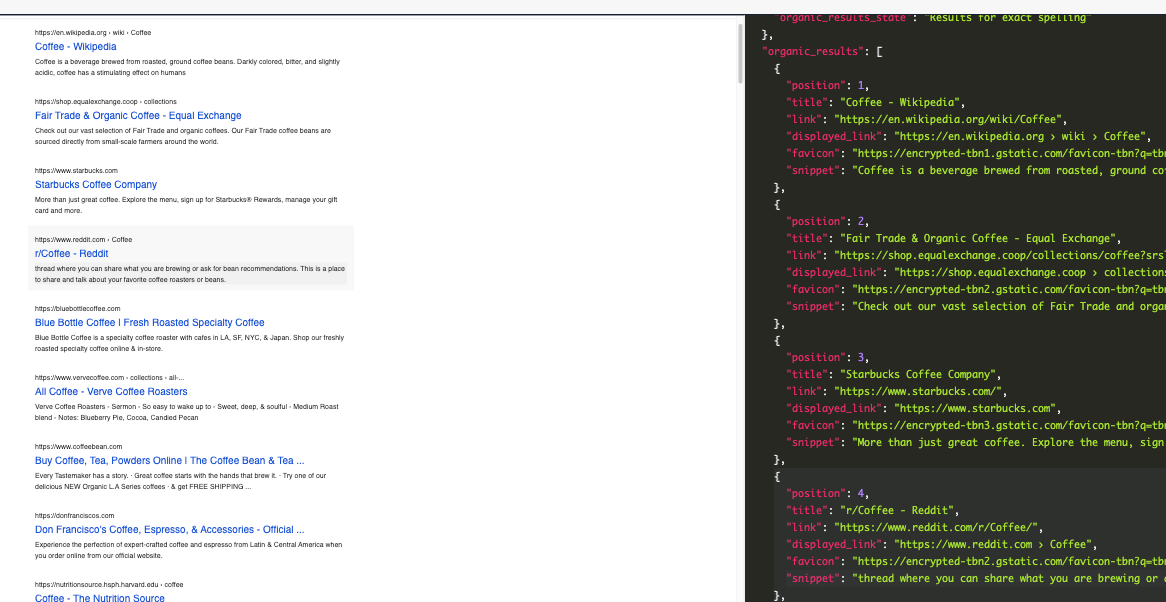
Why Did Google Remove the num=100 Parameter?
For years, adding &num=100 to a Google query was a neat trick: instead of showing 10 results per page, you could display 100 at once. SEOs, researchers and developers leaned on this for:
- Bulk rank tracking across hundreds of keywords.
- Large-scale competitor research.
- Efficient data scraping for analysis or reporting.
But in mid-2024, Google began restricting access. Now, most queries default back to 10 results per page, regardless of the parameter.
While Google has not given a formal explanation, industry watchers suspect two main reasons including Resource Management which means rendering 100 results per page increases server load.
And second is Anti-Scraping Measures which is the parameter that was heavily used by SEO tools and bots, not just regular users.
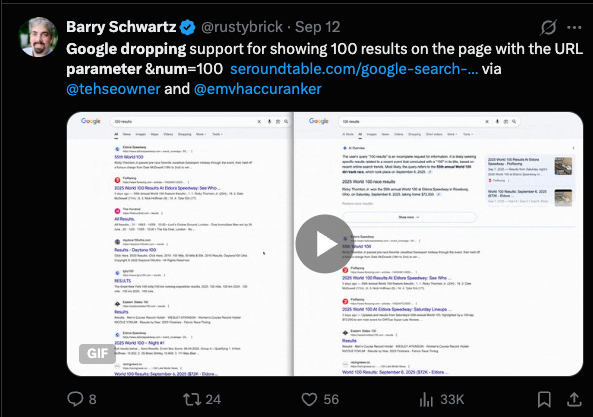
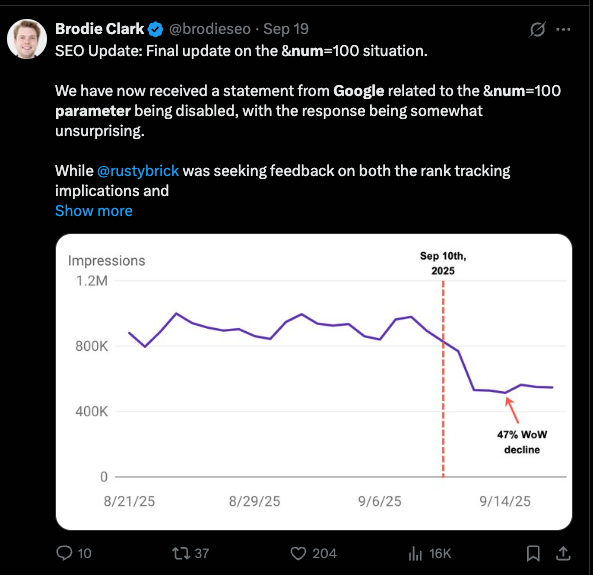
As Barry Schwartz, founder of Search Engine Roundtable, noted in a tweet, this change “impacts how SEO tools fetch ranking data at scale.” Independent SEO consultant Brodie Clark echoed similar concerns, saying workflows were being disrupted across the industry.
So, was it an efficiency move, an anti-scraping step or both? Either way, the impact was immediate.
What Is the Google Fast Light API?
Enter SerpApi’s Google Fast Light API. Launched as a direct response to Google’s change, this API allows users to scrape 100 organic search results with a single request.
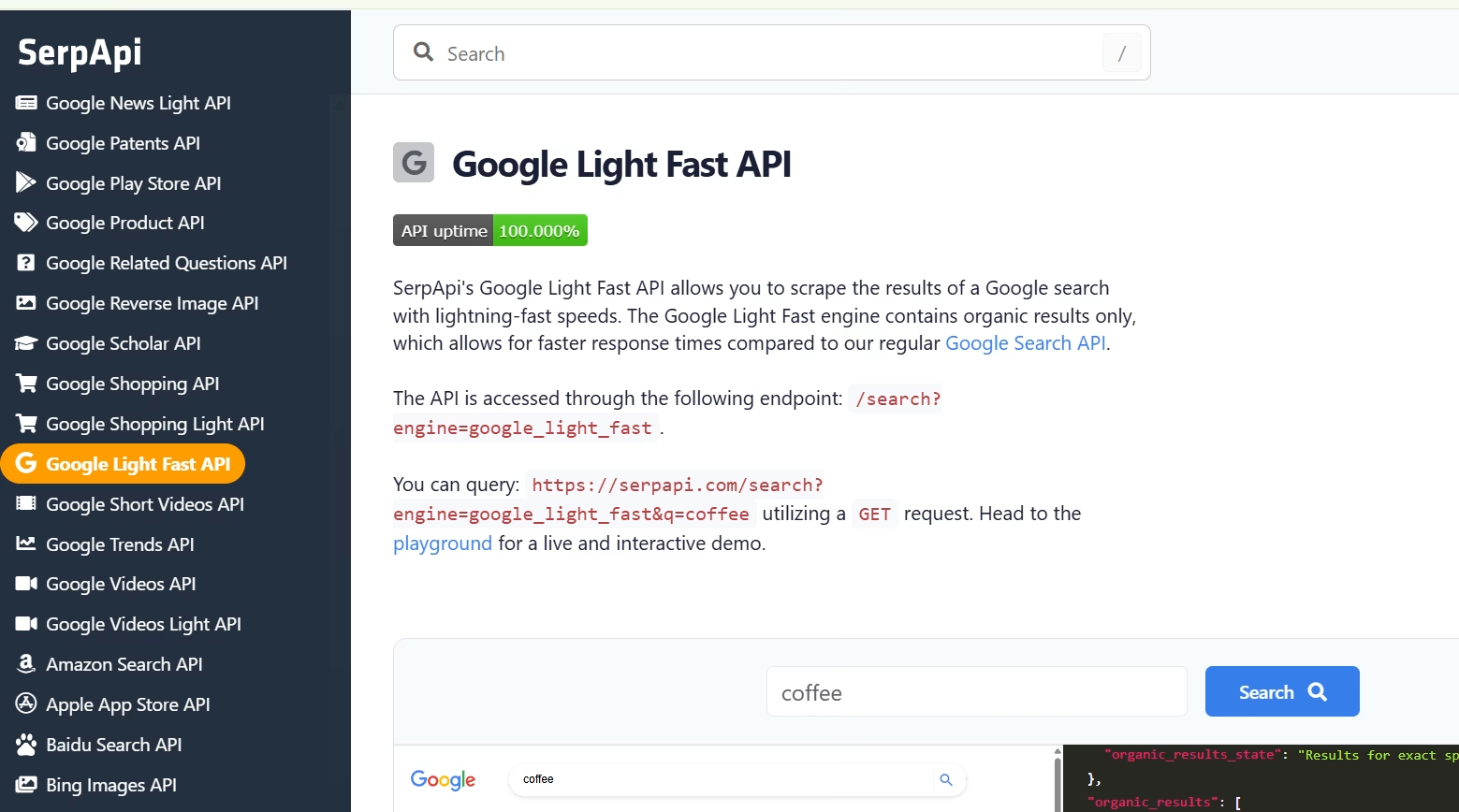
Unlike SerpApi’s regular Google Search API, which provides everything from AI Overviews and Knowledge Graphs to ads—the Light Fast API is streamlined. It delivers only organic results, making it faster and more efficient for those who simply want bulk ranking data.
The output includes: title, link and snippet.
And it returns results in JSON format, making it developer-friendly and easy to integrate into rank-tracking workflows.
How Does the API Work in Practice?
Using the API is straightforward. A single GET request fetches all 100 results:
https://serpapi.com/search.json?engine=google_light_fast&q=coffee&api_key=YOUR_API_KEY&num=100
Replace “coffee” with your keyword of choice, plug in your API key and you are good to go.
Developers can also test it in real time using the SerpApi Playground, which supports Google, Maps, YouTube, Bing, Walmart, eBay, Baidu, Yandex and more.
By focusing purely on organic results, the API avoids extra overhead and delivers speed gains compared to the full-featured Search API.
Does It Replace the Regular Google Search API?
Not entirely. If you only need the top 100 organic results, the Light Fast API is enough. But if your workflow also requires:
- AI Overview answers
- Knowledge Graph data
- Featured snippets
- Ads or shopping results
And you will still need the regular Google Search API.
SerpApi recommends using both:
- Google Fast Light API → to grab 100 organic results.
- Google Search API → to fetch rich results.
This two-step approach restores the ability to collect comprehensive data without running 10 separate queries.
Why Is This Important for SEO and AI Companies?
The impact goes beyond traditional rank tracking.
- SEO agencies: Can continue reporting keyword rankings efficiently without increased costs.
- Data companies: Maintain workflows for competitor and market analysis.
- AI companies: Get access to broader real-time datasets for training or integrations.
In other words, the Fast Light API keeps the SEO and AI ecosystems running smoothly despite Google’s policy shift.
As SerpApi explained in its launch statement: “The removal of the num=100 parameter impacts many SEO companies that serve ranking data for their clients. With the Fast Light API, there’s no need to paginate or run 10 searches anymore.”
How Is the SEO Community Reacting?
The announcement quickly spread across X, with SEOs sharing both relief and caution.
- Barry Schwartz highlighted it as a critical workaround for agencies.
- Brodie Clark noted that while it doesn’t fully replace the old parameter, it stabilizes workflows that were disrupted.
For many, the sentiment is clear: this is not just a convenience, it is a lifeline for data-driven SEO.
Could Google Crack Down Further on Scraping?
This is the question hanging in the air. Google has steadily tightened access to its SERPs, not just by removing num=100 but also by limiting bulk collection methods.
While APIs like SerpApi operate within legal and technical frameworks, the broader trend suggests Google prefers controlling how data is accessed.
Future restrictions could push even more SEOs toward APIs rather than DIY scraping methods.
The irony? By shutting down open parameters, Google may be driving more business to API providers like SerpApi.
What Should SEOs Do Now?
For professionals affected by the change, the roadmap is simple:
- Adopt the Google Fast Light API if bulk organic results are your primary need.
- Use the regular Google Search API if you also need rich results.
- Monitor costs and performance, as running both may still be cheaper and faster than 10 paginated calls.
- Stay updated on Google’s next moves because access rules may shift again.
Ultimately, this is about adapting to ecosystem changes rather than fighting them.
For now, SEOs and data companies can breathe easier because bulk ranking data is back on the table. But the long-term game is clear: those who adapt quickly to shifts in search infrastructure will thrive, while those clinging to old methods risk being left behind.

Dileep Thekkethil
AuthorDileep Thekkethil is the Director of Marketing at Stan Ventures, where he applies over 15 years of SEO and digital marketing expertise to drive growth and authority. A former journalist with six years of experience, he combines strategic storytelling with technical know-how to help brands navigate the shift toward AI-driven search and generative engines. Dileep is a strong advocate for Google’s EEAT standards, regularly sharing real-world use cases and scenarios to demystify complex marketing trends. He is an avid gardener of tropical fruits, a motor enthusiast, and a dedicated caretaker of his pair of cockatiels.
