
Ahrefs has issued an official statement confirming that Google’s removal of the “&num=100” parameter is reshaping how keyword rankings are tracked—particularly for positions beyond the first page.
What Changed
The “&num=100” parameter, once used to view the top 100 results for a search query, is no longer functional. This impacts not just Ahrefs, but the entire SEO industry, as many third-party data providers relied on this functionality to surface ranking data.
Ahrefs explained:
“Google recently made changes to a specific parameter that impacts the ability to view the first 100 results for any search query. The change has had an industry-wide impact, including on third-party data providers to Ahrefs, who relied on this functionality to assess a website’s presence in search results.”
Google just capped SERPs at 10 results.
That means no more 100-result pages. This change affects every SEO rank tracker, including Ahrefs.
Here’s what you need to know:
• Right now: Rankings beyond the top 10 will show inconsistencies. We’re still receiving updates for many…
— Ahrefs (@ahrefs) September 19, 2025
Impact on SEOs
While Ahrefs clarified that this update does not affect the frequency of their rank tracking updates, it does reduce the number of results they can analyze per keyword beyond page one.
For SEOs, that means less visibility into “striking distance” keywords—those sitting in positions 11–20 that can often deliver quick traffic gains if pushed onto the first page.
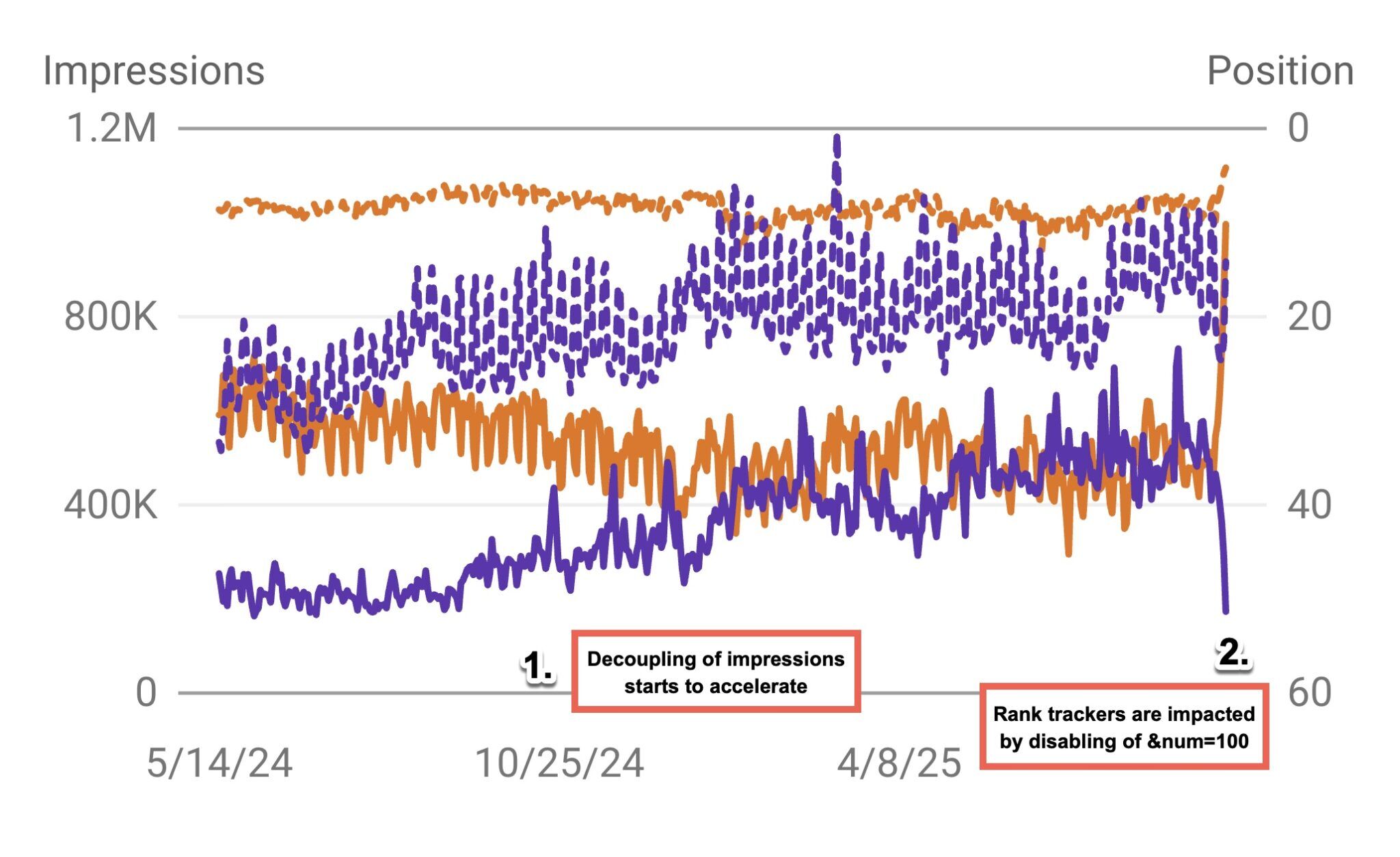
Ahrefs acknowledged this directly:
“The first page of search results has always been the most valuable—as that’s where most clicks tend to go—but there’s also value in the rankings beyond that. For instance, you may want to see opportunities to improve and refresh your content, or identify recently published content that’s starting to perform well on your own site or others.”
Ahrefs’ Roadmap
Despite the setback, Ahrefs emphasized its commitment to minimizing disruption:
“Our aim is always to provide the most accurate and actionable data possible, and we fully understand this data is something our customers rely on. We’re continuing to monitor the situation and are reviewing ways to adapt to this new environment while minimizing disruption to your workflows.”
The company also pointed out that as AI-driven search evolves, new opportunities will continue to emerge:
“The search landscape is constantly evolving, especially with new opportunities thanks to AI, but we believe we’re well-positioned to continue delivering insights that improve brand visibility across the web.”
Semrush and AccuRanker on the Change
Earlier, Semrush and AccuRanker had both issued updates confirming that Google’s removal of “&num=100” affects rank-tracking depth.
- AccuRanker now defaults to tracking the Top 20 results, allowing SEOs to still see striking distance keywords in positions 11–20, but limiting visibility beyond that.
- Semrush has clarified that both Top 10 and Top 20 rankings remain intact in their platform, meaning striking distance keywords (positions 11–20) are still monitored reliably.
- Ahrefs, by contrast, has confirmed that it can now only track first-page results (positions 1–10), reducing visibility into those near-page-one opportunities until further adjustments are made.
While each platform is exploring different adaptations, all three stress the same takeaway: rank-tracking visibility is narrowing beyond page one, and SEOs must adapt their workflows accordingly.
Stan Ventures’ Take
At Stan Ventures, we see this change as both a challenge and a chance to evolve. Striking distance keyword tracking has long been a go-to SEO tactic, but with Google tightening visibility into results beyond the first page, marketers need to adjust.
Instead of relying solely on parameter-based data, SEOs should double down on first-page optimization, AI-driven visibility (GEO/AEO), and entity-based strategies like brand mentions to surface in AI summaries and search overviews. These methods not only safeguard against tracking blind spots but also future-proof visibility in the AI-driven search ecosystem.
The bottom line: while this shift makes traditional tracking tougher, it also forces the industry to move toward smarter, AI-aligned SEO practices—where Stan Ventures continues to guide partners with strategies built for the next era of search.
Ready to Adapt Your SEO Strategy?
Don’t let Google’s changes set your rankings back. Our experts at Stan Ventures specialize in AI-era SEO strategies, striking distance recovery, and brand visibility solutions that deliver results even in a shifting search landscape.
Book a Free Consultation with an SEO Expert Today

Dileep Thekkethil
AuthorDileep Thekkethil is the Director of Marketing at Stan Ventures, where he applies over 15 years of SEO and digital marketing expertise to drive growth and authority. A former journalist with six years of experience, he combines strategic storytelling with technical know-how to help brands navigate the shift toward AI-driven search and generative engines. Dileep is a strong advocate for Google’s EEAT standards, regularly sharing real-world use cases and scenarios to demystify complex marketing trends. He is an avid gardener of tropical fruits, a motor enthusiast, and a dedicated caretaker of his pair of cockatiels.
